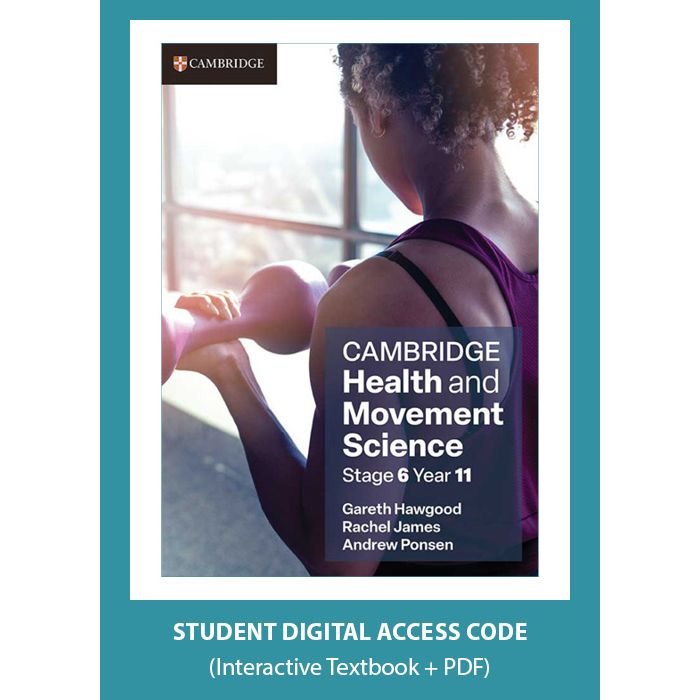
Written specifically for the NSW Health and Movement Science Stage 6 Syllabus, this thought-provoking and future-focused series encourages students to explore the interrelationship between health, body, mind and movement; the many barriers to health and movement; the importance of culturally responsive health and movement practices; and opportunities to improve health and wellbeing outcomes for themselves, their community and beyond.
Digital-only product
This is a DIGITAL-ONLY product. When you order this product you will be emailed one (1) access code used to activate your digital resource at www.cambridge.org/go. A free Cambridge GO account is required.
We recommend that you check the minimum system requirements for your resource type. For more information on how to use / access your Cambridge digital resource, check the official Cambridge Help Portal.
eBook Duration
This eBook/interactive textbook is available as a "one-calendar-year subscription". Cambridge defines this as:
• If you activate your code in January to July; one calendar year ends on 31 December of the same year.
2021
Jan
Feb
Mar
Apr
May
Jun
Jul
Aug
Sep
Oct
Nov
Dec
Light Blue = month of activation | Dark Blue = remaining duration
• If you activate your code in August to December; one calendar year ends on 31 December of the following year.
2021
Jan
Feb
Mar
Apr
May
Jun
Jul
Aug
Sep
Oct
Nov
Dec
2022
Jan
Feb
Mar
Apr
May
Jun
Jul
Aug
Sep
Oct
Nov
Dec
Light Blue = month of activation | Dark Blue = remaining duration
Components
Access Code (emailed to you upon purchase) The 16-character code gives Cambridge GO access to:
PDF Textbook: The downloadable PDF version of the student text enables students to take notes, highlight key passages, and bookmark pages.
Interactive Textbook - 1 year access: The online version of the student text delivers a host of interactive features to enhance the teaching and learning experience of the student text.
Series Features
This series provides authoritative and up-to-date information that represents best practice in teaching in the contemporary health and movement science world.
Contemporary case studies of a variety of demographic groups and geographic locations not only reflect the diverse make-up of the Health and Movement Science classroom but also encourage students to make connections between local, national and international experiences.
Clearly labelled activities invite students to apply the key skills of collaboration, analysis, communication, creative thinking, problem-solving and research to the concepts in each chapter.
Practical applications encourage students to actively and creatively explore, demonstrate, review and communicate health and movement science concepts, and are explicitly linked to key skills.
Chapter summaries, multiple-choice revision and exam-style questions provide plenty of opportunities for students to test and apply their knowledge and understanding and prepare for the types of questions they may encounter in exams.
The Interactive Textbook brings the study of Health and Movement Science to life with online activities and resources such as videos, animations, case studies, and exercise and activity demonstrations. Videos can also be accessed directly from the print book by scanning the QR codes.
Contents
Health for individuals and communities
Understanding and measuring Australia's health
Young people's meanings of health
Key health issues that affect young people
Improving and promoting young people's health
The body and mind in motion
Body systems and movement
Factors influencing movement and performance
Acquiring, developing and improving movement skills
Relationship between psychology, movement and performance