eBook access code The eBook version of the student text provides 27-months access from date of activation. It is accessed online through FS Portal using a unique 14-character code found in the hardcopy book. A free FS Portal account is required.
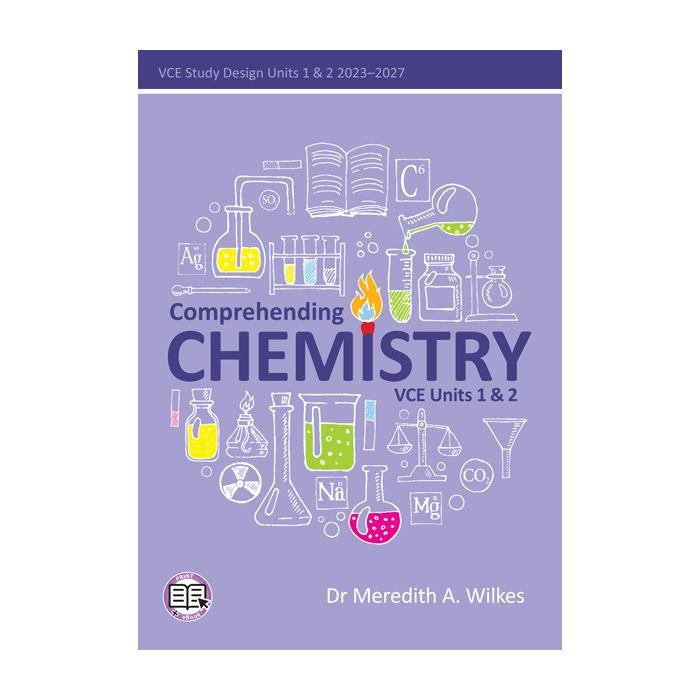
Comprehending Chemistry Year VCE Units 1&2 follows the VCE Study Design for Chemistry Units 1 & 2: 2023–2027. Each Area of Study is composed of clearly identified topics which are further broken down into focus areas which address the key learning points and the chemistry underpinning these key aspects. Dr Meredith Wilkes understands that many students are more visual learners, so she has included links to many videos and resources for each topic in the LOOK and LEARN section. Meredith also subscribes to the education theory of learn by doing – hence the name of the experimental sections, LEARN by DOING. The experiments have been designed to illustrate and complement the theory and many can also be performed at home – just remember to take all the necessary precautions!
Features
Key Learning Points for each focus area
LOOK and LEARN - links to videos and other resources
LEARN by DOING - experiments designed to illustrate and complement the theory
Calculations - worked examples of how to use important formulas
Exercises - plenty of exercises for students to consolidate their learning
Topic reviews - check that students understand the key learning points and inquiry questions before moving onto the next topic
Review test - each Area of Study finishes with a review test
Answers to all exercises and review tests included
Contents
Becoming a chemist
Unit 1: How can the diversity of materials be explained?
Area of Study 1: How do the chemical structures of materials explain their properties and reactions?
Topic One: Elements and the periodic table
Topic Two: Covalent substances
Topic Three: Reactions of metals
Topic Four: Reactions of ionic compounds
Topic Five: Separation and identification of the components of mixtures
Area of Study 1 Review test
Area of Study 1 Answers
Area of Study 2: How are materials quantified and classified?
Topic One: Quantifying atoms and compounds
Topic Two: Families of organic compounds
Topic Three: Polymers and society
Area of Study 2 Review test
Area of Study 2 Answers
Area of Study 3: How can chemical principles be applied to create a more sustainable future?
Topic One: What is a research investigation?
Unit 2: How do chemical reactions shape the natural world?
Area of Study 1: How do chemicals interact with water?
Topic One: Water as a unique chemical
Topic Two: Acid-base (proton transfer) reactions
Topic Three: Redox (electron transfer) reactions
Area of Study 1 Review test
Area of Study 1 Answers
Area of Study 2: How are chemicals measured and analysed?
Topic One: Measuring solubility and concentration
Topic Two: Analysis for acids and bases
Topic Three: Measuring gases
Topic Four: Analysis for salts
Area of Study 2 Review test
Area of Study 2 Answers
Area of Study 3: How do quantitative scientific investigations develop our understanding of chemical reactions?