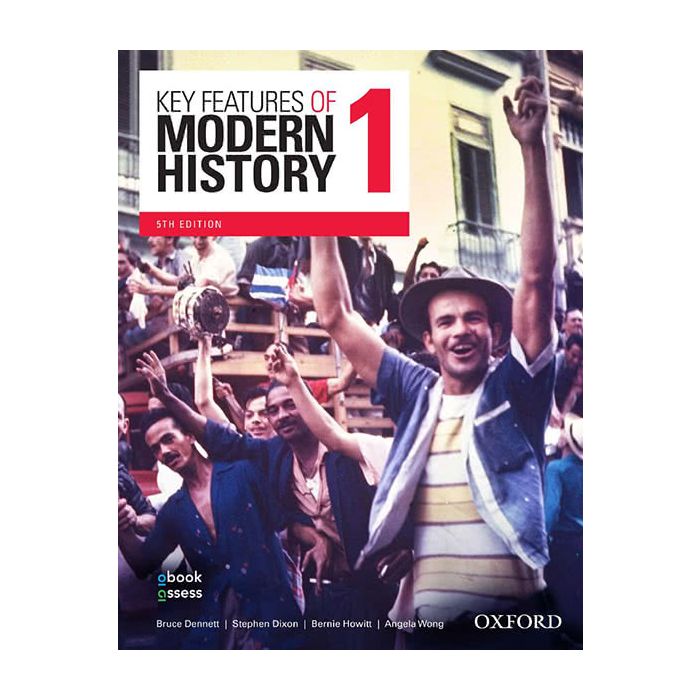
Key Features of Modern History has been updated for the 2018 Modern History Stage 6 syllabus. The first of a two-volume series, Key Features of Modern History 1 offers complete support for teachers and their students in 2018 and beyond.
Authors Bruce Dennett, Bernie Howitt, Stephen Dixon and Angela Wong bring their years of classroom, curriculum and academic experience to the fifth edition of Key Features of Modern History 1 and provide unparalleled depth and coverage in an easy-to-read, easy-to-understand and easy-to-master format.
Features
All content has been explicitly aligned to the Modern History Stage 6 syllabus (Year 11).
Trusted, in-depth and appropriately levelled content has been developed by expert teachers.
All chapters follow a new, simplified structure with content organised into manageable double-page topics.
The language is clear and unambiguous, supported by plenty of visuals.
obook assess provides comprehensive student and teacher digital support, including answers to every question in the book, teacher notes, assessment support and more.
New: 'Focus questions', 'Key concepts and skills', and 'Learning goals' are clearly stated at the beginning of each chapter to guide teachers and students through the content.
New: 'Check your learning' questions for each topic allow students to review and expand on what they have learned.
New: 'Understanding and using the sources' questions throughout each chapter enhance student understanding of how to use and critically analyse historical sources.
New: A 'Profile' for each chapter allows for more in-depth learning about a historically significant person, event or phenomenon.
New: Bolstered by a digital platform, teachers will be equipped with an array of resources to effectively deliver the course, and students will be able to interact with content using a variety of digital tools, making for an engaging and enjoyable history lesson.
Contents
PART A: INVESTIGATING MODERN HISTORY – THE NATURE OF MODERN HISTORY
Chapter 1 The investigation of historic sites and sources: The trenches of World War I and the archaeology of Fromelles
Chapter 2 The contestability of the past: Pearl Harbor
Chapter 3 The construction of modern histories: the Holocaust
Chapter 4 History and memory: autobiography
Chapter 5 The representation and commemoration of the past: film, television and history
Chapter 6 Historical investigation
PART B: INVESTIGATING MODERN HISTORY – CASE STUDIES
Chapter 7 Terrorism
Chapter 8 The American Civil War
Chapter 9 The decline and fall of the Romanov dynasty
Chapter 10 The Cuban Revolution
Chapter 11 The Boxer Rebellion in China
Chapter 12 The origins of the Arab–Israeli conflict