


Flat Rate Shipping
$9.95 flat rate shipping or free over $110

Aussie Owned
Australian family-owned & sourced

School Supplier
Supplier to over 1,000 schools Australia wide
For Stages 5 and 6
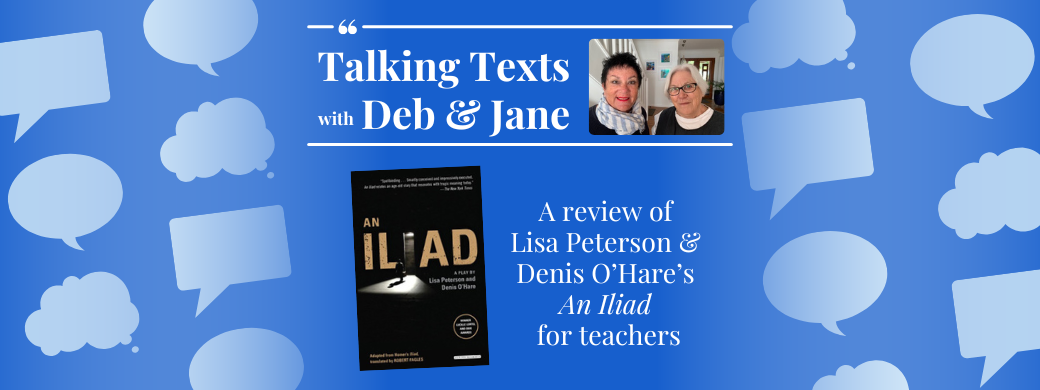
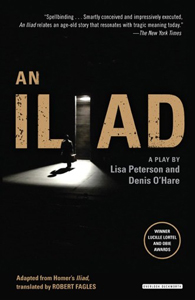
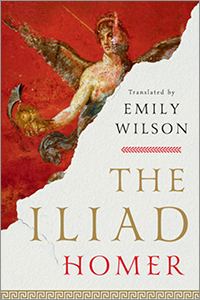
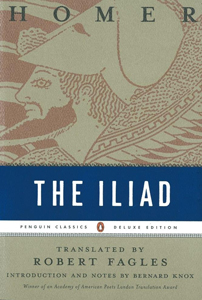
An Iliad is adapted from Homer’s classic work and uses a translation by Robert Fagles. Keen-eyed English teachers will notice the play is called An Iliad not The Iliad. This use of the indefinite article rather than the definite article is important as the play is about all wars, not just Homer’s Trojan one. In the play the poet responds to the universal question about what starts a war:
What drove them to fight with such a fury? Oh ... the gods, of course .... Um ... pride, honour, jealousy ... Aphrodite ... some game or other, an apple, Helen being more beautiful than somebody - it doesn’t matter. The point is, Helen’s been stolen, and the Greeks have to get her back.
This play is accessible and fascinating. It is also deeply intelligent and authentic. There are counterbalancing times of informality and chatter, as the poet/storyteller engages with the audience, and formality and poetics as narrative unfolds on the stage. There is passion, humour, rage and heart-breaking grief as well as music which provides solace and relief as well as catharsis. The play moves through a range of human emotions that have a relevance and power that is unforgettable.
An Iliad deserves a place in your English program for your Stage 5 and 6 students not only to continue the power of reimagining texts but the ongoing relevance and resonance of ideas across time and context.
Lisa Peterson is an American OBIE Award-winning writer/director. Her works include An Iliad, written with Denis O'Hare. Denis O'Hare holds dual American and Irish citizenship and is a writer and actor who won the Lucille Lortel Award for his play, An Iliad. He also received an Obie Award for his performance in the play.
Petersen and O’Hare have re-imagined Homer’s classic poem in a dramatic form with the main character as a poet, a travelling storyteller, an everyman. It is a play that makes a powerful and universal statement about war. The poet travels from town to town recounting, proclaiming and singing the Trojan War story hoping to convince humans to stop killing each other. It seems he is driven and can never stop travelling or performing.
The poet pulls a cart onto the stage with a double bass and assorted belongings including a doll, some stones, two spears, a helmet, sand and lights. The play is divided into seven parts. Part One sees ‘The Armies Gather’. Part 2 features ‘Achilles’. Part Three focuses on ‘Hector’. Part Four introduces ‘Patroclus’ and Part Five displays ‘Achilles’ New Shield’. Part Six recounts ‘Hector’s Death’ while Part Seven is ‘Funeral Games’. The play opens with an Ancient Greek incantation and then the poet begins to tell the story of the Trojan War by listing the places the soldiers in the armies had come from. In the published playscript the names come from towns in the United States. In the production I saw at the Sydney Theatre Company some of the towns mentioned are in Australia as directors across the globe choose to localise the playwrights’ message. This addition amplifies how wars over time have attracted young men to enlist from small towns around Australia. There are many memorable moments. A fire is lit on stage, and a huge sphere, rises as a glowing sun to represent Achilles’ famous shield. The poet is joined on stage by a musician who emerges from the cart to play that double bass. Her presence and music provide some relief. As the cost and horror of war rises, cathartic moments of wailing, keening and prayer are agonisingly drawn from the musician. There are battle scenes, meditations, dangers and sorrows and above all there is rage: a consuming wrath and a defining despair. As the poet says ‘Every time I sing this song, I hope it’s the last time’: and of course, it never is.
Towards the end of the play the storyteller lists the wars of the world. I saw and heard this relentless rollcall starting with the Peloponnesian War in 431 BCE. The list grows over five scripted pages of wars which extends over many eras and countries to modern times. The audience realises with growing horror that every time the play is performed there will be more wars to add. In the Sydney production the latest wars in Ukraine and the Middle East are added to the scripted list.
The Sydney Theatre Company production directed by Damien Ryan with David Wenham in the poet role made great use of darkness and light and shifting shadows on a bare stage with the cart, the poet and the musician in a dance that moved from humour and pathos to righteous anger and grief. The play invited the audience in to share it all and to finally conclude by asking us: do ‘You see?’
Note: a video promo for the Australian production can be found on Facebook https://www.facebook.com/reel/1369512151831024
Plays need to be understood as a specific literary form that is intended for performance, and this will help students understand the magic of drama. Scripts are prompts for performance and students need to be given opportunities to move and be active with scripts. This is about vocalising the script, not creating actors. Discuss with students the use of the metalanguage of drama and theatre, for example, script, stage directions, set design, scenes, acts. Let students experiment with the text and consider using a Readers’ Theatre approach with this play where a number of students can share responsibility in bringing the text to life.
If you need an example of Readers’ Theatre be sure to share the reading by Cate Blanchett and a team of actors of the poem ‘What They Took With Them: https://www.youtube.com/watch?v=xS-Q2sgNjl8. This is a powerful rendition of the Jennifer Toksvig poem based on first-hand testimonies from refugees who were forced to feel their homes and what they decided to take with them
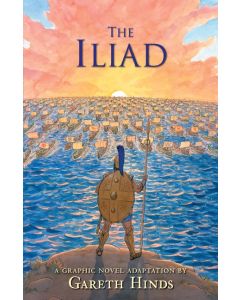
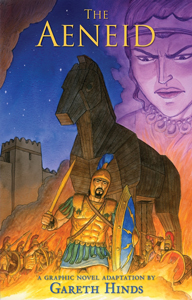
Have a class discussion on the famous story of the Trojan War and the battle between Achilles and Hector. Find out what the class already knows about these mythical characters. Provide a shorter version of the original Iliad via Garth Hinds graphic novel adaptation.
Use a short modern teaser of An Iliad on Vimeo to engage and interest students in the play. https://vimeo.com/1118486611
Lisa Peterson and Denis O'Hare discuss the genesis of the play and their ideas about writing in an expansive discussion in the Sydney Theatre Company notes provided on their website. This is a valuable interview and would allow students to understand the way in which the playwrights approached the difficult task of reimaging a classic poem as a play. https://sydneytheatre.shorthandstories.com/an-iliad/index.html
We began talking about creating An Iliad not long after the United States invaded Iraq in 2003. We were both thinking about war and plays about war – thinking that at the time, the best thing a theatre artist could do was to find a way to talk about what it means to be a country at war. A work as monumental as Homer’s Iliad is not easily reducible to one or two themes. To say that it is an anti-war tract is as wrong-headed as saying that it is an epic about the glory of war. When we started grappling with this work, attempting to form our own theatrical narrative, we did so using two distinct lenses: the lens of pacifism – summed up by the idea that war is a waste, and should be eradicated; and the lens of humanism – the idea that human nature is warlike, and can’t be changed. We let these two tensions battle it out in the person of our narrator.
Give students some examples of how the play may sound and what sort of set design can be devised. You can access some vision of the play at the following sites
Peterson and O’Hare give students a start on helping them to understand their narrator.
…our desire was to give an audience the sensation of being present at the very invention of this epic story, we found ourselves hearkening back to the bards of old, recalling campfire mesmerists, ghost-story purveyors, even con-men. Our narrator is one of a long line of vagabonds, or perhaps he is the original vagabond: a man (or woman) who ekes out a living by begging a crowd to stop, listen, and imagine for a while. The Poet is an ancient teller of tales who might still exist in the universe, doomed to tell the story of the Trojan War until the day when human nature changes, when our addiction to rage comes to an end, when the telling of a war story becomes unnecessary
Form groups and ask each group to select some scenes and use Readers’ theatre to share the role of the single narrator and present their scenes to the class.
Ask students to collect evidence from the play about the storyteller and to consider how he involves the audience through including them in his conversation.
Ask students to consider the impact of the play and their response to its universal themes in a written response to take the form of a review.
They could consider this explanation by the playwrights:
An Iliad started out as an examination of war and man’s tendency toward war. In the end, it also became an examination of the theatre and the way in which we still tell each other stories in order to try to make sense of ourselves. Someone started telling the story of the Trojan War over 3,000 years ago. We pass it on.
“Mr. O’Hare and Ms. Peterson have condensed the long sweep of The Iliad s narrative . . . with intelligence . . . chatty, informal, occasionally spiced by digressions that, echoing Homer’s brilliant use of simile, seek humble parallels in contemporary life to the passions that inflamed the Greeks and Trojans.” —Ben Brantley, New York Times
“The language sears impossible-to-stage tableaux of death and destruction on your mind’s eye.” —Time Out New York
“[A] sleek distillation of Homer’s epic . . . An Iliad supports classicists’ claim—often dismissed today— that canonical works can still speak to us profoundly.” —Variety
Other reviews can be found at:
As Denis O’Hare and Lisa Peterson explained in their interview, ‘Someone started telling the story of the Trojan War over 3,000 years ago. We pass it on.’
What would you ‘pass on’ to future generations? In a discursive article consider what you have learned from the play and what might be important to pass on to future generations.
In what ways does theatre raise powerful and fundamental questions about humanity?
Consider this question in regard to your study of An Iliad.
The Sydney Theatre Company provides excellent resources including a synopsis and notes by the playwrights at https://sydneytheatre.shorthandstories.com/an-iliad/index.html
Text requirements: An Iliad is a play by writers from around the world with cultural, social and gender perspectives. .
Concepts could include Genre • Intertextuality • Theme • Characterisation.
A student uses a range of personal, creative and critical strategies to interpret complex struction texts EN5-RVL-01
Reading, viewing and listening skills
Reading, viewing and listening for meaning
Reading for challenge, interest and enjoyment
Reflect
(English K-10 Syllabus 2022 © NSW Education Standards Authority for and on behalf of the Crown in right of the State of New South Wales, 2023)
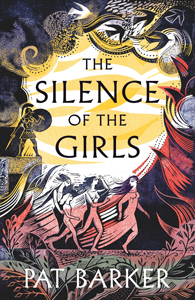
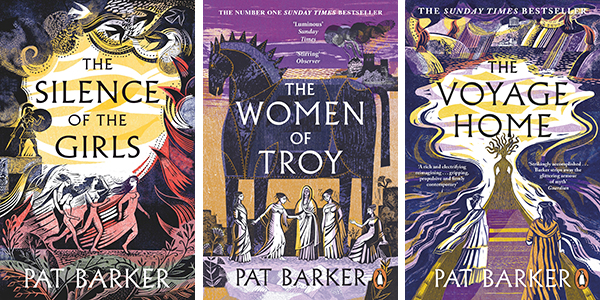
Consider a Narratives that shape our world focus as adaptations and re-imaginings of the Trojan War story.

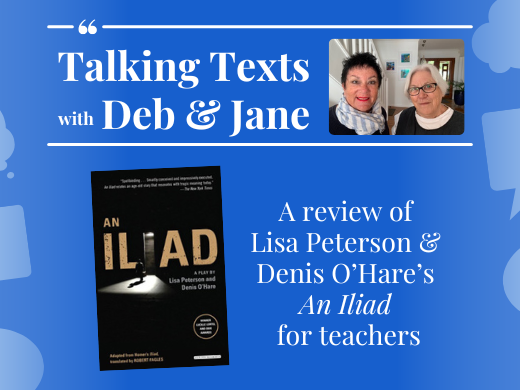
Jane Sherlock and Deb McPherson are experienced and passionate English teachers. They have also been involved in the education sector as authors and presenters at teaching conferences.
$9.95 flat rate shipping or free over $110
Australian family-owned & sourced
Supplier to over 1,000 schools Australia wide