




Flat Rate Shipping
$9.95 flat rate shipping or free over $110

Aussie Owned
Australian family-owned & sourced

School Supplier
Supplier to over 1,000 schools Australia wide
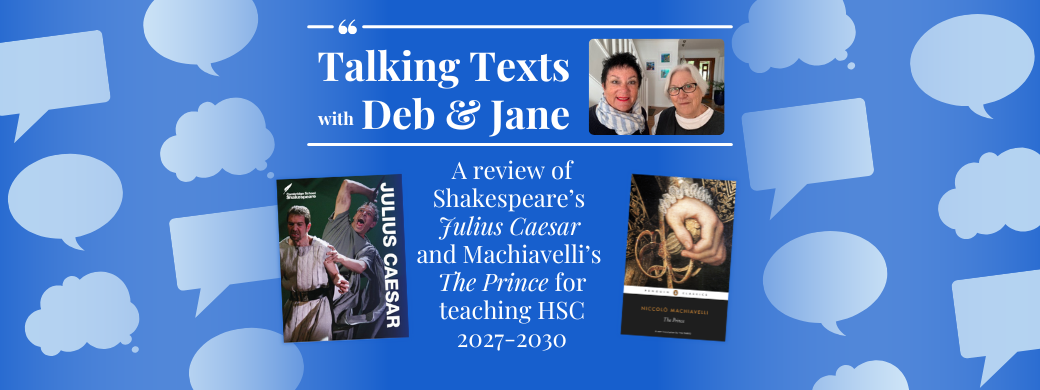
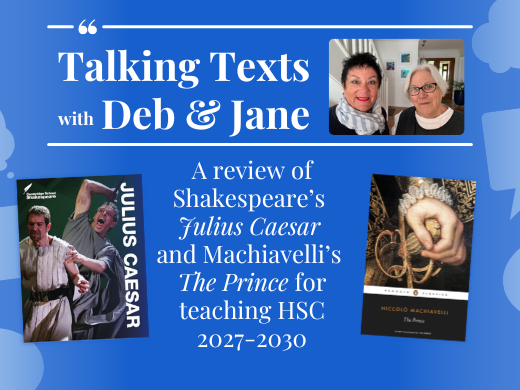
William Shakespeare's Julius Caesar and Niccolo Machiavelli's The Prince is set for study in 2027-2030 in Year 12 for Advanced in Textual conversations.

Conspiracy. Friendship.
Intrigue. Treason. Betrayal.
These concepts and qualities are not part of the latest Netflix series or an investigation into local municipal council expenditure or indeed, a speech from President Trump but are a list of some of the ideas and concepts which connect Niccolo Machiavelli’s The Prince and William Shakespeare’s Julius Caesar.
Advanced students must study a Shakespearean play; there are four on the HSC list: two in ‘Textual conversations’ - Hamlet and Julius Caesar and two in ‘Critical study’ - Henry IV Part I and Othello. This Shakespearean selection is wonderful; the challenge is which one and which focus area. You know your students and student engagement is a key to text selection.
In the 2027-2030 Prescriptions list there are six pairs in ‘Textual conversation’ across the range of textual forms. Keats and Bright Star have been on the list since 2019, Mrs Dalloway and The Hours since 2015. Hamlet is paired with Emily Dickinson’s poetry; a new pairing but both have often featured on the HSC. Barbara Baynton’s Bush Studies is paired with Ali Cobby Eckermann’s s poetry and Olga Tokarczuk’s Drive your Plow Over the Bones of the Dead is paired with Donne’s poetry. Both Baynton and Tokarczuk are new to the list.
The Prince and Julius Caesar have previously been on what was known as ‘Module A Comparative Study of texts and Context’ in 2015-2018 so there are some existing resources to help you and your students including Barbara Stanners’ excellent Advanced Modules and Electives 4th Ed. Your librarian may assist with locating these useful resources.
Our teacher resource, Pathways for English, was published this year and covers 29 texts for the current HSC. There are comprehensive chapters on Hamlet and Dickinson, Blake and Tokarczuk, and Keats and Bright Star.
‘Textual conversations’ is examined in Paper 2, Section I. It is customary for many schools to start the new year with ‘Textual conversations’ and to devote the entire term, but this is a school decision as the sequencing of texts after ‘Texts and human experiences’ is flexible. Time management and programming are always important and more so in this focus area to ensure that the texts are given comprehensive coverage as a pair. The challenge is not to treat the texts as separate critical studies but to work in tandem with the other text and to consider how the second text echoes the first and in turn how it is disparate to it. This is demanding but is part of understanding how a text tells us about its context and two texts on similar ideas tells us more about humanity.
This blog is not a full unit of work but a resource to give you some ideas about ways in to the two texts and some other teaching ideas.
Your HSC students will be facing elections in their futures - municipal, State and Federal- and while politics is not the favoured topic for most adolescents, this pair of texts is a certainty to engage your students in the danger, intrigue and destruction that can be politics. Both texts are surprisingly accessible: Julius Caesar is one of Shakespeare’s shortest plays, and its unity of narrative and setting helps navigation. The play echoes Republican Roman history and events and many of the characters have moved into literary and historical folklore. There are big and powerful speeches and Shakespeare is an accurate and perceptive reader of humanity. Julius Caesar is a popular play and indeed, was part of Bell Shakespeare’s 2026 season so you can access images and insights about the play in production. The Prince is short at 124 pages and surprisingly, very accessible in its prose and is extraordinarily perspicacious in its insights. The edition which is prescribed by NESA is translated by Tim Parks and it is refreshing in its style and clarity. His Introduction to The Prince will be valuable for your students because of its insights to Florentine and fifteenth century European geopolitics.
The Stage 6 English Syllabus (2024) is your prime guide to what students need to know and understand in this focus area.
The focus area description and the dot points under Understanding and Responding should underpin your textual explorations, student responses and will provide the basis for HSC examination questions.
The focus area content advises that students should be responding in different styles (such as imaginatively, interpretively and critically) to the comparative study. Through these responses students will ‘explore and evaluate individual and common textual features, concepts, ideas and values.’
In this way the craft of writing certainly has a purpose and the ideas featured in the pair of texts open the door to some interesting responses in the imaginative, persuasive and discursive styles.
The dot points under Understanding and responding could become focus areas for discussion, individual student reflection and writing:
The Prince is a nonfiction text which acts like a handbook on the realities of political behaviour. ‘Machiavellian’ is now a term we use to refer ruthless, pragmatic and at times, dangerous politics and it would appear that this reputation was gained early and probably contributed to the popularity of The Prince. The author’s own experiences of the volatility and unpredictability of politics clearly shaped his perspectives. There is no evidence of Machiavelli’s own corruption or duplicity, and his ultimate impoverishment was used by him to validated this observation. The twenty-six chapters provide blunt assessments about the pragmatism of politics and feature both effective and unsuccessful leaders as Machiavelli’s examples. The extensive historical references to a wide range of leaders of the past adds authority and legitimacy.
Julius Caesar is a play and is Shakespeare’s dramatization and reimagining of specific events in Roman history in 44BCE including the conspiracy against Julius Caesar, his assassination and the subsequent civil war. When the play opens Rome is a Republic and Caesar has successfully defeated Pompey, a former ally. In the opening scenes we see the adoration of the public and the concern about such adoration. The senator, Cassius, is able to convince Caesar’s close friend, Brutus that Caesar’s power is growing to a dangerous level which Cassius says would threaten the Roman republic. Brutus is convinced by Cassius that Caesar must be stopped to prevent such tyranny. On the Ides of March Caesar is stabbed in the senate and Mark Antony’s sarcastic funeral oration incites the public against the conspirators. Antony, Octavius and Lepidus form a triumvirate and civil war erupts between this group and that led by Brutus and Cassius who both commit suicide. Power transfers to Octavius and Antony. The Bell Shakespeare site includes an accessible summary of the play.
Sitting watching Bell Shakespeare’s production of Julius Caesar this year, it struck me that The Prince is political theory and the play is that theory in practice. The Prince is like a political treatise on leadership and politics and the play, Julius Caesar is the practical example of how such political theory and insights operate.
Unlike some of the other pairs, this pair is less about a direct echo of the earlier text and more about how ideas and insights about leadership and politics resonate across time and context. This pair is about the continuity of key ideas and insights about human behaviour, specifically political behaviour which resonates across time and text.
Their form is very different and while, on first discussion, The Prince may not seem to have the richness of the play’s form, there is still sufficient to discuss.
The phrase ‘values and perspectives’ is most accessible in this pair; the context of each composer clearly shaped their values and their perspectives about those values. I find it easier to consider the question ‘what is it about his context and society that Machiavelli valued and in turn, what did Shakespeare value? Were there similarities in these values and indeed, how resonant are those values across time to us as readers and audiences?
This pair of texts has the least time gap between texts and the writers’ context. The Prince was written around 1513 and Julius Caesar was written in 1599. The Prince was not published in Machiavelli’s lifetime. It was first published as a manuscript in Latin and in 1532 appeared in Italian and by 1559 it was on Pope Paul IV’s Index of Prohibited Books having been asserted by the English cardinal, Reginald Pole, that it was written by ‘Satan’s finger.’
Niccolo Machiavelli lived from 1469 until 1527 and is regarded as the ‘father of political science’ in his treatise on leadership and politics titled The Prince. Machiavelli had a checkered career but was apparently a successful diplomat for Florence by the age of twenty-eight. At this time the political geography of Italy was complicated and complex and Tim Park’s introduction covers it well. Machiavelli certainly fell out of favour and by his death at 58 in 1527 he was impoverished, politically unpopular and had lost his previous positions in the Florentine government. The Prince can thus be seen as drawing on the experiences Machiavelli had in his own life and career.
It is incorrect to consider the title in the same way we understand the term ‘prince’ today. Machiavelli’s ‘prince’ is not the son of the king but is the translation of the Latin ‘principe’ which is a generic term referring to ‘men of power’ or ‘men who rule the state’. The prince is thus the first (or principal) man.
Given The Prince is a series of short chapters on different elements of leadership it is not like a more conventional nonfiction text with a clear narrative or chronological trajectory. Each chapter often includes specific examples from European history to illustrate the key points about leadership. Machiavelli is also influenced by the generally bitter and controversial experiences he had as a diplomat and member of the ruling group. The style of Machiavelli’s writing is frank, direct, often blunt, mostly cynical and provides realistic albeit sceptical, contemptuous and scathing insights. Some academics believe the work is more of satire but it is clearly disparaging and at times, sardonic reminiscent of the realities of the realpolitik.
Tim Park makes some clever observations on p. xix:
In so far as The Prince remains a persuasive account of how political power is won and lost it is so because it eventually focuses on the mind, or , to be more precise, on the interaction of individual and collective psychologies, the latter fairly predictable, the former infinitely varied, the two together dangerously volatile … there is one circumstance that a man cannot easily change it is his own character… a man can be successful in one situation then fail miserably in another; a policy that works well in one moment is a disaster the next.
William Shakespeare (23 April 1564 – 23 April 1616) should be well known to your students. He is regarded as one of the greatest writers in the English language and while many students may struggle with his language, Shakespeare’s insights about humanity enable rich exploration of his plays. He wrote 39 plays, 154 sonnets, and three long narrative poems.
Shakespeare wrote in Elizabethan England. Under Queen Elizabeth, English commerce prospered and the Arts flourished. It is also the time known as the Renaissance which refers not just to the historical context but the social and cultural conditions which affected ways of thinking. The Renaissance was a culturally rich and colourful time with a huge growth in public architecture, sculpture, science, exploration, painting, theatre and literature.
Elizabethan England was a monarchy with Queen Elizabeth I as the powerful head of the country. Elizabethan values reinforced a structured and ordered society, with a strict hierarchy, patriarchal dominance, loyalty and notions of honour playing a central part. Shakespeare was loyal to the monarchy and his writing supported and validated Elizabethan rule. Like many Englishmen Shakespeare was concerned about what would happen when Elizabeth 1 died as she did not have heirs and refused to nominate a successor. England knew first-hand the experience of civil war and this was also feared if the stability of future leadership was not considered. Indeed, the Elizabethans were well aware that following the assassination of Julius Caesar the Roman world suffered a series of destructive civil wars which eventually saw the end of the Roman republic and the consolidation of Octavian as the first Roman emperor under the name of Augustus. After Elizabeth’s death in 1603 she was succeeded by her cousin James I of Scotland. But by 1642 any stability had disappeared and a decade of civil wars saw the defeat of the monarchy with republican rule under Cromwell until the monarchy was re-established in 1660.
While Julius Caesar reflects historical events it is primarily a work of Shakespeare’s imagination and belongs to the form of tragedy. Tragedy was very popular in Shakespeare’s time and blood, violence and retribution were box office staples then as they are now.
The essential principles of tragedy were established by the Greek philosopher Aristotle (384-322BC) in his work The Poetics. Traditionally the hero was of high status and the fall was immense. The downfall of the hero is often attributed to a specific weakness of character. Caesar suffers from pride and arrogance and wanting to go beyond the republican view of leadership to achieve some sort of status as King. Another explanation for the hero’s downfall is that he or she has no real control over their destiny and that their fate is determined. Aristotle writes that tragedy should succeed in ‘arousing pity and fear in such a way as to accomplish a catharsis of such emotions.’ There should be a serious and significant struggle and the tragic hero should face his downfall in such a way as to attain heroic stature.
One key feature of drama as form is to consider the impact on the audience of the play’s structure and Shakespeare was very aware of the importance of this structure in engaging his audience. Shakespeare’s plays follow a specific 5-Act structure and in a tragedy Act III is the point of most intensity, usually involving an increase in conflict and often death. Shakespeare had to ensure that the ending validated stability and indeed, the establishment of a leader who would be the legitimate embodiment of authority. There could be no doubt in the audience that insurrection, treason, conspiracy, subordination and indeed, the overthrow of the rightful leader should not be normalised or encouraged.
Group task: Place students in small groups to construct a graph of the key points of action from the play. They should consider the contribution made by the orientation, complication, climax and the consequences with a conclusion leading to a satisfying and ‘rightful’ conclusion.
Consider:
In this pair there are four contexts:
Group research task: Ask students to list three to five features of each context and to construct responses to the questions below.
What ideas link the two texts?
Power, influence and authority are keystones to political theory and often to the success of a leader. They are not just a variation of the same quality and are not mutually exclusive of each other.
These words will be important for students to understand throughout the exploration of the two texts: Conspiracy, intrigue, treason, friendship, betrayal, ethics, politics, integrity, monarchy, republic, honour, nobility … Students should add to this list as their exploration progresses.
Basically, this pair of texts is linked by four contexts which have common features and many ideas which resonate strongly across the contexts.
There is no doubt that Shakespeare was aware of Machiavelli’s writings and these shaped the ideas and characterisation of such plays as Julius Caesar, Richard III and Othello. In fact, Iago is regarded as the epitome of Machiavellian behaviour. The Prince was not published in English until after Shakespeare’s death but the playwright also spoke and wrote Latin. Shakespeare could have become informed of his ideas through court circles or secondary sources.
This table may be valuable for students to complete individually or in small groups to establish some key concepts from the focus area statement.
| Textual conversations | |
| Text 1: The Prince by Niccolo Machiavelli | Text 2: Julius Caesar by William Shakespeare |
|
If a comparative study is to consider the similarities and differences of the texts across time and place what are the key similarities and differences of your two texts? In what ways is the second author influenced by the first text? Consider: contexts, values, purposes, conventions and textual features |
|
| Text 1 | Text 2 |
| Context of Text 1 and what was valued and how this affected the author’s perspectives in the text |
Context of Text 2 and what was valued and how this affected the author’s perspectives in the text. In what ways was the author of Text 2 influenced by the historical and cultural context of Text 1? |
| What was the purpose of the author of Text 1? | What was the purpose of the author of Text 2? |
| Conventions of the form of Text 1 | Conventions of the form of Text 2 |
| Textual features of Text 1: structure, medium, form, language, style, theme, genre, aesthetics and effect on meaning | Textual features of Text 2: structure, medium, form, language, style, theme, genre, aesthetics and effect on meaning |
| Resonances and dissonances | |
| What is common in: | What is disparate (different, contrasting) in: |
|
|
1. Create a display of these well-known phrases from Machiavelli and ask students to consider what these phrases suggest about the writer’s perspective on leadership, politics and people and what is the key point behind each phrase:
What do you understand by the word ‘Machiavellianism’? What are the key characteristic of such behaviour?
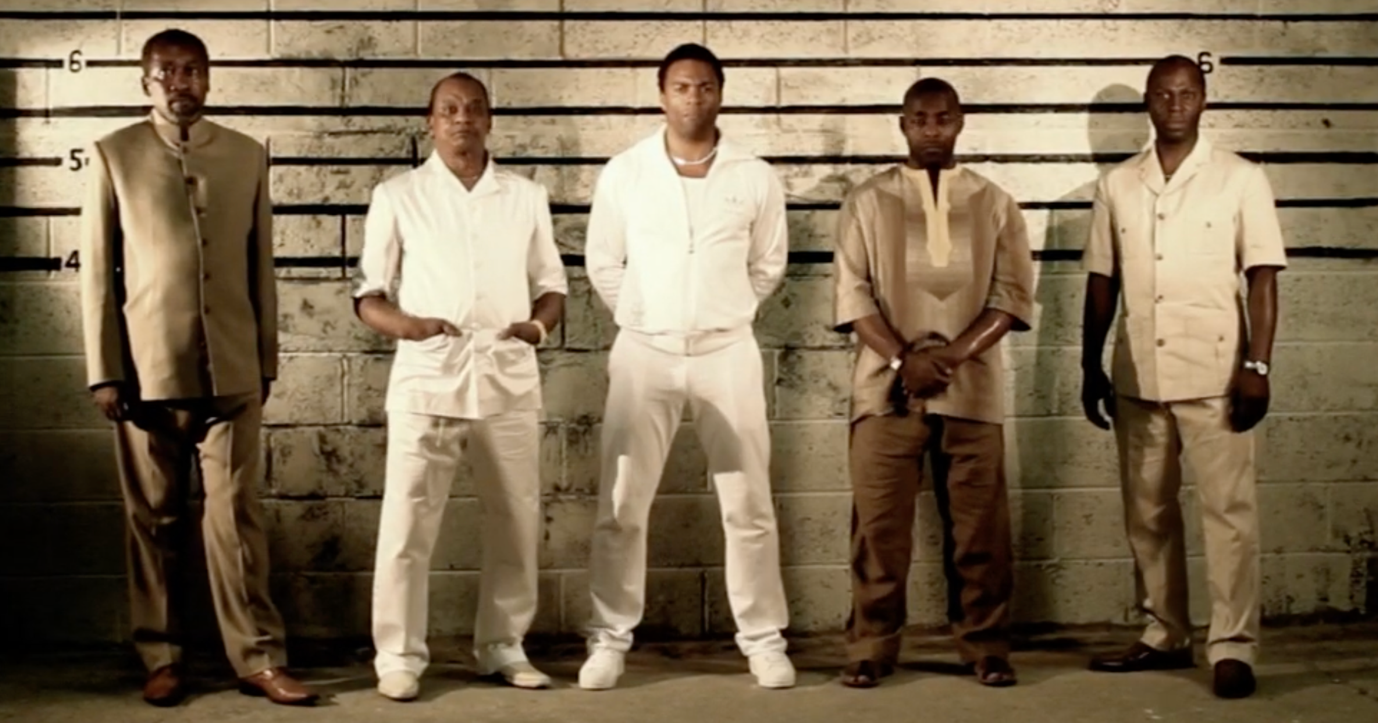
2. A trailer from the Royal Shakespeare Company’s 2012 production is an engaging way to immediately position students to the intrigue and precarious nature of leadership: https://www.youtube.com/watch?v=bB7a1S-2YyI
Here is a screenshot: What is being suggested by the positioning and presentation of these characters in this shot?
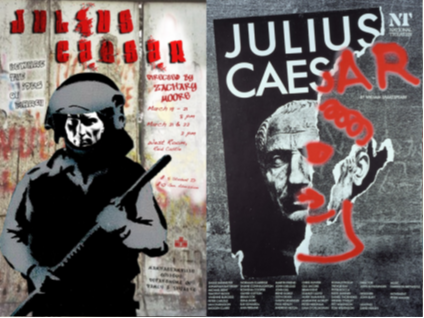
3. Show several posters from different productions of Julius Caesar. What shaped the promoters’ creative decisions in designing these posters?
You will have students who study Ancient History and Art and some may study both. But there will be others whose knowledge of Ancient Rome and Renaissance Florence will be minimal. Students do not need to be fully conversant with each context but these are two texts where contexts have clearly shaped the exploration of ideas and the perspectives of each composer.
A few ideas could help:
Alert students to be mindful of what Machiavelli and Shakespeare say about leadership.
Use this list of leaders from today and the recent past to raise awareness about leadership styles and to promote thinking about the types of leaders Machiavelli and Shakespeare explore.
Ask your students to add to this list.
Today: Trump, Putin, Carney, Kim Jong Un, Albanese, Zalensky, Minns
The past: Hawke, Keating, Churchill, Kennedy, Stalin, Franco, Hirohito, Mussolini, Hitler, Eisenhower, Menzies, Lang
Encourage students to ‘walk through the NESA prescribed text (Penguin classics 2011 translated by Tim Parks) and draw students’ attention to:
The aim of the exploration of The Prince is to make connections with how it shaped and influenced Shakespeare’s play, Julius Caesar and in what ways the two texts reveal resonances and dissonances. The first clear resonance is that both texts are exploring the precariousness of power and leadership.
Use the video, First Encounters: Julius Caesar-what you need to know, to establish the background on the play. It can be found at: https://www.youtube.com/watch?v=vCIWrZAFj5Q&t=70s
Be sure to access the Royal Shakespeare Company (RSC) site where you will find wonderful resources on this play. The RSC site has a simple summary of the play, images of past productions and an excellent list of well-known quotations from the play including these famous lines:
Sydney’s Bell Shakespeare Company has an excellent video on the play: Fact or Fiction and establishes some important ideas about the play’s background and context.
The NESA prescribed text Julius Caesar (Cambridge University Press 2014) contains a rich collection of information, insights and images from various productions. Encourage students to ‘walk through’ the text to appreciate its features. For example, the images from productions are accompanied with 1-2 sentences of plot summary which is very useful e g: Beware the Ides of March: Shakespeare’s play dramatises the political machinations surrounding the assassination of Julius Ceasar. The action Is focused on three characters: Mark Antony, Julius Caesar and Marcus Brutus.
The list of characters on p. 5 will be an essential reference and students would benefit from having their own copy of the list.
On the opposite page to the play’s text there are valuable insights including the summary of that page, the language, some insights and tasks and at the end of each Act, the section on “Looking Back at Act x” will be essential reading.
After the playscript there is an impressive section on:
This table is only a starting point for a way to link the two texts using specific textual evidence.
It is a model for further exploration of more ideas and examples:
| Key ideas | Extract from The Prince | Key ideas | Reference from Julius Caesar |
|
If a ruler has the people on side there is less to fear about conspiracies. Be aware of what the populace will forgive and what they will not. |
Chapter 19: Avoiding hatred and contempt. Chapter 17: Cruelty and compassion. Whether it is better to be feared than loved. Chapter 15: What men and particularly rulers are praised and blamed for. What are the key points Machiavelli makes about these ideas? Give specific examples. |
The fickleness of the public Disdain for the commoner Conflict within the populace |
I,I Rome. A street Lines 1-59 pp 7-9 List the key words and phrases |
|
What brings respect to a ruler. The importance of demonstrating one’s character in handling affairs. Importance of appearing to have remarkable abilities. Caution against being indecisive. |
Chapter 21: What a ruler should do to win respect. Chapter 19: Avoiding hatred and contempt. What are the key points Machiavelli makes about these ideas? Give specific examples. |
Popular support can increase one’s perspective of power |
Flavius is a loyal Pompeyite: lines 67-83. p. 11 ‘…let no images Be hung with Caesar’s trophies.. These growing feathers plucked from Caesar’s wing, Will make him fly an ordinary pitch, Who else would soar above the view of men And keep us all in servile fearfulness.’ |
|
The choice of people around a leader is important in ensuring credibility. Importance of having people that understand good policies. Beware a minister who is actually putting their own interests ahead of the leader’s interests. Role of trust. |
Chapter 19: Avoiding contempt and hatred. Chapter 22: A ruler’s ministers What are the key points Machiavelli makes about these ideas? Give specific examples. |
Opponents mock the growth in Caesar’s perception of his own worth. The power and influence of those in power The dangers of such power and control Professional jealousy. Power of suggestion, flattery |
Cassius: lines 135-161 p. 19 This speech has an abundance of evidence and contains some of the play’s best evocative imagery. |
|
The danger of succumbing to flattery. Accept the importance of being told the truth. Being sensible vs shrewd. |
Chapter 23 Avoiding Flatterers p. 93-95 What are the key points Machiavelli makes about these ideas? Give specific examples. |
Awareness of those around you need to be watched. Enemies and friends. Keep your friends close but your enemies closer.
The manipulation of friends for one’s own gains |
aesar: 191-214 p. 21-22 Which lines best capture Caesar’s concerns re Cassius?
Cassius (soliloquy) 296-311. p. 27 |
| The use of plain-speaking especially on serious subjects |
Letter to Lorenzo de’ Medici. p.3-4 |
The power of rhetoric. Once an idea is shared it can become reality. |
Cassius is forthright, blunt and knows how to use words. Choose the best examples of this in Act I |
Question 1:
“From start to finish we have a vision of a man manoeuvring precariously in a suffocating net of cause and effect. What is at stake is survival. Anything else is luxury.” Tim Parks.
To what extent does this statement from The Prince resonate with Shakespeare’s Julius Caesar?
Question 2:
In what ways does the treatment of leadership in The Prince and Julius Caesar ensure an ongoing textual conversation?
Question 3:
An exploration of how texts converse across time and context reveals the relationship between context and key values. Discuss this view with detailed reference to the extracts below and The Prince and Julius Caesar.
BRUTUS:
If it be aught toward the general good,
Set honour in one eye and death i’ th’other
And I will look on both indifferently.
For let the gods so speed me as I love
The name of honour more than I fear death. (from Julius Caesar)
… if you always want to play the good man in a world where most people are not good, you’ll end up badly. (from The Prince)
With a change from the previous syllabus of prescribing specific texts for The craft of writing, the opportunities have broadened to enable authentic connections with texts from the other focus areas including Textual conversations. Niccolo Machiavelli’s The Prince and William Shakespeare’s Julius Caesar provide a rich source of craft to inspire and shape our students’ writing.
In the teacher resource Pathways for English there is a substantial chapter on The craft of writing which includes details on the different styles of writing:
1. Imaginative
“The means justifies the end.”
Does it?
Part (a) Write an imaginative piece which explores this idea.
Write about 600 words.
15 marks
Part (b) Explain how you used this advice from Niccolo Machoiavelli to craft your imaginative response.
Write about 200 words.
5 marks
2. Persuasive
Use this speech by Antony in III, I to write a persuasive speech which explores the dangers of the growth of power. Consider examples from history.
Write about 700 words.
20 marks
ANTONY
O pardon me, thou bleeding piece of earth,
That I am meek and gentle with these butchers.
Thou art the ruins of the noblest man
That ever livèd in the tide of times.
Woe to the hand that shed this costly blood!
Over thy wounds now do I prophesy
(Which like dumb mouths do ope their ruby lips
To beg the voice and utterance of my tongue)
A curse shall light upon the limbs of men;
Domestic fury and fierce civil strife
Shall cumber all the parts of Italy;
Blood and destruction shall be so in use
And dreadful objects so familiar
That mothers shall but smile when they behold
Their infants quartered with the hands of war,
All pity choked with custom of fell deeds;
And Caesar’s spirit, ranging for revenge,
With Ate by his side come hot from hell,
Shall in these confines with a monarch’s voice
Cry “Havoc!” and let slip the dogs of war,
That this foul deed shall smell above the earth
With carrion men groaning for burial.
3. Discursive
Part (a) With close reference to The Prince and Julius Caesar write a feature article in the discursive style about how literature shapes and affects the language we use. Consider including other literary texts which have seen words and phrases enter the lexicon; for example, Nineteen Eighty-Four, The Crucible, Catch-22.
Write about 500 words.
12 marks
Part (b) In what ways were your own language choices influenced by those of other writers of the feature article? Consider the writings of Richard Glover, David Sedaris, Phillip Adams, Malcolm Knox and other writings of this form.

Jane Sherlock and Deb McPherson are experienced and passionate English teachers. They have also been involved in the education sector as authors and presenters at teaching conferences.
$9.95 flat rate shipping or free over $110
Australian family-owned & sourced
Supplier to over 1,000 schools Australia wide