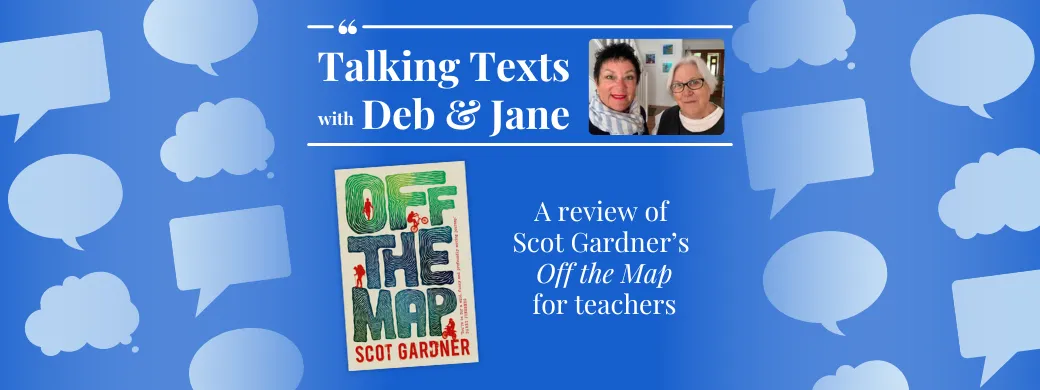
Scot Gardner's "Off the Map" teachers' review - Talking Texts with Deb & Jane #42Scot Gardner's "Off the Map" teachers' review - Talking Texts with Deb & Jane #42

Brief description and distinctive features

For Stage 5

I am a big Scot Gardner fan having now read all his young adult fiction. He has a wonderful capacity for quirky and original plots and many of his main characters are young men with lots of strengths as well as frailties. 

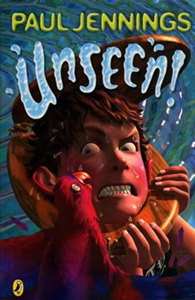
I am also a big fan of short stories for adolescents. Years ago, when I had a challenging year 10 boys class, Paul Jennings’ collection Unseen was a favourite. Off the Map has taken short stories further into adolescent popular culture with language which is rawer than Jennings. Gardner ensures the key elements of accessibility, engagement and interest are there. 

The NSW 7-10 English Syllabus states that across each stage, the selection of texts must give students experiences of a range of cultural, social and gender perspectives, including from popular and youth cultures. We know that student interest and engagement will be heightened if the texts mean something to our students’ lives. I can see your Year 9 and 10 students really enjoying these stories which explore the challenges of growing up and the voices have the authenticity of adolescence.

While there is no specific definition currently in the new 7-10 English Syllabus glossary, this definition from the English 7-12 Syllabus 2012 is still very relevant:

“The shared beliefs, knowledge, creative activities, customs and lifestyle of young people, particularly teenagers, within a culture.

Youth cultures develop in those societies which differentiate teenagers as a group separate from children and adults. In Australia, the dominant youth culture identifies closely with popular culture and finds expression in the music and multimedia texts of popular culture.”

The reading level of Off the Map could be accessed by Year 8 but the subject matter is more suited to Years 9-11. The collection could work well in a Stage 5 Representation of Youth Voices unit combined with short films, media articles and a wide reading focus. The collection would also suit an author study in Stage 5 where you could explore these stories and one other Scot Gardner novel then consider self-selected reading of his other fabulous novels. My favourite Scot Gardner is probably The Way We Roll or, then again, perhaps Changing Gear. The stories could also work well in Reading to Write for Year 11 especially for reluctant or disengaged Standard or Studies readers. 

Allen and Unwin are the publishers and they have a valuable teaching resources which includes a Q&A with Scot Gardner.

Brief description of Off the Map

There are 15 stories of about 10-16 pages so like any good short story they can be read in one sitting. Each story focuses on a different character and at times there is some cross-over in setting so you feel you know some of these characters from the other stories. The content is varied from the opening story, “Answers”, which explores some interesting questions about the internet. In “The Tunnel” Gardner creates a credible narrative combining excitement of danger. Family secrets are explored in “The Wave”; there is also a very sad tale involving a goat in “The Kid”. As a lover of any story with a dog, I found “Stray” a compelling tale, which involves a ferocious storm on a farm and a very sad dog. “Bone Moon” is a marvellous story about a school camping trip and there is some edgy material in “Bad Billy”. In fact, edgy is probably how I would describe these stories and that is very Scot Gardner. He must have the most amazing imagination to think of his plotlines.


Distinctive features of Off the Map

  • Each story has a subheading of the main character’s name e.g. Jael is the narrator of the first story “Answers”, Alex tells “The Tunnel” and Rhiannon is the narrator of “The Stray”.
  • Each story is told in the first person and this focalisation adds immediacy and engagement.  
  • The titles are often one to two words and are often cryptic and compelling.
  • The fictional town of Nerrima is common to several of the stories.
  • The main characters are adolescents facing common challenges of youth.
  • The language is very accessible and engaging.

Ways to use Off the Map in the classroom

Short stories are a popular genre in the publishing world and many successful writers explore this form between extended novels. There are many excellent short stories from the past which could be explored after Off the Map. Consider Edgar Allen Poe’s “The Fall of the House of Usher”, Ray Bradbury’s “The Pedestrian”, Raymond Carver’s “So Much Water So Close to Home”, Shirley Jackson’s “The Lottery”, Angela Carter’s “The Bloody Chamber”,  Ernest Hemingway’s “The Snows Of Kilimanjaro,  Daphne du Maurier’s “The Birds,  and Katherine Mansfield’s “The Garden Party”.  


The short story is an excellent vehicle for story-telling and engaging adolescents. It differs as a form from extended prose and has distinctive features:

  • It is short: it should be able to be read in one sitting – usually about 15-20 minutes
  • Description is tight and focused, and the action needs to move quickly
  • It usually has 1-3 characters
  • It tends to have a single focus 
  • It has a unity of time and place: the setting tends to be singular and the time-span compressed
  • The introduction should efficiently and quickly orient the reader to the key features of the narrative
  • It usually has one central conflict 
  • The story ends as soon as the climax is reached
  • It often ends with a punch or twist 
  • It suits any genre.

Share these features with your class and during the stories’ exploration you can refer to how effectively the stories have fulfilled these features.


Five Senses published an excellent teacher resource, Charged With Meaning: Becoming an English Teacher (edited by Professor Wayne Sawyer 2019), and Paul Grover has written a very valuable chapter, “Working with Short Stories”. This chapter includes some highly accessible classroom strategies and an extensive list of short story resources. It also includes one of the most compelling short stories in English literature: Liam O’Flaherty’s “The Sniper”.


Some general approaches to Off the Map stories

  • Why has Gardner chosen his title?
  • Identify two ways Gardner has engaged the reader’s interest in the opening paragraph.
  • How does the first-person narrative affect your response to the story?
  • Is this story character or plot-driven?
  • In what ways does the setting contribute to the appeal of this story?
  • What specific features of this story are aimed at adolescents?
  • How effective is the ending – were you expecting this?
  • What most appeals about this story?
  • What are 1-2 ideas explored in this story which can be seen as Gardner’s message or theme?


Specific stories:

Answers (p. 1-15)

  1. This story explores topics relevant to adolescents: Artificial Intelligence, computers, emails, family, relationships, conflict.
  2. In what ways do the opening two sentences engage you in the narrative?
  3. The turning point occurs with the second answer: Two older half-brothers. One living, one dead and then later the question Who is my father? adds more tension. Gardner increases this tension with “My heart was a drum roll…” and then: “mum groaned. It came from deep inside her and was as mournful as a dingo’s howl.” At this point the fun of AI has changed to revealing deep and dark family secrets. Identify 3-4 other sentences which reveals this idea, for example: “The whole afternoon had been a Netflix binge about the dark corners of my life.” 
  4. The ending is a clever cliff-hanger: “Nothing except a few numbers hastily scribbled on a scrap of notepaper.” Why does Gardner not add any details about the lotto numbers?
  5. Going further with the story: collaboratively write two extra paragraphs of questions and answers that increase in their complexity.

The Tunnel (p. 16-32)

  1. Scot Gardner is the master of engaging and unexpected openings: “Boredom is the mother of insane stunts” This opening immediately invites us into the world of adolescent recklessness, adventure, danger, excitement, and hair-breadth escapes. 
  2. The three characters are very credible: which character most appeals to you?  Identify 3 lines which captures the characterisation of Alex, Meat or Nick.
  3. Of course, the bike would be called something like “Ball Tearer”! Find two other examples of similar adolescent male humour.
  4. Identify where you think is the turning-point in the story. 
  5. Identify three sentences which change the mood of the narrative for example, p. 28: "the fun was gone … Meat… now looked like an idiot bossing us around, bent on self-destruction.” 
  6. How does the ending contribute the narrative’s symmetry?
  7. Going further with the story: Individually or collaboratively write your own 250 vignette which opens with: “This was the sort of thing holidays were for. We were in the middle of an adventure.” 

Stray (p.33- 43) and The Wave (p. 44-56)

  1. Read both stories. They have a different mood to the previous story.
  2. They both open with a short sentence which immediately invites the reader into the action. Which opening sentence do you prefer and why?
  3. The storm adds menace and tension in “Stray”. Which 2-3 sentences are most effective at building this tension? 
  4. The ending of “Stray” is full of sadness: individually or collaboratively write a different ending of about 300 words. Try to maintain the same style as Gardner. 
  5. The ending of “The Wave” is unexpected as a good short story should be. When does Gardner foreshadow this ending? 
  6. What key ideas are explored in each story?


Engaging with the other stories:

Encourage students to enjoy reading all the stories but if this is not succeeding, consider groups choosing another story to explore. The choice can be achieved randomly or groups selection.

Create a table for each story and document the following textual detail.

Responding to a Scot Gardner short story
Name of story  
Relevance of title  
Significance and effectiveness of the opening  
Setting: in what ways does it contribute to the narrative? Include specific textual references  
List the characters and the key features of Gardner’s characterisation  
Identify 3 stylistic features of Gardner’s craft.  
How well does the ending represent the conventions of a short story?  
Themes and messages  


Sustained response

Consider offering choice to students:

  1. A new edition of short stories for adolescents is being published. It is called Don’t Look Back.  Scot Gardner has been invited to contribute two stories from Off the Map. Decide which two stories would be most engaging for this anthology and write a persuasive proposal to the publishers outlining your reasons. Be sure to include textual detail as part of your pitch. 
  2. “A successful short story should be a great read.”

    In what ways does Scot Gardner succeed? Choose 2-3 stories from Off the Map to explore this comment.


Taking the short story further 

Short stories are excellent models for students’ own writing and Off the Map contains a range of topics relevant to adolescents. The realism of the stories will be a valuable incentive for students to explore their own experiences in a short story.

This writing can occur individually or as a collaborative project.

Encourage discussion as a pre-writing activity so that students have something to write about. 


Ideas for short stories

  • An event or activity from your childhood which involved danger or excitement or an unexpected ending
  • Someone who has made a significant contribution to your life e.g. grandparent, best friend, uncle, teacher, coach
  • A series of journal entries about a place or experience form the point of view of when you were aged 8, 12, now. 


Pre-writing:

  • Decide on what narrative voice will best suit your story: first or third.
  • How will you structure your story: linear, flashback, a series of vignettes, series of letters from different characters?
  • Where and when will you set your story?
  • How many characters?
  • Be sure to know the ending before you start.
  • Will you foreshadow the ending? 
  • Consider a range of language choices to add interest and engagement e.g. a powerful opening, variation of sentences, incorporation of text messages, clever comparisons through simile and metaphor, limited but effective dialogue, intertextuality with a song or television series or movie, specific, concrete detail. 
  • Be sure to have a title of no more than three words. 


Consider the power of publication

  • Collate all the stories into a class anthology.
  • Hold a competition for the best title for the anthology.
  • Create an index including the authors’ names.
  • Include an author description: each student to write a brief biography in the third person about themselves and include a photograph which best captures them. Exaggeration is acceptable in the biographies.
  • Create a cover, print and bind the collection for students to have their own copy.
  • Hold a book launch where authors are called on to read their favourite paragraph.
  • Celebrate on the school’s Facebook page and/or newsletter. 
  • Celebrate with parents at parent and teacher interviews. 

Relevant details in relation to the new NSW English 7-10 syllabus

Text requirements: Off the Map is an example of short prose which is a text requirement in 7-10. Scot Gardner is an Australian author and the stories engage with youth cultures.
For more recommended texts suitable for Stage 5, explore our Year 9 texts and study guides and Year 10 texts and study guides.

Concepts could include Genre, Narrative and Characterisation 


Relevant NSW English 7-10 Syllabus content

A student analyses how meaning is created through the use and interpretation of increasingly complex language forms, features and structures EN5-URA-01

  • Analyse how language forms, features and structures, specific or conventional to a text’s medium, context, purpose and audience, shape meaning, and experiment with this understanding through written, spoken, visual and multimodal responses
  • Examine elements of focalisation, such as omniscience, limitations, indirect speech, tone, reliability and multiple narrators, and how these interact to shape perceptions of meaning in texts, and apply this in own texts
  • Analyse how engaging, dynamic and complex characters are constructed in texts using language features and structures, and use these features and structures in own texts
  • Analyse how narrative conventions vary across genres, modes, media and contexts and how they can be used to represent ideas and values and shape responses, and apply this understanding in own texts
  • Analyse how themes can be understood to underpin cohesive meaning in texts, and apply this understanding in own texts
  • Analyse how the distinctive aesthetic qualities and stylistic features of a text can shape and be shaped by its purpose, and experiment with this in own texts
  • Examine the way an author’s distinct personal style shapes meaning in their work

A student investigates and explains ways of valuing texts and the relationships between them EN5-URC-01

  • Analyse how elements of genre in texts can shape the way ideas and values are represented and perceived, and experiment with elements of genre in own texts to shape meaning and response

A student crafts personal, creative and critical texts for a range of audiences by experimenting with and controlling language forms and features to shape meaning EN5-ECA-01

  • Experiment with language to create tone, atmosphere and mood
  • Use rhetorical language strategically and subtly to shape complex ideas and convince others of a point of view, as appropriate to audience and purpose
  • Apply narrative voice to depict complex ideas and enhance engagement
  • Create engaging and authentic temporal and spatial settings for a range of purposes and audiences
  • Use the structural conventions of analytical writing purposefully, including a well-articulated and considered thesis, a sustained and cohesive progression of supporting points, and a rhetorically effective conclusion
  • Use the structural conventions of persuasive texts to purposefully justify opinions and develop expanding arguments, including a focused opening and thesis, logically sequenced elaboration paragraphs, and a conclusion that synthesises complex ideas
  • Use the structural conventions of imaginative texts purposefully, including shaping complex complications and conflicts, and crafting authentic characters, to depict ideas

A student uses processes of planning, monitoring, revising and reflecting to purposefully develop and refine composition of texts EN5-ECB-01

  • Engage with model texts to develop and refine features, structures and stylistic approaches in own work
  • Produce co-constructed complex texts to represent a diversity of ideas and values


(English K-10 Syllabus 2022 © NSW Education Standards Authority for and on behalf of the Crown in right of the State of New South Wales, 2023)

Connecting texts