



Flat Rate Shipping
$9.95 flat rate shipping or free over $110

Aussie Owned
Australian family-owned & sourced

School Supplier
Supplier to over 1,000 schools Australia wide

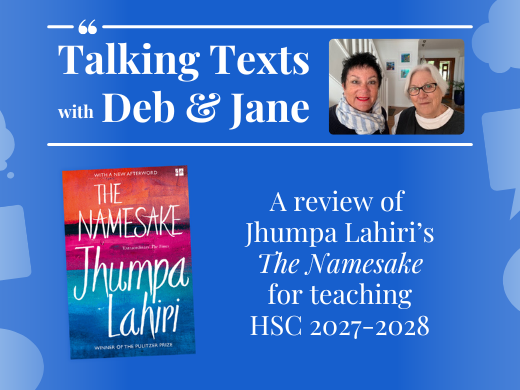
For HSC Standard English course Language, identity and culture and for EAL/D: Language, identity and culture: Stage 6 English syllabus for 2027 and 2028
Complement your study of this text with our Year 12 texts and study guides, Year 11 texts and study guides, and English Years 11–12 Study Guides at Five Senses Education.
Jhumpa Lahiri brilliantly captures what it feels like to live three decades in the life of a young man born in the USA to migrant parents. Lahiri explores the identity confusion, culture shock and loneliness that is common to the immigrant experience through her closely observed family portrayal using languages that spans continents and generations. The Namesake is a perfect fit for the Focus area Language, identity and culture.
Jhumpa Lahiri was born in London, raised in America and is of Indian descent. She is known for her short stories, essays and novels. Her short story collection, Interpreter of Maladies, won the Pulitzer Prize for Fiction in 1999. She has also written and published in Italian. She was Professor of Creative Writing at Princeton University from 2015-2022.
Ashoke and Ashima Ganguli migrate from Calcutta, India to the USA in the 1960s and the novel opens with the birth of their first child. Flashbacks tell the reader about the brutal accident that Ashoke experienced when, as a young electrical engineer he was involved in an horrific train crash. The flashback also explains the nature of the place in his life of the Russian writer, Nikolai Gogol. It was because a rescuer saw the white pages of the Russian short stories fluttering in his hand in the torchlight, that Ashoke was discovered still alive in the crash. When their son is born both parents are waiting for a letter from the matriarch of the family with a chosen name for the boy. However, the letter never arrives and in the USA a baby cannot leave hospital without a name being formally registered. Bengali culture involves two names - a ‘pet’ name used in the family and a ‘good’ name used in public. The parents must decide on a name so Ashoke selects Gogol as a temporary name. However, when Gogol starts school, he does not respond to his newly-decided name Nikhil and the school insists on calling him Gogol. When he becomes a teenager, he finds his name an embarrassment and comes to hate his name and to reject his culture, feeling that both do not reflect him. As an adult he changes his name to Nikhil. While this dismays his parents, they love him dearly and do try to use Nikhil when they are in the company of his friends.
As the family have settled permanently in the USA, trips back to Calcutta to see family and friends are a very important part of the family life, especially for Ashoke and Ashima. Over the years Ashima builds up a large group of Bengali friends in the USA; she is responsible for many of the regular meetings and celebrations. Nikhil goes to university and becomes involved with two American women, first Ruth, then Maxine and finally marries another Bengali and family friend, Moushumi. However, they separate after she confesses to having an affair and at 32 years old, he finds himself divorced.
Ashoke has become a professor at the prestigious Massachusetts Institute of Technology but suffers a fatal heart attack which brings the family back together in sorrow and grief and to the comfort of their culture and their friends. Ashima after being at home for her children begins a part time job at the public library and makes her first American friends. When Sonia, Gogol’s sister, becomes engaged it occasions the last celebration of the novel as Ashima has decided to sell the family home and spend six months in India and six months in the states at a flat in Salt Lake, becoming ‘a person without borders, a resident everywhere and nowhere.’
Life appears to have come full circle when, at the end of the book during the celebrations, Nikhil/Gogol is about to finally read the short story ‘The Overcoat’ by his namesake for the first time.
In this Focus Area Language, identity and culture, students study ONE prescribed text in detail and a range of textual material to explore, analyse and assess the ways in which meaning about individual and community identity and cultural perspectives is shaped in and through texts.
When people leave a home, a place or a country they leave behind so much: family, friends, familiar customs, food and language. The first generation to leave suffer homesickness, loneliness and dislocation. The next generation, while born in a new country also have to straddle two cultures as well.
What we eat, what we wear, what we say, how we celebrate, reflects our own identity ad our cultural background. Think about what you would select as iconic of your own culture. In groups discuss some common and different aspects of the cultures in the classroom.
Complete the table below to clarify cultural differences between the generations: use quotations and your own response to the characters and issues in the novel
| Characters | Appearance | What left behind | What gained | Your comments |
| Ashoke | Kinship ties | Professor at MIT | ||
| Ashima | Wears sari in public | Family [Being a foreigner] ''is a sort of lifelong pregnancy -- a perpetual wait, a constant burden, a continuous feeling out of sorts.'' | Christmas Eve parties | |
| Gogol/Nikhil | Adapts American clothes and language | A sense of detachment | ||
| Sonali/Sonia | ||||
| As a family | Take on the Christmas tree decoration |
When Jhumpa Lahiri went to kindergarten the teacher decided to call by her familiar name as it was easier to pronounce. Lahiri said "I always felt so embarrassed by my name.... You feel like you're causing someone pain just by being who you are...” and her ambivalence over her name/identity was the inspiration for her character Gogol/Nikhil and his difficulties in coming to terms with who he really is.
Reread the section in the novel (pages 24-29) about the naming dilemma that face Gogol’s parents and their solution. Next read the section about his first day at school (pages 56-60) and the confusion about his name. Then consider Gogol’s decision to change his name and the reasons he gives (pages 97-103) to his parents and to the judge at the courthouse.
The Cambridge Dictionary defines identity as “a person’s name and other facts about who they are”. So, you can appreciate that Gogol’s dilemma about his name could be a source of confusion and conflict for his understanding of his identity.
At the end of the novel, (pages 285-291) with his father dead and his mother about to spend half the year in India, Gogol reflects that:
‘Without people in the world to call him Gogol, no matter how long he himself lives, Gogol Ganguli will, once and for all, vanish from the lips of loved ones, and so, cease to exist.’
Such thought brings him no solace and it is then, after finding the book of Russian short stories by Nikolai Gogol that his father gave him long ago, that he decides to read ‘The Overcoat’, the story his father was reading when he was badly injured in a train crash in India.
Group discussion and report: After re-reading the sections listed above prepare a class report on The naming of the son of Ashoke and Ashima Ganguli, its history and its consequences for that child and his identity, both as a student and an adult.
Additional material: ‘The Overcoat’ can be found for a free download at Fountainhead Press.
Task reading and group discussion: Read this short story (only 8 pages) and then in groups consider why it had such an impact on Ashoke Ganguli that he named his son after the author. Also consider would Gogol/Nikhil find any connection to this story about a poor government clerk and copyist often bullied by his workmates and rarely recognised for the hard work he did, whose name is equally influential in establishing his identity.
“Through understanding and responding to texts, students deepen their understanding of how language can affirm, ignore, challenge and disrupt prevailing assumptions and beliefs about themselves, individuals and culturally connected groups.”
Small group task: In groups choose 5 different events/episodes in the novel and use the table below to list examples of Lahiri’s language which affirms, challenges, disrupts or ignores specific assumptions and beliefs about culture and identity.
| Assumptions and beliefs | Your response | Language choices | Your response |
| What assumptions and beliefs are affirmed in The Namesake? | How is this achieved through Lahiri’s language choices? | ||
| What assumptions and beliefs are challenged in The Namesake? | How is this achieved through Lahiri’s language choices? | ||
| What assumptions and beliefs are disrupted in The Namesake? | How is this achieved through Lahiri’s language choices? | ||
| What assumptions and beliefs are ignored in The Namesake? | How is this achieved through Lahiri’s language choices? |
When Jhumpa Lahiri said in an interview that she "felt intense pressure to be two things, loyal to the old world and fluent in the new” she was expressing a common feeling for migrants straddling two countries and two cultures.
To what extent do you think The Namesake explores individual and community identity and cultural perspectives? In your response make close reference to your prescribed text and to other textual material you have explored.
There are requirements for particular types of texts to be selected from the prescribed texts list for different courses. Great care must be taken in selecting a pathway of texts that meets all the requirements.
In the Standard English course students are required to closely study 3 prescribed texts, with ONE drawn from each of the following categories:
The novel, The Namesake by Jhumpa Lahiri, includes a range of cultural, social and gender perspectives.
Pathway 1 for HSC Standard English with The Namesake as first choice
Poetry

Texts and human experiences:
Love Poems and Death Threats by Samuel Wagan Watson
Prose Fiction

Language, identity and culture:
The Namesake by Jhumpa Lahiri
Film

Close study of literature:
Arrival directed by Denis Villeneuve
Pathway 2 for HSC Standard English with Harwood as first choice
Drama

Texts and human experiences:
Away by Michael Gow
Prose Fiction
Language, identity and culture:
The Namesake by Jhumpa Lahiri
Poetry

Close study of literature:
Collected Poems by Carol Ann Duffy

Jane Sherlock and Deb McPherson are experienced and passionate English teachers. They have also been involved in the education sector as authors and presenters at teaching conferences.
$9.95 flat rate shipping or free over $110
Australian family-owned & sourced
Supplier to over 1,000 schools Australia wide