The Old Vic Company's "A Monster Calls: the play" teachers' review - Talking Texts with Deb & Jane #52The Old Vic Company's "A Monster Calls: the play" teachers' review - Talking Texts with Deb & Jane #52

Brief description and distinctive features

For Stage 4

Patrick Ness’s glorious book A Monster Calls is an absolute favourite of mine and I know it is very popular in many schools. When I read that there was a play based on the novel, I was very curious to read it and see it performed. 

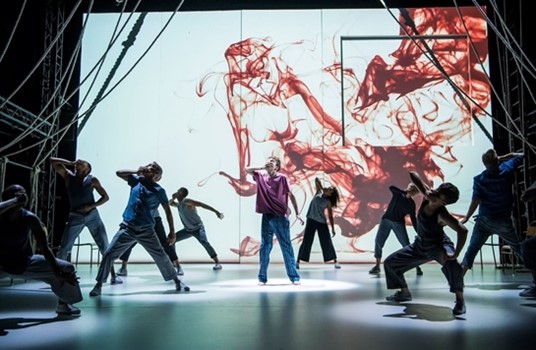
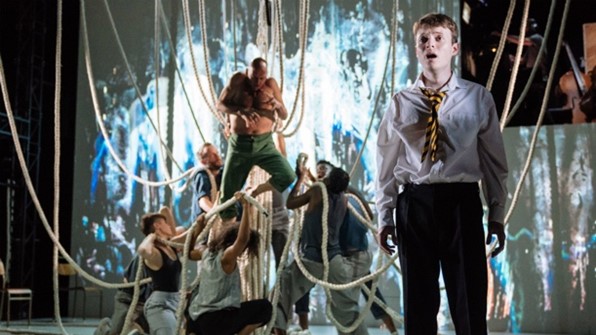
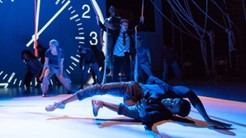
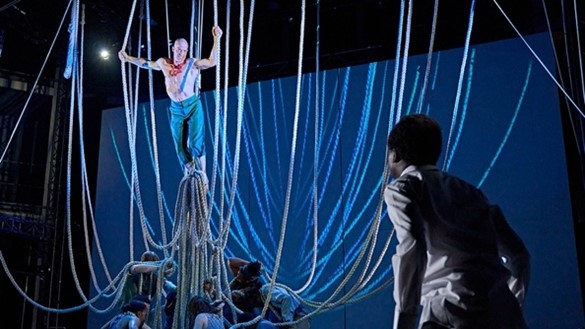
Not all play adaptations work, but this one does. It could be because it is a collaborative project with a broader creative team. Indeed, the team have really captured the power of Ness’s story and the images of the production which are available online will add to the engagement of this adaptation. 

The play will be most powerful if students have already read the novel.  

I wrote a Five Senses blog on the novel so if you are new to A Monster Calls, please access the resource posted on September 28 2023.


Brief description of A Monster Calls: the play

The story focuses on Conor O’Malley who is 13. His dad has a new wife and has moved to America, his mother has terminal cancer, his friends bully him at school because of his mother’s illness and his grandmother has come to stay and eventually take Conor to live at her house. Conor is trying to cope with all of this at the same time as a monster meets him each night at 12.07 am. The monster is terrifying, powerful, bold and very plausible. He challenges Conor to confront the truth. The monster shares several fable-like stories with Conor to help him understand the complexities of his own experiences.

Distinctive features of A Monster Calls: the play

  • A powerful and intense adaption of a longer novel; it is relatively short at 95 pages
  • Several short introductions to the production give valuable information and insights to the creative collaboration involved in writing and performing this play including:
    • A Note from Patrick Ness (the same Author’s Note as in the novel which acknowledges Siobhan’s original idea and hands the baton on to the reader to “Make trouble”)
    • Director’s Note by Sally Cookson provides background on the genesis of the adaptation
    • Writing in the Room by the scriptwriter Adam Peck sheds light on the team effort on development of the script
    • Designer’s Note by Michael Vale on the “very physical approach to the design and story telling”
    • Costume Designer’s Note by Katie Sykes on the need for design to be “exciting, practical, beautiful” and work with the set design
    • Composer’s note by Benjo Bower on the challenge of meeting the director’s needs while tapping “into Conor’s heartbeat”
    • Note on the Ensemble which details the unique role in the performance*
  • List of characters and actors of the original cast from the Bristol Old Vic in June 2018 and a list of the Creative Team (it takes a big team to deliver a play performance)
  • There are two Acts and each Act has sixteen short scenes
  • Like the novel, the scenes have titles and some are the same as the novel e.g. Breakfast, School, Life Writing
  • The dialogue is very convincing and powerfully captures the original story and at times is even more poignant, such as the conversations between Connor and his mother.

* Note on production: The characters also include the Ensemble and in this play they are on stage throughout the play. They sometimes play specific characters and the stage directions indicate they prepare their costumes and props in view of the audience. This Ensemble adds a different dimension to the play to enhance the dramatic and theatrical impact rather than representing realism.

Ways to use A Monster Calls: the play in the classroom

  • Build student understanding that the features of a play are different to other forms like a novel, poem or film: that a play is a script to be interpreted by the actors, director and other members of the creative team which is then realised for the stage.
  • Showcase a range of novels which have been adapted into plays and films. Discuss with students as to the success or otherwise of these adaptations.
  • Discuss with the class or form groups to discuss what they see would be the main challenges of adapting A Monster Calls to the stage.
  • Show this YouTube clip to the class to both engage their interest and to help them visualise the creative staging of the play.
  • Provide some background on this play’s collaboration which is atypical in the way most plays are created. Emphasise the uniqueness and the creative energy that such a collaboration would produce.
  • Consider reading with the class the six introductions.  Allocate one to each group for the group to capture their introduction into three important dot points and then display the various summaries and check-in with them as the play is explored.


  • Some scenes are very close to the novel especially the dialogue, e.g., scene 3 Breakfast. Other scenes like the opening scene are additional to the novel and provide context for the play’s action.
  • Scenes, like the school scenes, are different in that the novel’s narrative about Conor is omitted.  But the vindictive behaviour and bullying by Harry and Sully seems to be even more poignant and powerful in the play, as if the playwrights’ have distilled the novel’s chapters into the most salient features which are the cruel words of the boys against Conor.
  • Students should re-read the chapters exploring the school scenes from the novel or listen to them on an audio recording. Discuss the role and impact of Ness’s powerful third person narrative which focalises the perspective of Conor e.g.:

    He could already taste the blood in his mouth as he got up. He had bitten the inside of his lip when he hit the ground, and it was what he focussed on now as he stood, the strange metallic flavour that made you want to spit it out immediately, like you’d eaten something that wasn’t food at all. He swallowed it instead. Harry and his cronies would have been thrilled beyond words if they knew Conor was bleeding. He could hear Anton and Sully laughing behind him, knew exactly the look on Harry’s face, even though he couldn’t see. p.18

  • Form small groups. Each group to read the “school” scenes in the play and choose one they would like to present to the class. The presentation could be in the form of Reader’s Theatre where the group sits in a line or circle and each person takes a different line. This could be enhanced by having Conor in the centre of the circle as if he is being bombarded by the cruel words.
  • Written response: choose a “school” scene from the play and the corresponding chapter from the novel. In what ways do the writers bring to life the experiences of Conor in their chosen medium? 


Destruction of Grandma’s house:

Read the chapters The Rest of the Second Tale and Destruction (or listen to an audio recording).

The chapter “Destruction” in the novel is extraordinarily powerful in its raw human tragedy. The pain and helplessness that both Conor and his grandmother feel is palpable. Ness’s skilful evocation of the grandmother’s reaction is breathtaking:

Her mouth closed, but it didn’t close in its usual hard shape. It trembled and shook, as if she was fighting back tears, as is she could barely hold the rest of her face together.

And then she groaned, deep in her chest, her mouth still closed.

It was a sound so painful Conor could barely keep himself from putting his hands over his ears.

She made it again. And again. And then again until it became a single sound, a single ongoing horrible groan. Her handbag fell to the floor. She out her palms over her mouth as if that was all that would hold back the horrible, groaning, moaning, keening sound flooding out of her.

These chapters have been transformed into scene 16 which is the final scene of Act I. If there is an interval after this scene, it is certainly an appropriate scene to allow the audience to stop, pause and consider what they have just viewed. 

The stage directions on p61-62 are particularly significant in creating the scene’s mood and intensity. The writers have included a musical reference: “Adagio of Spartacus and Phrygia” builds to a climax. This is a truly beautiful piece of classical music and the intensity builds at about 6.13 minutes. Please share this music with your students and discuss how the music amplifies and reinforces the actions of Conor. 

There is a powerful version of this music at this link.

Read the rest of the scene with close attention to the stage directions. 

It is a valuable example of how a play is intended to be watched so that the full realisation of the action can be seen.

This could be an effective scene for students to mime.
 

Responding to the play

  1. Share images from the Old Vic performance. Either individually or in small groups students choose one of the images and respond: with what scene does this image best align? In what ways does it capture the scene especially the key ideas?
  1. Class debate: It is common for audiences to compare a novel and a film or in this case, the novel and the play. Divide the class into two groups, one group to argue that the novel is the better and the other group for the play. Each side must include specific details from the novel or the play to substantiate their perspective.

    Each group is to list their reasons and choose their most persuasive speakers to argue their case.

    Hold a class vote (consider a secret ballot) for the most convincing point of view.

  2. Writing tasks: Use the data from each group and students can choose their writing task:

    • Create a digital essay which explores the key features of the novel and the play. Include links to the play and images from each text.
    • Compose a feature article which explores the tradition of adapting existing novels into film and plays. Include about five examples of such adaptations. Allocate about half of the article to a discussion of the key features of A Monster Calls in novel and play form.
  3. Share several reviews of the play; they are all very positive in their awe of the staging and re-imagination of the Ness’s story:

    Here is an extract from one of the reviews:

    A Monster Calls is undoubtedly one of the most visually stunning productions I've ever laid my eyes on. The use of physical theatre oozes personality and fierce emotional portrayal, whilst the original music and use of the actor's voice for sound adds ambience to the entire show. The actors are sat at the side of the stage for a large proportion of the show and are very much in the midst of all of the action. The use of chairs, rope and other props are helped largely by the striking projections on the space at the back. The rope plays an important part in representing how our life is connected by different threads and experiences. It takes the different roles of support and threat that is hauntingly mesmerising for the audience. At the back of the space is where the musical score is also played from, live in this production. The original score sits well alongside this moving story and completely captivates the emotions.

    Students are to choose the review which most engages them and to write a paragraph: in what ways did the review engage and excite your interest.

Relevant details in relation to the new NSW English 7-10 syllabus

Text requirements: A Monster Calls: the play is a drama text which is regarded as quality literature from around the world.

Concepts could include Representation • Narrative.


Relevant NSW English 7-10 Syllabus content

Reading, viewing and listening to texts

A student uses a range of personal, creative and critical strategies to read texts that are complex in their ideas and construction EN4-RVL-01

Reading, viewing and listening skills

  • Apply a range of strategies to develop fluency in reading aloud, including an understanding of pace, tone and voice
  • Revisit texts to develop a clear understanding of the themes, ideas and attitudes they express

Reading, viewing and listening for meaning

  • Explore the main ideas and thematic concerns posed by a text for meaning
  • Engage with the ways texts contain layers of meaning, or multiple meanings
  • Identify and understand that relevant prior knowledge and personal experience enables and enhances understanding when reading, viewing or listening to texts
  • Explain personal responses to characters, situations and issues in texts, recognising the role of written, oral or visual language in influencing these personal responses
  • Explain how the use of language forms and features in texts might create multiple meanings

Reading for challenge, interest and enjoyment

  • Read texts selected to challenge thinking, develop interest and promote enjoyment, to prompt a personal response
  • Communicate purposefully with peers in response to texts
  • Understand the ways reading helps us understand ourselves and make connections to others and to the world

Reflecting

  • Reflect on how reading, viewing and listening to texts has informed learning
  • Reflect on how an understanding of texts can be enhanced through re-reading and close study
  • Discuss and reflect on the value of reading for personal growth and cultural awareness
  • Reflect on how reading promotes a broad and balanced understanding of the world and enables students to explore universal issues
  • Reflect on own experiences of reading by sharing what was enjoyed, discussing challenges to strengthen an understanding of the value of reading

Understanding and responding to texts A

A student analyses how meaning is created through the use of and response to language forms, features and structures EN4-URA-01

Representation

  • Explore how language and text are acts of representation that range from objective to subjective and may offer layers of literal or implied meanings, and apply this understanding in own texts

Point of view

  • Recognise how texts engage and position the audience to perceive events, characters and ideas using narrative voice and focalisers, tense, sequencing and intrusion, and apply this understanding in own texts

Characterisation

  • Analyse how engaging characters are constructed in texts through a range of language features and structures, and use these features and structures in own texts
  • Understand how the interactions of characters, such as protagonists and antagonists, might be perceived to represent aspects of human relationships, and experiment with interactions when composing texts

Narrative

  • Understand narrative conventions, such as setting, plot and sub-plot, and how they are used to represent events and personally engage the reader, viewer or listener with ideas and values in texts, and apply this understanding in own texts
  • Examine how narratives can depict personal and collective identities, values and experiences

Understanding and responding to texts B

A student examines and explains how texts represent ideas, experiences and values EN4-URB-01

Perspective and context

  • Understand how perspectives are shaped by language and text
  • Explore how the perspectives of audiences shape engagement with, and response to, texts
  • Examine how elements of personal and social contexts can inform the perspective and purpose of texts and influence creative decisions
  • Consider the influence of cultural context on language

Expressing ideas and composing texts A

A student creates personal, creative and critical texts for a range of audiences by using linguistic and stylistic conventions of language to express ideas EN4-ECA-01

Representing

  • Compose visual and multimodal texts to represent ideas, experiences and values
  • Select modal elements to work together to support meaning or shape reader response
  • Use digital technologies where appropriate to compose multimodal texts

Speaking

  • Deliver spoken, signed or communicated texts with effective control of intonation, emphasis, volume, pace and timing
  • Participate in informal discussions about texts and ideas, including speculative and exploratory talk, to consolidate personal understanding and generate new ideas
  • Use features of gesture, manner and voice to signal the progression and development of ideas through language and structure


(English K-10 Syllabus 2022 © NSW Education Standards Authority for and on behalf of the Crown in right of the State of New South Wales, 2023)

Connecting texts