



Flat Rate Shipping
$9.95 flat rate shipping or free over $110

Aussie Owned
Australian family-owned & sourced

School Supplier
Supplier to over 1,000 schools Australia wide

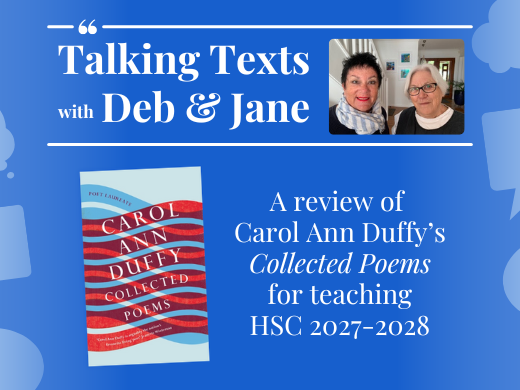
Seven poems from this anthology are set for study in English Standard: Close study of literature for the new Stage 6 English syllabus for 2027 and 2028:
‘War Photographer’, ‘Stealing’, ‘In Mrs Tilscher’s Class’, ‘We Remember Your Childhood Well’, ‘The Good Teachers’, ‘Little Red Cap’ and ‘Mrs Midas’
Carol Ann Duffy’s Collected Poems, have a clarity, a richness, an immediacy and a depth that make them an excellent choice for poetry for your students in Standard: Close Study of Literature, when they sit for the HSC in 2027. The set poems are ‘War Photographer’, ‘Stealing’, ‘In Mrs Tilscher’s Class’, ‘We Remember Your Childhood Well’, ‘The Good Teachers’, ‘Little Red Cap’ and ‘Mrs Midas’.
It is good to know that Duffy has a special affinity for teachers and certainly she thought highly of her own English teachers and this is reflected in some of her poems. In a Lincoln Review Interview on 18 October 2019 Duffy spoke about influences on her life as a writer. She said:
“I think in common with many writers, I was very lucky with my English teachers. I’ve written about this, and have written poems about some of my teachers. I had a fantastic teacher in year six at my junior school who was really encouraging to all of us to do creative writing and then when I went to secondary school I had a really inspirational English teacher there who was very good one-on-one with encouraging me to write poetry, would suggest poets to read and then read books and things. In my case, it was fantastic English teachers who really helped me as a young writer.”
Carol Ann Duffy also leads us in understanding the importance of reading and of reading and writing poetry:
‘I think it’s important that everyone reads from a young age and then some of those readers will want to become writers. I think that it’s an enriching and civilising and very human part of life to be able to sing, to be able to paint, to play an instrument, to have a go at writing a poem, to read, to go to the theatre, and we’re very much in danger of those things in education withering on the vine or not being properly invested in. I’m not kind of saying that everyone has to write and be a poet, but I am saying that everyone should read poetry and hear poetry and have it as part of their lives and some of those will want to grow up and be writers.’
Carol Ann Duffy has won major poetry prizes in the United Kingdom and sold over one million copies of her books around the world. Her poetry has been set for study at Scottish and English final examinations for many years. She was appointed UK Poet Laureate in 2009. Duffy made it clear that she had agreed to become poet laureate only because, since its inception in the 17th century, no woman had previously held the post.
Duffy is an engaging and accessible poet who believes that ‘poetry is the music of being human’. Her poems range widely in both content and form. Her poems can be celebrations and protests. They can address public issues and be very private and personal. She can be wise and profoundly humorous, as well as serious and distraught. She uses simple words, even cliches, in a complicated way.
The selection for the NSW HSC examination in 2027 includes seven poems. ‘War Photographer’, has an emphasis on the horror of war and our ability to look away from its victims. ‘Stealing’ is about a young juvenile ‘thieving’ a snowman’s head while, ‘In Mrs Tilscher’s Class’ is a beautiful exploration of a young child growing up in a primary school and the profound impact of a wonderful teacher. ‘We Remember Your Childhood Well’ is a disturbing, ambiguous dual monologue about parental denial when confronted by an unseen adult daughter about an abusive past. ‘The Good Teachers’ is about just that, good teachers and their impact on their students. ‘Little Red Cap’ is a very different interpretation of ‘Red Riding Hood’, and ‘Mrs. Midas’ is a comic; a crafty and yet moving dramatic monologue on the dramatic consequences of King Midas’ thoughtless and selfish wish to turn everything he touches to gold.
On first looking at a poem…
Re-visit strategies for reading and accessing a poem to build student competence and above all, confidence. Students will do better if they can see and enjoy the way Duffy has shaped meaning.
Hints to students for reading a poem
Context
Bring some famous war photographs, to the classroom either as digital, images or printed A4 copies and ask students in groups to discuss the craft and content of the war photographers that took them. For example:
Synopsis
‘War Photographer’ was inspired by the profession of a friend. In the poem she explores the contradictions between a war photographer’s job: they record horrific events in people’s lives without being able to support or help them. In her own way she is doing much the same thing but uses words, not photographs. She is conscious that as readers and viewers we can become desensitised to the pictures we see and the words we read.
This serious and reflective poem takes the reader though stages in the work of a war photographer. We start in a darkroom watching the examination of the spools of film, then move to developing the film and to memories of the places the photos were taken and to the actions of the newspaper editor carelessly selecting the photographs to run in the paper. The poem concludes with the photographer leaving England again for another assignment.
Listen to the poem
Play this dramatic reading to the class and ask students to discuss their first response. Then play it again and ask groups to consider what more came to light their understanding.
Story board the poem
Ask students in groups to design a story board for the poem. This activity promotes the visual images in the poem and allows students to mimic the actions of the war photographer.
Form of the poem
The poem has four six line stanzas and a rhyming couplet at the end of each stanza. Ask students to consider why the poet might have chosen such a rigid structure when you consider the chaos of the war zones the photographer visits. Is control, a need to distance himself from what he sees, reflected in the organisation of the poem?
Language use
Religious language and imagery has a powerful impact in this poem. The poet uses the sense of sight to bring clear and contrasting images to the reader. Ask students in groups to identity and explain this imagery and language and consider how it sets and changes the mood and tone of the poem and reinvoices the key issues that Duffy is exploring in the poem.
Duffy says
“I stumbled into this [a retelling the story from Ovid's metamorphoses of Midas] by accident … and I decided to do that from the point of view of Mrs Midas—who's, in my version, in danger of being touched and turned to gold; so how would you deal with that? So, it was a story I was very familiar with and I was playing around with retelling to see if I could do something fresh with it.”
Duffy certainly does something fresh with it. It is Mrs Midas retelling the famous story and her perspective is sharp, satiric and poignant.
Ask students to research the Greek myth of King Midas and his golden touch from a variety of sources e.g. Penn Museum's Expedition Magazine and to compose a short precis of the myth.
Groups listen to performance of the poem read through the poem. Hear the poet read it or listen to actor Juliet Stevenson’s more compelling recitation.
Ask questions and seek out answers
In groups discuss and decide what could be said about each poem under the following headings.
| ‘War Photographer’ | ‘Stealing’ | ‘In Mrs Tilscher’s Class’ | ‘We Remember Your Childhood Well’ | ‘The Good Teachers’ | ‘Little Red Cap’ | ‘Mrs Midas’ | |
| Key ideas | |||||||
| Distinctive features: Example of language choices which represent the ideas | |||||||
|
Distinctive features: Specific stylistic devices/poetic techniques |
|||||||
| Effect/impact on the reader | |||||||
| Which other poems could connect with this poem? |
Duffy said that “I’m very fond of something Picasso said . . . in his case painting, but I’ve taken it on board as a writer which is “Inspiration will come, but it must find you working.”
So, let’s get to work and meet the challenge of writing a poem in response to a line, an idea, a poem or an image in a poem by Duffy. Try to reflect your perspective on characters or ideas but uses Duffy’s diction e.g. use simple words in a complicated way’ and use the dramatic monologue form which so many of her poems use or if you prefer, another poetic form.
Duffy’s poems have been set for study in the UK and you will find good resources at the BBC on some of Duffy’s poems at their bitesize site.
There are requirements for particular types of texts to be selected from the prescribed texts list for different courses. Great care must be taken in selecting a pathway of texts that meets all the requirements.
In the Standard English course students are required to closely study 3 prescribed texts, with ONE drawn from each of the following categories:
Carol Ann Duffy is a Scottish poet and her Collected Poems include a range of cultural, social and gender perspectives.
Pathway 1 for HSC Standard English with Contemporary Asian Australian Poets as first choice
Film

Texts and human experiences:
One Night the Moon directed by Rachel Perkins
Prose Fiction

Language, identity and culture:
The Namesake by Jhumpa Lahiri
Poetry

Close study of literature:
Collected Poems by Carol Ann Duffy
Pathway 2 for HSC Standard English with Contemporary Asian Australian Poets as first choice
Drama

Texts and human experiences:
Away by Michael Gow
Prose Fiction
Language, identity and culture:
The Namesake by Jhumpa Lahiri
Poetry
Close study of literature:
Collected Poems by Carol Ann Duffy

Jane Sherlock and Deb McPherson are experienced and passionate English teachers. They have also been involved in the education sector as authors and presenters at teaching conferences.
$9.95 flat rate shipping or free over $110
Australian family-owned & sourced
Supplier to over 1,000 schools Australia wide