



Flat Rate Shipping
$9.95 flat rate shipping or free over $110

Aussie Owned
Australian family-owned & sourced

School Supplier
Supplier to over 1,000 schools Australia wide

For Stage 4
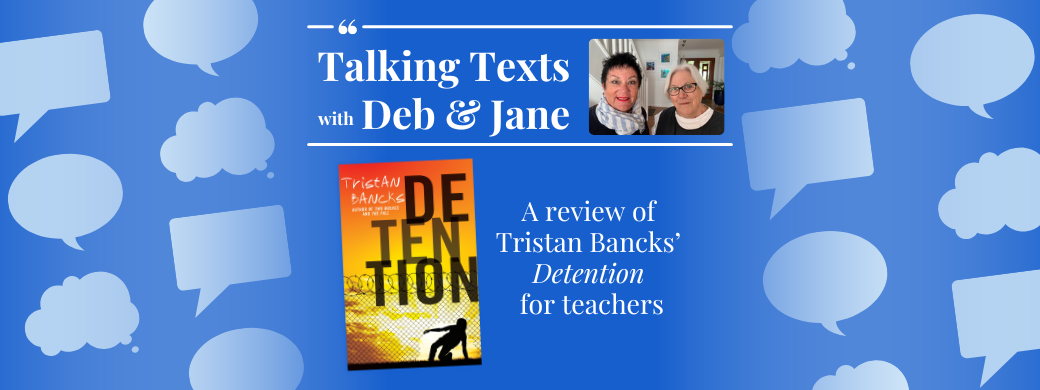
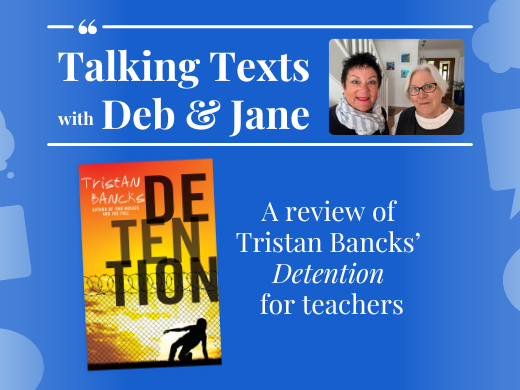
I came late to Detention but enjoyed Scar Town so much (I reviewed it on the Five Senses blog in 2024) that I decided to read more widely in the Tristan Bancks collection. Detention was a text I heard many teachers were using in the classroom, and I can see why that would be the case after finished this fast paced, accessible, empathetic and gripping novel.
Tristan Bancks is a children’s author who has also worked in acting and filmmaking. His books include Two Wolves, The Fall and Scar Town. Two Wolves won Honour Book in the 2015 Children’s Book Council of Australia Book of the Year Awards and was shortlisted for the Prime Minister’s Literary Awards. The Fall was a Notable Book in the 2018 CBCA Book of the Year Awards and was shortlisted for the Adelaide Festival Awards for Literature. Detention won the YABBA & KOALA Children’s Choice Award, it was a 2020 CBCA Book of the Year Younger Readers Notable Book and was on both the Australian Book Industry Awards Shortlist NSW Premier’s Literary Awards Shortlist. Scar Town was named the Children’s Book Council of Australia’s Book of the Year for Younger Readers in 2024.
Brief description of Detention
This thrilling story opens unexpectedly with an entire family lying on the ground. Sima and her family are being held at a detention facility and have been told they will be deported. They are desperate to stay in Australia and the family - father, mother, baby sister and Sima are about to escape through barbed wire and try to get to Griffith to find help with relatives who live there. In the escape Sima is separated from her parents and takes refuge in a boys’ toilet in a nearby school. In unfolding chapters, we follow Sima but also see the world through the eyes of another character called Dan. He is facing tough times with parents separated and mum distracted with a new fella. Dan is often alone in the caravan park van and hungry. When the school alarm sounds and a lockdown commences Sima is discovered and it is Dan who must decide what to do. Should he help her or report her to the authorities? Sima must decide can she trust this boy and the tension ratchets up as police start to move around the school looking for escapees. It’s a thriller so I can’t really tell you anymore!
Banck’s reflection on what inspired him to write Detention could be a useful introduction to the class about the novel if you choose to use it for a close study of text.
“Ten years ago, I was presenting at a school in Queensland and there was a fire drill right in the middle of my talk (this has happened several times since). We were all evacuated, 1200 kids and maybe 70 staff, to the school oval. While we were there, a few of the teachers and kids told me about lockdown situations they’d been in and I was fascinated. Escaped prisoners, wild animals on the loose, mistaken sightings of suspicious characters on school grounds.
While lockdowns could be scary for kids, I felt that I could write a book about a class being forced to pull together with their teacher in order to overcome whatever it was that caused the lockdown.
One of my favourite books as a teen was Gabrielle Lord’s Fortress and I love stories that take place in contained spaces. It provides a great challenge for the writer and is a good scenario for suspense and tension.”
From Penguin Teaching notes on Detention.
Prediction is a valuable tool in drawing students into a book and encouraging them to complete it. After reading the opening paragraph (below) ask students to predict what might happen in this novel.
“Sima watches the man carefully as he snips fence wires one by one. He's skinny, nervous, his shaved head slick with sweat and glowing silver in the moonlight. His tattooed hands squeeze the sharp cutters closed. The gap looks almost wide enough to get through now.”
Prediction 1: Write a possible plot line as prediction 1
Prediction 2: Then read the next line in the novel aloud, “Sima and her family are pressed to the rough, cold ground among about fifty others” and ask students to make a second prediction based on that new information.
Prediction 3: Then distribute the books and ask students to use the front cover to expand on their prediction.
Prediction 4: This final prediction can be made after reading the blurb and considering any additional information it contains.
Provide each student with an envelope and ask them to write their name on the front and place their predictions inside the envelope. Collect the envelopes and at the end of the unit return them to students and ask them to share if any of their predictions came true in the novel.
Both protagonists are believable and authentic characters whose actions, words, fears and dreams are so important in establishing their interest for the reader. The character Sima is a member of the Hazara people and she was born in Afghanistan. Due to the volatile political and economic conditions in both Afghanistan and Pakistan many Hazara people fled their homes as refugees and some came to Australia. Sima’s courage, tenacity and terror as she runs are all too real.
The character Dan is often alone at home in the caravan park van. His parents have separated and his mum is preoccupied with a new partner and is often just not there so Dan has to fend for himself. Finding enough food and clothes is becoming an issue. He is lonely and keeps to himself at school which he can’t wait to leave. His teacher, Miss Aston is concerned about him and has even come around to the van to find some answers. He is vulnerable and worried about a dog he is trying to help. When faced with Sima he has to make a really tough decision.
Draw up a table and in groups list the major characteristics of both protagonists
Support your decisions with evidence from the novel.
| Characterisation | ||||
| Sima | Evidence from the text | Dan | Evidence from the text | Comments |
Genre is defined in the NSW 7-10 English Syllabus (2022) as
“categories into which texts are grouped based on similarities in premise, structure and function. The ‘genre’ of a text describes larger recurring patterns of subject matter and textual structures observable between texts, such as typical plots, characters and setting. ‘Genre’ can also describe categories of form and structure in texts.”
Thrillers elements can include
Such elements are also often found in the Adventure genre. Ask students to identify and explore the ways such conventional elements operate in Detention. Have a book box containing several copies of texts such as Scar Town, A Walk in the Night, Holes, The Amber Amulet, The Good Thieves, The Wolf Wilder and Trash. Ask students to choose a book from the book box so they can read more widely in the genre while discussing the overlap between adventure genre and thriller genres. Sometimes the difference between these two genres comes down to mood, tone and purpose and students can decide if their second novel is a thriller or an adventure genre or both!
Detention is a book well supported with teaching resources by both the author and the publisher. Tristan Bancks has a range of resources on his webpage on Detention that support teachers in the classroom. You can find a book trailer and videos on creating a book soundtrack and vision boarding a novel at: https://www.tristanbancks.com/2019/03/detention-book-videos.html
Extensive teaching notes by the author are also available as a download from Penguin. They are valuable for teachers as they show what has influenced the author in the writing of the book and have many ideas to inspire students’ own creative writing.
Text requirements: Detention is a novel (extended prose) written by an Australian author and includes a range of cultural, social and gender perspectives.
Looking for more classroom texts for Stage 4 students? Browse our Year 7 texts and study guides and Year 8 texts and study guides at Five Senses Education.
Concepts could include Narrative• Characterisation • Genre.
A student uses a range of personal, creative and critical strategies to read texts that are complex in their ideas and construction EN4-RVL-01
Reading, viewing and listening for meaning
Reading for challenge, interest and enjoyment
A student analyses how meaning is created through the use of and response to language forms, features and structures EN4-URA-01
Characterisation
Narrative
Genre
(English K-10 Syllabus 2022 © NSW Education Standards Authority for and on behalf of the Crown in right of the State of New South Wales, 2023)


Jane Sherlock and Deb McPherson are experienced and passionate English teachers. They have also been involved in the education sector as authors and presenters at teaching conferences.
$9.95 flat rate shipping or free over $110
Australian family-owned & sourced
Supplier to over 1,000 schools Australia wide