




Flat Rate Shipping
$9.95 flat rate shipping or free over $110

Aussie Owned
Australian family-owned & sourced

School Supplier
Supplier to over 1,000 schools Australia wide

For Stage 4
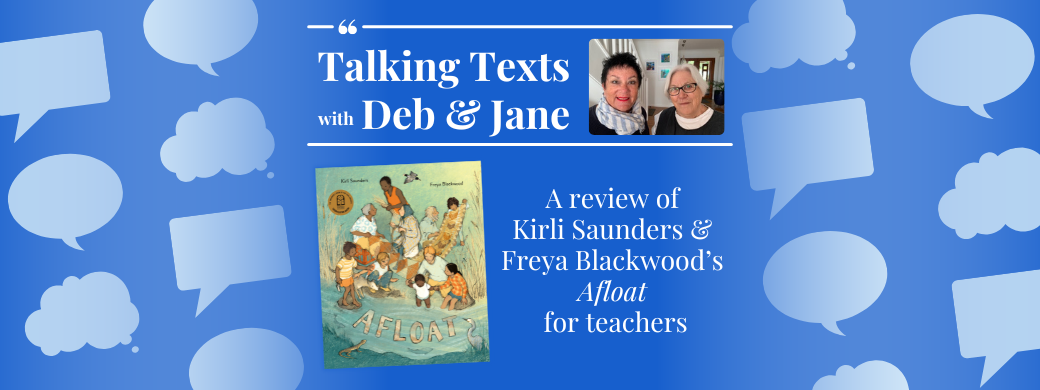
What is there not to love about contemporary picture books? When you add the joy and power of First Nations wisdom and the current concerns for our planet you realise this picture book—Afloat— should be in your classroom repertoire.
In the previous syllabus I was often drawn to the dual application of the term “sustainability.” It became a valuable lens for exploring texts about the environment but it was also used to refer to supporting each other. Afloat explores both ideas with power and sensitivity and highlights the importance of working and learning together which is not just about survival but nurturing, growing and indeed, as the last sentence of Afloat reiterates, the capacity to “thrive."
In her reflection, the writer Kirli Saunders says:
Afloat suits in the broader global context of the climate crisis. It is written for this time of rising seas, where First Nations peoples particularly are disposed of their homelands and displaced.
While I imagine Afloat will have currency in some primary schools, it will suit Stage 4 with its subtlety and First Nations Connection to Country.
I am a big fan of Kirli Saunders so please be sure to explore her other works especially the ones where she includes her other passion and skill- painting. Freya Blackwood is another star in the publishing world and her credentials are impressive.
Over the past decade there has been a huge growth in the number of picture books, graphic novels and digital texts suitable for students in years 7-10. You do not have to have full class sets of each text but a selection which can then be explored collaboratively.
Reading Australia has a resource pending on Afloat.

Kirli Saunders is a proud Gunai Woman, who excels in so many different creative fields. She has received many awards in Australia and overseas. Her books among others include Bindi, Kindred and Returning. In 2022 Kirli was awarded an Order of Australia Medal for her contribution to the arts. Kirli has partnered with global organisations including Google, Fender, Sydney Opera House, Qantas and Spotify, Mecca and Aesop to celebrate stories and cultivate change. Kirli’s artwork is extraordinary, and her paintings can often be found in galleries, online and in government commissions.
More details can be found on her site and on the red Room Poetry site:
Freya Blackwood was born in Scotland and grew up in Orange in NSW, Australia where she now lives with her daughter Ivy. After graduating in Visual Communications from UTS, Freya worked in the film industry. In 2002 Freya began illustrating picture books and has since won many prestigious awards, including the Kate Greenaway Medal in 2010. Freya talks about her studio and the books she has illustrated at her website: https://www.freyablackwood.com.au/about
Brief description of Afloat
Afloat uses the practice of weaving as an effective metaphor for representing the traditional cultural practices of First Nations which in turn both honours and acknowledges the importance of First Nations wisdom and understanding of Caring for Country. In the story an Elder guides a child along a waterway which flows from the natural landscape to urban, industrial areas. Walking together is both a shared experience and one to symbolise the importance of unity. Weaving is also used to symbolise collaborative experiences to encourage Peoples to work together for their common goals and aspirations and ultimately to build our capacity to not just survive, but to thrive.
Afloat has a place in a range of teaching and learning experiences. One of the delights of picture books is that they are rich in meaning but can be explored quite quickly and Stage 4 students can build their capacity to understand subtlety, richness and the power of combining written text and images.
Afloat could be part of a Representation focus which explores a range of texts which represent different perspectives on the world around us with a specific focus on the environment and on collaboration for future community efficacy. It could also be one of numerous texts which celebrate the power of Storytelling in First Nations culture and it would also suit a focus on the role and place of picture books to explore significant ideas and perspectives about people and communities.
The future of our planet is certainly a concern of adolescents, so it is important that the English classroom is a place to explore their concerns.
Mission Australia annually surveys young people about what matters to them. The 2025 survey is soon to be released but in 2024, Mission Australia surveyed 17,480 young people to learn about the issues that concern them most. 27% identified climate change and the environment as one of the most important issues in Australia.
This comment from Sharon Callister, Mission Australia CEO provides validation for such classroom exploration:
“The insights from our annual Youth Survey remain crucial for young people, their parents, educators, policymakers, community services and everyone who support them. By listening to their voices and addressing the issues they raise, we can work together to build a more inclusive and supportive Australia to grow up and thrive in.”
The survey also revealed that connecting with others can often be a barrier to well-being so texts like Afloat, which promote collaborative experiences, highlight the positives of interacting with each other, groups and communities.
You would not need to have a full class set as small groups could explore one copy between them. Students need to be encouraged that re-reading and revisiting a text is rewarded.
Now read with the class the two reflections at the back of the book.
Kirli Saunders’s reflections add important details for the reader including that “the text pays homage to cultural and plant knowledge handed down by our Elders. It honours women especially.” In addition, “Afloat is written with the knowledge that connection to our homelands, our Country, is paramount to our identity.”
Weaving is invariably a communal activity, so Kirli Saunders has been able to authentically link “weaving” to collaborating and indeed, yarning and talking. She plays with words when she says “Weaving is also a vehicle to yarn”- her play on words emphasises both to use yarn to weave and to talk.
We need to be mindful about making assumptions about our students’ knowledge about a range of topics including traditional crafts. (I recently had some HSC students misunderstand a graphic in their Trial HSC because they had no experience of knitting and knitting needles). It may be necessary to provide some background about weaving and what it involves. Freya Blackwood explains in her back cover reflection that:
“Gathering weaving references from all over the globe, I noticed similar patterns across different cultures … in carpets, baskets, clothes. Weaving really is an ancient practice that is very much part of every human’s life.”
Return to the text and re-read.
Freya Blackwood’s images evoke harmony within the natural world with soft blue-green shades and animals watching from the edge of the river. Both characters seem at ease in the river and the older woman is gentle in her guidance of the young boy who has started the process of collecting reeds for the weaving.
“Roam the water with me
We are here to learn.”
Two lines of written text will become the pattern and Kirli Saunders uses the plural second person as her narrative choice. Her words take on the imperative mood which in some texts can be a forceful command but in Afloat the tone is inclusive as the speaker unites the characters and in turn, the reader in the task. Also note the use of the verb “roam” which has a gentler modality than for example, “walk” or “travel”.
What does “roam suggest”? The last word- “learn” will become a key idea of sharing First Nations wisdom and knowledge.
Soon the landscape becomes entirely urbanised and industrialised suggesting that finding the natural fibres is going to be more challenging but they are necessary to weaving. There are tiny patches of the grasses at the edge of the river and the building digger remains a salient feature through its distinctive colour. Kirli Saunders’s deliberate choice of the verb “fuse” reinforces the concept of blending the fibres to create the artefact:
“Here to find the rushes,
To fuse the fibres.”
The people become the key image and their presence is now the most salient. They are all working together to both learn how to weave but also to talk with each other:
“To roll between finger and thumb.
To yarn.”
The older woman takes control of the weaving process and directs her people to:
“Take the string with me,
We are here to know and loop.”
The point of view created by Freya Blackwood is like an overhead shot looking down at the hands of the people all involved in different aspects of weaving and the collaborative experience is then reinforced that they are there not just to make their raft but
“to form bonds, to make ties.”
“To weld oneness
To unite.”
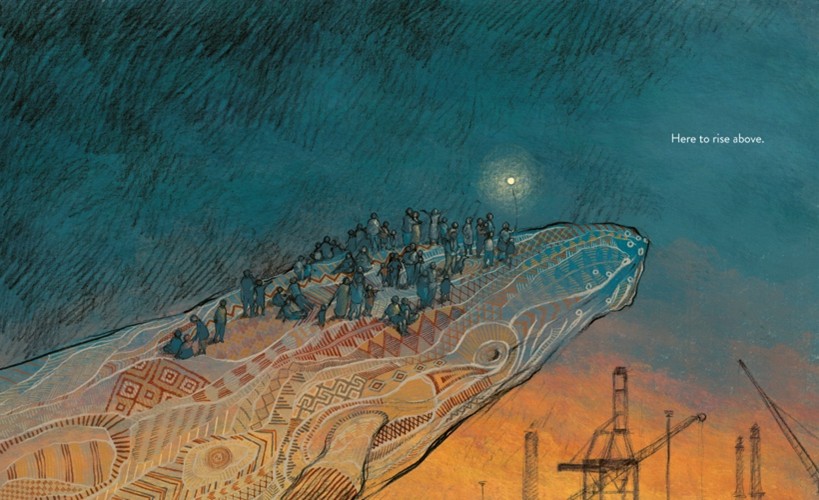
But it is the final page which captures the true message of this special picture book- it is not enough to survive- humanity must “thrive.”
Why does Kirli Saunders choose the word “thrive” and not, for example, “grow”, “live” or “nurture”?
In groups write another two sentences which would be suitable to add before the last two double pages. Echo the same structure and narrative voice as used by Kirli Saunders.
Share the sentences around the class and decide on which two would most authentically fit the narrative and why.
Here are three reviews for Afloat.
Form small groups and choose one of these reviews and respond to it in terms of how the quotation from the review captures the main idea of the text.
‘Hope is the ultimate takeaway from this moving story about community, First Nations wisdom and climate change.’ The Guardian
‘[Afloat] delves into themes of creating a future of balance and community with the natural world, while a slow, rhythmic tone and loose-lined illustrations emphasize saving what’s most important’ Publishers Weekly, starred review
‘Saunders (Gunai) uses weaving as a metaphor for community-building, demonstrating that Indigenous knowledge can be a source of connection and power as we work toward creating a better world. Blackwood’s art underscores hope and opportunities to help cultivate the land.’ Kirkus Reviews
1. In her reflection Freya Blackwood includes some insightful comments about the importance of research to our composing:
“As research, I followed the creek that runs by my house, which flows under a road via a concrete drain that disappears beneath the city centre before reappearing flanked by electric substations, industrial sites and rubbish.”
(a) Write your own imaginative piece of about 500 words which explores your own landscape. Include a visual for example, a photograph, a pen and ink drawing, a watercolour or oil representation.
Before you start writing be sure to do some research which could include actually walking in the landscape, using google maps or seeking information from Trove at the NSW State Library.
(b) After you complete your final draft write about 300 words on what research you used and how you translated that research to concrete detail.
2. Write to one of the large environmental movements like WWF and Greenpeace to persuade them about the important role of literature to grow awareness and understanding about the key issues of the future especially the sustainability of our planet and the sustainability of people.
In your persuasive text make close references to Afloat as a text which covers both types of sustainability. Reference two other texts which explore sustainability of the environment and/or people or both; for example, another picture book, song, speech, poetry, prose fiction.
Below is a list of texts which could be part of the students’ exploration and inclusion in this task:
Text requirements: Afloat is a picture book (multimodal text) by an Australian First Nations author and fulfils the requirements to give students experience of a range of types of texts inclusive of short prose, visual, spoken, multimodal and digital texts.
Looking for more classroom texts for Stage 4 students? Browse our Year 7 texts and study guides and Year 8 texts and study guides at Five Senses Education.
Concepts could include Representation • Perspective and Context • Theme.
A student uses a range of personal, creative and critical strategies to read texts that are complex in their ideas and construction EN4-RVL-01
Reading, viewing and listening skills
Reading, viewing and listening for meaning
Reading for challenge, interest and enjoyment
Reflect
A student analyses how meaning is created through the use of and response to language forms, features and structures EN4-URA-01
Representation
Code and convention
Connotation, imagery and symbol
Point of view
Narrative
A student examines and explains how texts represent ideas, experiences and values EN4-URB-01
Theme
Perspective and context
(English K-10 Syllabus 2022 © NSW Education Standards Authority for and on behalf of the Crown in right of the State of New South Wales, 2023)



Jane Sherlock and Deb McPherson are experienced and passionate English teachers. They have also been involved in the education sector as authors and presenters at teaching conferences.
$9.95 flat rate shipping or free over $110
Australian family-owned & sourced
Supplier to over 1,000 schools Australia wide