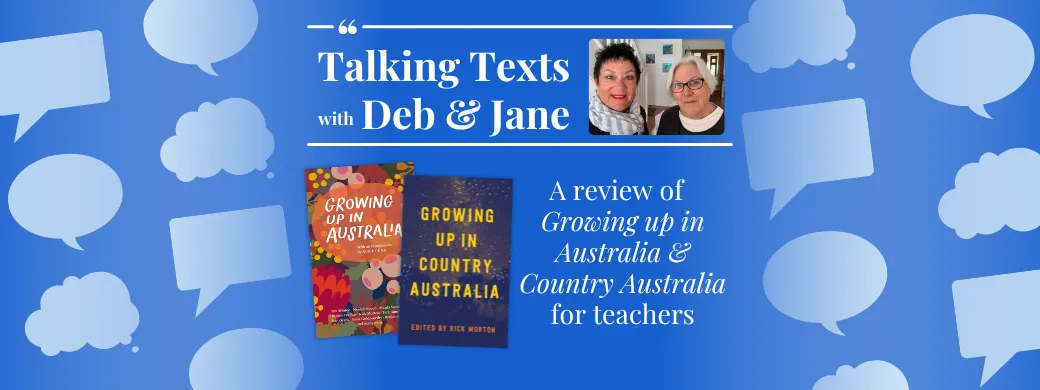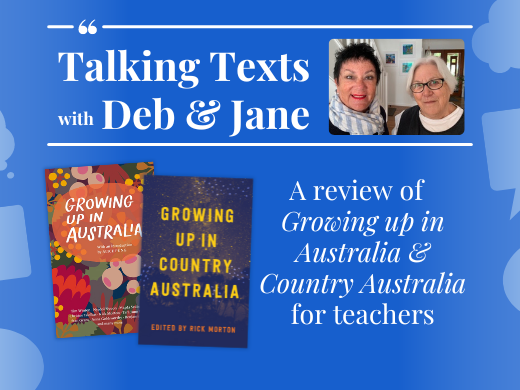
"Growing Up in Australia" & "Growing Up in Country Australia" review for teachers - Talking Texts with Deb & Jane #30"Growing Up in Australia" & "Growing Up in Country Australia" review for teachers - Talking Texts with Deb & Jane #30

Brief description and distinctive features

For Stage 5

I love these two collections.

I always found “growing up” stories would engage students, especially reluctant readers and/or those students who found our subject remote or irrelevant. Maybe it was the “appeal of the real” or seeing themselves in the evocative stories of billycarts and wild rides through Sydney suburbs as explored by Clive James or the joys of comics and Mars Bars on bleak Sunday afternoons in Tim Winton‘s Land’s Edge. Clive James may have lost some appeal but Tim Winton hasn’t and he appears in this collection. My examples are all a bit last century now, so these two collections from Black Inc. Books are a fabulous replacement.


Brief description of Growing up in Australia and Country Australia

The two texts are part of the popular and successful Growing Up series from Black Inc. 

Growing up in Australia and Growing up in Country Australia includes a diversity of writers explaining and exploring their own experiences of growing up in Australia. In the second collection, this is more specifically focused on “rural” Australia. 

Growing up in Australia contains 32 stories from a range of people including some your students will know like Stan Grant, Magda Szubanski, Benjamin Law, Tim Winton, Miranda Tapsell and Tara June Winch. This collection’s Introduction by Alice Pung provides an informative overview of the stories’ content and perspectives which has potential for close reading text and later, students could write their own introduction. 

Growing up in Country Australia contains 39 stories which focus on experiences outside Australia’s cities and larger regional centres. Students may not be as familiar with these writers but may know Annabel Crabb or Lech Blaine. Rick Morton’s introduction is engaging where he recounts his own experiences working in various newspaper jobs and developing his passion for journalism. He exhorts the importance and power of detail when re-telling a story and this is very much the appeal of this collection. One of my favourites in this collection is the clever and comical memoir about the mouse plague by Annabel Crabb.

Each collection features brief biographical notes on each writer.

These two collections would be excellent core texts for a range of units of work:

  • Voices of Australia: which voice? Whose voice? An exploration of different representations of the voices of Australia using a range of texts. Consider the ways such texts represent different perspectives like idealised, romaticised, urban, rural, refugee, migrant, First Nations. 
  • The Appeal of the Real: why and how nonfiction texts help us understand ourselves and make connections to others and the world. This unit could broaden to other  non-fiction texts including television interviews, interactive documentaries like SBS Cronulla Riots, bio-pics, websites on specific people, feature articles.
  • “Growing Up” as a narrative trope. Why are we attracted to stories of childhood, adolescence, change, rites of passage, bildungsroman?  
  • Celebrating the Stories in All of Us: memoir, narratives and storytelling. 

Distinctive features of Growing up in Australia and Country Australia

  • Each story is about 10 pages which enable it to be explored within a lesson 
  • 32 stories in Growing up in Australia; 39 in Growing up in Country Australia 
  • Contents provides title and authors
  • Well-known authors including some from popular culture
  • Introductions give valuable insights to the ideas of “growing up”
  • Biographical notes in the back are interesting and useful
  • Growing up in Country Australia includes a range of diverse voices e.g. Chinese migrant family in the Atherton Tablelands, Egyptian migrant in Alice Springs and powerful narratives from First Nations writers. 

Ways to use Growing up in Australia and Country Australia in the classroom

  • Engage students in discussion of the concept of “growing up.” Rick Morton says it is “exiting childhood” – is this all? What distinguishes “growing up” – what are the features of this experience? What kind of “growing” occurs? What is something you used to love doing or eating when you were in infants or primary school that you don’t anymore and why has this change occurred? 
  • How does childhood differ from adolescence and then, from adulthood?
  • Record this discussion for future exploration for students’ own writing: capture as a wall poster or google document or PowerPoint slides. 
  • Consider starting with a selection of stories from Growing up in Australia to read as a class and to explore the different ways each writer recreates significant experiences.
  • For the first one or two stories enjoy the reading and sharing experience. 
  • Before reading it might be engaging to contextualise the author with some images or even a brief clip from a television interview e.g. Miranda Tapsell.
  • In the selection of stories be sure to include some First Nations e.g. Miranda Tapsell, Tara June Winch, Stan Grant

Suggestions for initial stories

  • Tourism by Ben Law – the not-so-happy family experiences of holidays and theme parks.
  • Nobody Puts Baby Spice in a Corner by Miranda Tapsell about claiming her identity and navigating the challenges in her childhood. 
  • Perfect Chinese Children by Vanessa Woods is a self-deprecating view of growing up in her Chinese family in Sydney.
  • Selected Epistles by Olivia Muscat is a series of moving and poignant letters to different people in her life about the challenges of growing up as a blind person.  

Allocate one of these stories for individual analysis or in collaboration.

Make notes under these headings:

  • Title 
  • Relevance of title eg intertextuality, popular culture
  • Three to five key ideas of the writers’ experience
  • Three to five examples of language choices which you/your group found engaging
  • Your two favourite sentences.

Share the notes with the rest of the class on each story and add any other detail to enhance the notes.


Further reading and responding:

In the next choice of stories consider the capacity and interest of your students as some are more challenging than others.

Some ideas:

  1. Students to read the Introduction by Alice Pung or the biographies at the back: which other three stories would you now like to read?
  2. Explore in greater depth the following stories:
    • Talking to my Country by Stan Grant: Analyse how elements of Stan Grant’s personal, cultural and political contexts shapes his perspectives and representation of ideas.
    • A Portrait of an Artist as a Young Larrikkin by Lech Blaine is a colourful portrait of his parents and his childhood. Analyse the key ways that Blaine invites us into this specific world and expereinces of his own growing up. 
    • Land’s Edge by Tim Winton: In what ways does Winton draw us into his world of growing up in Western Australia? 
    • Don’t Touch Alcohol by Sara El Sayed: In what ways does the ending draw together the key ideas of this narrative?


Taking the text further:

A new Introduction

  • In small groups or individually write your own Introduction to one of the collections. In your introduction include an analysis of 4-5 stories. 
  • Consider the distinctive features of each story and what insights you gained to “growing up.” 
    • One of these stories should be written by a First Nations author. 

Imaginative Writing:

Exploring our childhood:

  • Ask students to bring something from when they were 10 (and teacher too if possible)  e.g. toy, favourite book and create a display
  • In groups brainstorm the transport your family used, any holidays you had, your favourite foods and toys and interests 
  • Each lesson to open with a five-minute writing activity related to an object or experience from your childhood—sometimes it can be the same object for the whole class and other times can be self-selected 
  • Choose a topic and write a series of short vignettes: pets, homes, holidays, camping, theme parks
  • Write a series of journal entries: Ages 7, 10 and now which captures your experiences over time of a family ritual or celebration 
    • Possibilities include: Christmas, Eid, Sabbath, holiday, family visits
    • Include specific features that capture 3 different contexts e.g. television shows, toys, food 
    • Aim to include detail to capture your own “growing up.”

Relevant details in relation to the new English 7-10 syllabus

Text requirements: Growing up in Australia and Growing up in Country Australia are collections which contain memoirs (non-fiction prose) by Australian authors. The narratives have cultural, social, gender perspectives and youth culture references and include literature by authors with diverse backgrounds and experiences, including authors with disability.
For more recommended texts suitable for Stage 5, explore our Year 9 texts and study guides and Year 10 texts and study guides.

Concepts could include Narrative • Perspective and context • Genre.


Outcomes and content for Stage 5

Reading, viewing and listening to texts

A student uses a range of personal, creative and critical strategies to interpret complex texts EN5-RVL-01

Reading, viewing and listening skills

  • Develop a deeper understanding of themes, ideas or attitudes by revisiting and reinterpreting texts to find new meaning

Reading, viewing and listening for meaning

  • Analyse the main ideas and thematic concerns represented in texts
  • Investigate how layers of meaning are constructed in texts and how this shapes a reader’s understanding and engagement
  • Clarify and justify personal responses to texts, explaining how aspects of the text, such as character, genre, tone, salience or voice, position a reader and influence these personal responses
  • Analyse how the use of language forms and features in texts have the capacity to create multiple meanings

Reading for challenge, interest and enjoyment

  • Read increasingly complex texts that challenge thinking, pique interest, enhance enjoyment and provoke a personal response
  • Engage in sustained and varied reading that presents increasingly diverse and complex perspectives and experiences, including those of Aboriginal and Torres Strait Islander Peoples, and respond in a range of ways, including through extended written response
  • Consider how the social, cultural and ethical positions represented in texts represent, affirm or challenge views of the world
  • Evaluate experiences of reading by sharing responses to texts
  • Evaluate the ways reading texts help us understand ourselves and make connections to others and the world

Reflecting

  • Reflect on how reading, viewing and listening to texts has informed and inspired learning
  • Reflect on how an appreciation of texts can be enhanced through re-reading, and close or critical study
  • Understand and reflect on the value of reading for personal growth and cultural richness
  • Use reading strategies, and evaluate their effectiveness, when reflecting on the successes and challenges of extended reading
  • Reflect on how reading promotes a broad and balanced understanding of the world and enables students to explore wider universal issues
  • Reflect on own experiences of reading by interacting with peers in meaningful ways about the value of reading

Understanding and responding to texts A

A student analyses how meaning is created through the use and interpretation of increasingly complex language forms, features and structures EN5-URA-01

Code and convention

  • Use metalanguage effectively to analyse how meaning is constructed by linguistic and stylistic elements in texts
  • Analyse how language forms, features and structures, specific or conventional to a text’s medium, context, purpose and audience, shape meaning, and experiment with this understanding through written, spoken, visual and multimodal responses

Narrative

  • Analyse how narrative conventions vary across genres, modes, media and contexts and how they can be used to represent ideas and values and shape responses, and apply this understanding in own texts
  • Explore how narratives can represent and shape personal and shared identities, values and experiences

Understanding and responding to texts B

A student evaluates how texts represent ideas and experiences, and how they can affirm or challenge values and attitudes EN5-URB-01

Theme

  • Analyse how themes can be understood to underpin cohesive meaning in texts, and apply this understanding in own texts
  • Appreciate the role of the audience in perceiving themes and how these themes can offer insights into an author’s perspective

Perspective and context

  • Understand how the personal perspectives of audiences are a product of historical and cultural contexts
  • Analyse how texts can be understood or interpreted from different perspectives, and experiment with this idea in own texts
  • Evaluate how texts can position audiences to accept, challenge or reject particular perspectives of the world, and reflect on this in own texts
  • Analyse how elements of an author’s personal, cultural and political contexts can shape their perspectives and representation of ideas, including form and purpose
  • Explain how texts affirm or challenge established cultural attitudes and values in different contexts
  • Appreciate the significance and value of expressions of cultural context in texts constructed using elements of languages and dialects, including Standard Australian English, Aboriginal and/or Torres Strait Islander Languages, and Aboriginal English

Expressing ideas and composing texts A

A student crafts personal, creative and critical texts for a range of audiences by experimenting with and controlling language forms and features to shape meaning EN5-ECA-01

Writing

  • Select and adapt appropriate codes, conventions and structures to shape meaning when composing written texts that are analytical, informative, persuasive, discursive and/or imaginative
  • Develop a personal and informed voice that generates ideas and positions an audience through selection of appropriate word-level language and text-level features
  • Experiment with language to create tone, atmosphere and mood
  • Use rhetorical language strategically and subtly to shape complex ideas and convince others of a point of view, as appropriate to audience and purpose
  • Use tense accurately and purposefully
  • Create engaging and authentic temporal and spatial settings for a range of purposes and audiences

Speaking

For students who are d/Deaf or hard of hearing, this will be through signing and/or speaking. For students who use other forms of communication to supplement speech, content should be taught through speaking (and listening) experiences, where appropriate, in combination with the student's preferred communication form.

  • Select effective rhetorical strategies to position an audience and evoke an emotional response
  • Craft a range of spoken, signed or communicated texts that convey complex ideas for specific audiences
  • Deliver spoken, signed or communicated texts with engaging use of intonation, emphasis, volume, pace and timing

Text features

  • Express ideas, using appropriate structures for purpose and audience, that reflect an emerging personal style
  • Introduce and define complex key ideas, academic concepts and positions for arguments in sustained analytical and persuasive texts
  • Use the structural conventions of analytical writing purposefully, including a well-articulated and considered thesis, a sustained and cohesive progression of supporting points, and a rhetorically effective conclusion
  • Use the structural conventions of imaginative texts purposefully, including shaping complex complications and conflicts, and crafting authentic characters, to depict ideas
  • Use the structural conventions of discursive texts purposefully, including the transition between personal and abstract texts, to present complex and nuanced ideas
  • Experiment with a range of poetic forms to explore ideas and express personal perspectives

Sentence-level grammar and punctuation

  • Select and justify the use of varied sentence type, length and complexity to support cohesion and for effect
  • Maintain subject–verb agreement, identifying the subject in collective nouns, extended noun groups or in extended complex sentences
  • Control the use of passive and active voice when crafting sentences for effect and to suit the purpose of a text
  • Craft concise sentences to suit text purpose
  • Craft elaborated noun and/or verb groups for effect, clarity or complexity of description
  • Apply punctuation to suit text purpose, support clarity and meaning, for effect, and to control reader response

Word-level language

  • Make vocabulary choices that enhance stylistic features of writing, and shape meaning through connotation

Expressing ideas and composing texts B

A student uses processes of planning, monitoring, revising and reflecting to purposefully develop and refine composition of texts EN5-ECB-01

Planning, monitoring and revising

  • Engage with model texts to develop and refine features, structures and stylistic approaches in own work
  • Research, summarise, evaluate and synthesise information and perspectives from different sources to generate new ideas and create detailed and informed texts
  • Develop an effective thesis for extended analytical and persuasive texts that is based on critical thinking about a text or topic
  • Produce co-constructed complex texts to represent a diversity of ideas and values

Reflecting

  • Reflect on own texts, using technical vocabulary to explain and evaluate authorial decisions appropriate to the target audience and specific purpose
  • Discuss the pleasures, challenges and successes experienced in the processes of understanding and composing
  • Evaluate the effectiveness of compositional choices in writing that have been influenced by elements of other texts, using specific examples
  • Evaluate own ability to plan, monitor and revise during the composition process, and how this can improve clarity, cohesion and effect


(English K-10 Syllabus 2022 © NSW Education Standards Authority for and on behalf of the Crown in right of the State of New South Wales, 2023)

Connecting texts

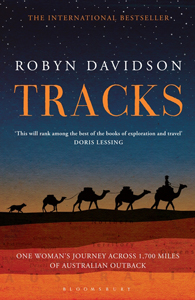
Tracks by Robyn Davidson