




Flat Rate Shipping
$9.95 flat rate shipping or free over $110

Aussie Owned
Australian family-owned & sourced

School Supplier
Supplier to over 1,000 schools Australia wide
For Stage 4
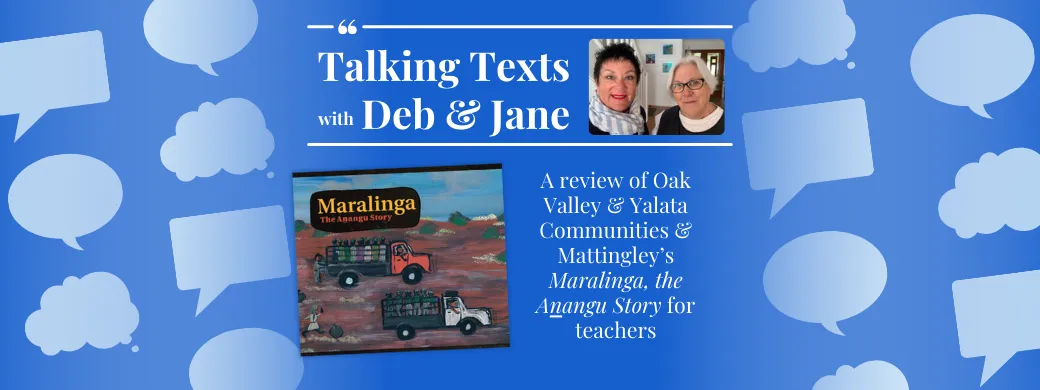
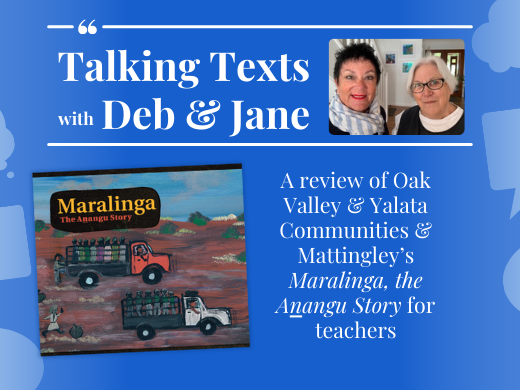
Maralinga: The Anangu Story is the result of a wonderful collaboration between two South Australian Aboriginal communities, Oak Valley and Yalata, and Christobel Mattingley.
Members of the Oak Valley and Yalata Aboriginal Communities, including Alice Cox, Margaret May, Pansy Woods, Mabel Queama, Marjorie Sandimar, Yvonne Edwards, Mima Smart and Janet May, worked as storytellers and translators, with award winning children’s author, Christobel Mattingley. Everyone met in planning and discussion groups to review the book’s progress. Workshops were held to create the artworks. Many voices contributed to this non-fiction, illustrated history of the Anangu. The picture book format combines words and images in a powerful and symbolic way to inspire critical and creative responses in Year 7 classrooms.
The Children’s Book Council of Australia made Maralinga: The Anangu Story an Honour Book in 2010. Maralinga: The Anangu Story also won the NSW Premier’s History Award (the Young People’s History Prize) in 2010.
Maralinga: The Anangu Story starts with a description by the Anangu (which means “people” in their Pitjantjara language) of their Country, and their custodianship and connection to it. That custodianship and connection with Country was fractured following the arrival of European settlers. The coming of the railway depleted Yuldi (the Ooldea Soak), a natural water source, and damaged the natural environment. A United Aborigines Mission was established, as the Anangu were dispossessed of lands and culture by the invasion of colonists and settlers. In the 1950s the Australian government rescinded Ooldea’s status as an Aboriginal reserve and allowed the British government to test atomic weapons at Maralinga. Anangu were forced south to areas outside of their traditional lands. The Anangu called the radioactive fallout from the tests the ‘black mist’. Some Anangu families were exposed to the fallout, which caused serious health problems. Many of those who were sent away suffered homesickness for their traditional lands.
A royal commission was set up in 1984 to investigate the British nuclear tests in Australia and compelling testimony was given by Anangu and others who had suffered from the contamination and fallout of the atomic bombs. Anangu lands were finally returned to the original owners in 1985, and some people could return to Oak Valley.
The Anangu people now live in both Yalata and Oak Valley. In the final chapter of the book called ‘We have survived’ there is some optimism about the future and the Anangu make an appeal to all Australians to know and understand their history.
Read Cara Shipp’s Listening from the Heart: Rewriting the Teaching of English with First Nations Voices (2023) to explore better ways to engage with First Nations People and their stories, their history and culture and to understand the protocols and appropriate terminology to use when reading and studying texts by First Nation authors. This warm, wise and generous book will be a huge help in the classroom.
It is important clarify with students that Maralinga: The Anangu Story is part of a broader history of First Nations people in Australia. They have lived here for at least 65,000 years and their land was never ceded. The Australian Institute of Aboriginal and Torres Strait Islander Studies (AIATSIS) website has some valuable resources about the history of First Nations people.
The site also offer guidance in selecting and evaluating texts and resources to use in the classroom. Of particular use is the Guide to evaluating and selecting education resources.
The resource has an excellent diagram which distinguishes texts and resources as:
For example, “by mob” would be texts created by First Nations composers e.g. Bindi by Kirli Saunders. Maralinga: The Anangu Story is an example of “with mob” where a collaboration has occurred between Indigenous and non Indigenous people.
An interesting article about how a librarian and her First Nations colleague at Byron Bay High School created spine labels reflecting this classification can be found online in Connections Issue 127, a quarterly school library magazine by SCIS.
Maralinga: the Anangu Story begins with the Tjukurpa – the story of the land, the Anangu love of their land and their care for Country long before the invasion came. The book ends with the aspirations and dreams of young Anangu and with an inclusive and positive reason for the “with mob” collaboration.
“Maralinga – the Anangu Story is our story. We have told it for our children, our grandchildren and their children. We have told it for you.”
The first image on the title page is a photograph of Anangu land and the final image (before maps, glossary and acknowledgements) is a photograph of the land with a rainbow above it.
Task: In groups students reread pages 1-7 and pages 65-66. Then discuss the following questions:
Wiltja (meaning “shelter”) Hostel for Aboriginal students is a place young Anangu can stay who need to go to Adelaide to complete secondary school. The hostel has three mottos:
In groups record your responses to the following questions
Present the results of your discussions in a summary for the rest of the class.
The artwork of Maralinga: the Anangu Story is colourful and vibrant and adds greatly to the story the Anangu are telling.
Task: In pairs go through the text and categorise the different types of artwork and layout used by the artists. List the dominant colours used and consider why the artists selected them. Select the images that you both think were most appealing and important in representing the Anangu story. Write a short statement or citation that explains your choices and contribute it to an art summary to be displayed on the classroom wall.
Context: In 1945 the United States of America used atomic weapons for the first time in warfare when they exploded atomic bombs over two Japanese cities, Hiroshima and Nagasaki, to bring the Second World War to an end. These weapons resulted in a catastrophic loss of life, mass destruction and radioactive fallout which led to disability and death, over a long period, for many survivors.
Sadako and the Thousand Paper Cranes (1977) is a short novel by Eleanor Coerr. It is based on the life of a real young Japanese girl called Sadako who was two when the atomic bomb fell. The story opens when she is twelve and discovers she has leukemia, like so many other survivors of the bomb blast. Sadako and her friends make paper cranes as there is an old legend that making them will make a person healthy again. Sadly, Sadako does not survive but she, and her cranes, became a symbol of peace and a monument was built to her in Hiroshima Peace Park. This beautiful and powerful story could be a companion read to Maralinga: the Anangu Story for students as the Anangu also suffered from the fallout from the testing of atomic bombs on their traditional lands. Alternatively, the teacher could read this short novel aloud to students.
John Hersey’s Hiroshima (1946) is an account for older readers about how six survivors experienced the atomic bombings and their aftermath. They represent the over 100,000 who died instantly. Many more would follow. This clear and slender classic of journalism shows us humanity at its worst and its best and makes for unforgettable reading.
The testing of atomic weapons at Maralinga in the 1950s was an extraordinary event in Australian history. Our government permitted another government to test their atomic weapons on traditional Aboriginal lands. In 1952 senior Australian scientists sent a memo to the Australian Prime Minster, Robert Menzies, stating that ‘no living beings will suffer injury to health from the effects of the atomic explosions’. This statement contrasts markedly with the subsequent McClelland Royal Commission on fallout from the atomic explosions, and the horrifying consequences for Indigenous people in the centre of the fallout area. Consider what Christobel Mattingley, who died in 2019, said in a 2009 interview:
I hope [the book] brings into recognition the terrible injustices against these people. The Maralinga land is a poisoned chalice and they are still suffering. The land is heavily contaminated and the health of the Aboriginal people both in and around Maralinga is still very badly affected…until people understand the deep spiritual relationship that Aboriginal people have with their land, we can never understand the pain and the suffering that our occupation of this land has caused.
(August 12 2009, Australian Women Online blog)
The following trusted sources of information in Australia contain information about the Maralinga atomic testing.
Task: In groups look at these sites and identify corroborating information that supports the perspective of the Anangu about the contamination of their land and the injustices they faced.
Text requirements: Maralinga: The Anangu Story is a non-fiction multimodal text by Aboriginal and/or Torres Strait Islanders and a non-indigenous Australian author.
Looking for more classroom texts for Stage 4 students? Browse our Year 7 texts and study guides and Year 8 texts and study guides at Five Senses Education.
Concepts could include Representation, Perspective and context, Connotation, imagery and symbol
Representation, Perspective and context, Connotation, imagery and symbol
Representation
Connotation, imagery and symbol
Perspective and context
(English K-10 Syllabus 2022 © NSW Education Standards Authority for and on behalf of the Crown in right of the State of New South Wales, 2023)


Jane Sherlock and Deb McPherson are experienced and passionate English teachers. They have also been involved in the education sector as authors and presenters at teaching conferences.
$9.95 flat rate shipping or free over $110
Australian family-owned & sourced
Supplier to over 1,000 schools Australia wide