




Flat Rate Shipping
$9.95 flat rate shipping or free over $110

Aussie Owned
Australian family-owned & sourced

School Supplier
Supplier to over 1,000 schools Australia wide

For Stage 4
Every year we are confronted with more challenges to the fragility of our planet. During the devastating bushfires of 2019 and 2020 there was an alarming observation about the millions of animals killed from the bushfires and how many of these animals are now at further risk. Global warming is impacting habitats and ecosystems are in peril.
The last known surviving thylacine died in Hobart Zoo in 1936. While it was not a victim of global warming some scientists blame human activity, while others suggest that increasing numbers of the dingo was responsible. Dingoes were introduced to Tasmania and at almost twice the size, female thylacines were quickly susceptible to the dingoes’ predatory habits. Also, the thylacine was such a rare species it was in demand by zoos and other such institutions all over the world which increased its removal from Tasmania. The loss of the thylacine is a story that moves us to think of the consequences of such destruction and extinction. Indeed, “a loss of one species is a loss for all.”
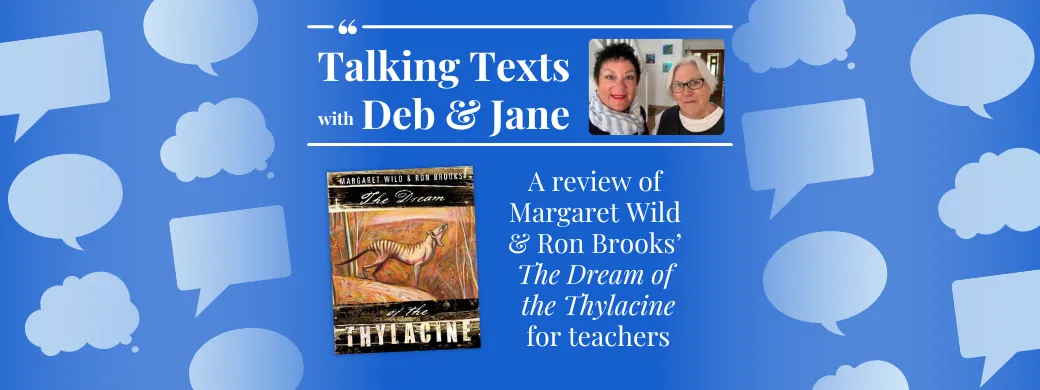
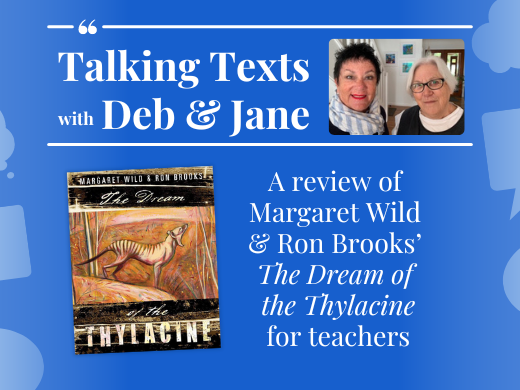
The Dream of the Thylacine is one of my favourite picture books for adolescents. It is beautifully produced; the written text is powerful and it is a rich text for exploring the powerful and relevant concept of representation. Also, this is a wonderful text to showcase the power of picture books for adolescents. Over the past decade there has been a huge growth in the number of picture books, graphic novels and digital texts suitable for students in years 7-10. You do not have to have full class sets of each text but a selection which can be explored collaboratively. Be sure to ask your librarian for a selection of effective picture books and digital texts.
The creators of The Dream of the Thylacine, Margaret Wild and Ron Brooks, have previously collaborated on texts that explore nature and sustainability. You might have encountered their other picture book, Fox, which is a powerful portrait of the relationship between animals and their environment.
Margaret Wild is one of Australia’s highly regarded writers for young people. She was born in South Africa and came to Australia in 1972. She has been a newspaper and magazine journalist, and a book editor in children’s publishing. Wild now writes full-time, and her books, which are published around the world, have won numerous awards.
Ron Brooks is the illustrator of the text. He has written, designed and illustrated picture books for over thirty years, and has won several awards.
Allen and Unwin have an excellent set of Teachers’ Notes on The Dream of the Thylacine - download the PDF here.
In The Dream of the Thylacine, Margaret Wild and Ron Brooks tell the story of a captive thylacine that longs for its freedom in the ‘wild lands.’ This is its dream which echoes the title. The story is told from the point of view of the thylacine and opens with the animal prowling, raging and growling in its cage of concrete and twisted wire. The story moves between the natural landscape of the tiger’s dreams and the despair of its caged existence.
The Dream of the Thylacine combines printed text and images to represent the thylacine’s story. Margaret Wild’s words are laid over a background that Ron Brooks has created using old photographs and film stills of the last surviving captive animals. The stills show the thylacine confined in a small concrete and wire enclosure, anxiously pacing.
The Dream of the Thylacine would suit a wider unit of work which uses the textual concept of representation as a core concept to explore a range of texts. The unifying idea could be “Nature in Peril” or if you want to be more provocative in your class exploration, a focus idea like “Our World is Burning” would be powerful.
The aim would be to explore how various forms, modes, features and language choices position the reader/viewer to consider the ways specific ideas are represented on your chosen topic. A selection of a range of different forms would best suit this unit so students can see the richness of representation.
Other texts could include:
A third unifying focus could be: Picture Books Have Grown Up. This unit could explore picture books as a genre and how popular they have become in the world of young adult publishing. Students could explore The Dream of the Thylacine and consider two others as a class and collaboratively explore another two texts. The focus could be how these texts have become powerful and compelling texts for adolescents to explore important ideas about how we interact with the world around us. A digital essay or feature article would suit an individual or collaborative task.
Picture books to suit this focus could include:
Class or group discussion through verbal questions, or a poster, or a PowerPoint of key questions accompanied by images which represent situations like animals at risk, the ivory trade, supertrawlersand fishing, deforestation.
Some questions to pose and provoke initial discussion:
What do we know about the thylacine?
Group brainstorm on what students know about the thylacine or group “power” research activity e.g. you have 60 seconds to use your preferred search engine to discover 5 points about the thylacine.
Build up a class fact sheet on the thylacine.
Share this brief clip which is rare footage of the last thylacine in Hobart Zoo
Consider the best way to initially share the story: perhaps in small groups or as a full class.
Students need time to explore the power of the images as well as the poignancy of the poetry.
In groups, students could record their initial observations, and after some close examination of the text, the teacher could share the points below with the class and ask for any other features:
Open each point with:
Did you notice?
OR
The composers have deliberately chosen this feature as part of their representation of the thylacine’s plight to engage our empathy and understanding of the fragility of our world:
In Stage 4 it is important to build the skills of sophisticated visual literacy including the appropriate metalanguage.
Share this analysis as a model for analysing visual texts:
The pages depicting the tiger standing ‘in glory at the edge of the cliff’ feature the strong orange and yellow of the rockface with bold red outlines of the rocks. It is like a wide-angle camera shot from a film, and Brooks’ landscape is expansive and stunning. These strong colours help draw our eye to the proud tiger who is the salient image on this page. In visual texts, we use the term ‘salience’ to refer to the most prominent feature or striking image that draws our attention, and this is usually the main element of the text. Brooks uses acrylic paints to add texture and a luminosity to his images. His powerful colours suggest the energy of the earth and the interaction of the wild thylacine with its natural environment. These bright and colourful pages are in stark and poignant contrast to the reality of the thylacine who is ‘trapped’ and ‘ailing’ and is a ‘shadow’ of itself.
Divide the class into small groups and allocate a section of the book to each group.
Each group is to create a presentation where specific features of Wild’s poetry and Brooks’ images are explained as examples of representation of their ideas.
Groups can share their findings with the class and ask for contributions.
Text requirements: The Dream of the Thylacine is a picture book (multimodal text) by an Australian author and fulfils the requirements to give students experience of a range of types of texts inclusive of short prose, visual, spoken, multimodal and digital texts.
Looking for more classroom texts for Stage 4 students? Browse our Year 7 texts and study guides and Year 8 texts and study guides at Five Senses Education.
Concepts could include Representation, Perspective and Context, and Theme
A student uses a range of personal, creative and critical strategies to read texts that are complex in their ideas and construction EN4-RVL-01
A student analyses how meaning is created through the use of and response to language forms, features and structures EN4-URA-01
A student examines and explains how texts represent ideas, experiences and values EN4-URB-01
(English K-10 Syllabus 2022 © NSW Education Standards Authority for and on behalf of the Crown in right of the State of New South Wales, 2023)




Jane Sherlock and Deb McPherson are experienced and passionate English teachers. They have also been involved in the education sector as authors and presenters at teaching conferences.
$9.95 flat rate shipping or free over $110
Australian family-owned & sourced
Supplier to over 1,000 schools Australia wide