


Flat Rate Shipping
$9.95 flat rate shipping or free over $110

Aussie Owned
Australian family-owned & sourced

School Supplier
Supplier to over 1,000 schools Australia wide

For Stage 3 and Stage 4
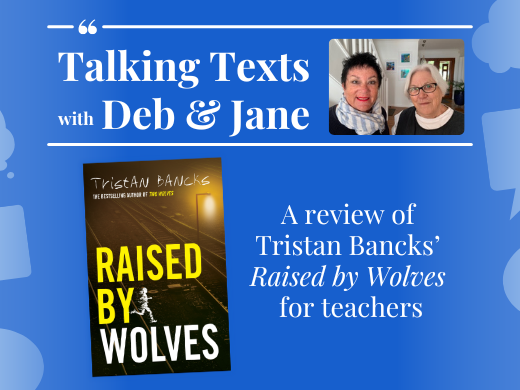
After previously enjoying (and reviewing) Scar Town and Detention by Tristan Bancks, I was keen to read his latest novel, Raised By Wolves, a sequel to Two Wolves which was published in 2014. Raised by Wolves did not disappoint and many of the distinctive features that Bancks uses so well in his other books are well represented in this novel. Bancks has such a direct and authentic way of engaging the reader; social realism is a powerful player in this novel and this new novel immediately hooks the reader with quick action, confronting circumstances and a terrible decision by the main character. Then the reader spends the rest of the book trying to keep up with his characters, Olive and older brother Ben, during a perilous night as they run full tilt after their fugitive father.
In his Author’s Note at the end of the novel Bancks explains that during school visits, students asked him what happened to the characters after the end of that original novel and he said he really had no ideas. But he decided to plan a sequel and he ‘loved being back in the Two Wolves universe, seeing the world, this time through the eyes of Olive five years on from the first book.’ Students can certainly read Raised By Wolves as a stand-alone novel, but knowing that Two Wolves has sold over 100,000 copies, you will be in good company if you pick up both books for the classroom.
About the author
Tristan Bancks is a children’s author who has also worked in acting and filmmaking. His books include Two Wolves, The Fall, Detention and Scar Town. Two Wolves was the winner, of the KOALA & YABBA Children’s Choice Awards and an Honour Book for the Children’s Book Council of Australia in 2014. It was also shortlisted for the Prime Minister’s Literature Awards. Detention won the YABBA & KOALA Children’s Choice Award, it was a 2020 CBCA Book of the Year Younger Readers Notable Book and was on both the Australian Book Industry Awards Shortlist NSW Premier’s Literary Awards Shortlist. Scar Town was named the Children’s Book Council of Australia’s Book of the Year for Younger Readers in 2024.
Twelve year old Olive is at high school while Ben, her older brother, is soon to graduate from the Police Academy. She remembers far too clearly that time five years ago when she and her family were on the run from the police, a story that is told in the novel, Two Wolves. Her father was a delinquent adult and a thief in Two Wolves and is still on the run. Even now, Olive checks the apartment with a knife in her hand when she gets home from school to where she and her mother live, scared her father may have returned. So when she sees her fugitive father, Ray Silver, outside her school she is shocked. She is also desperate to know if he loves her, despite all the pain and anxiety he caused her when she was little. She intervenes to help him when she sees him being beaten up, has a conversation with him and offers to help cover his debts with some of the money he stole, as she knows her mother has it stored in the roof. She heads home carefully checking he is not following. But then her father turns up, says he loves her and wants to come inside. Olive is twelve and confused. Should she listen to her mum who warned her never to let his father in if he turned up at the door or should she listen to the man who says he loves her and seems changed. Olive makes a bad choice and lets him in. Bancks says in his Author’s Note this chapter was the first scene that he imagined for the book and it is Olive’s decision which sets the subsequent frenetic action in motion. Her father takes the money, pushes her away and runs again. Olive is devastated and furious with herself for being tricked by him. Follow him is her thought. She runs out after him into the night. What follows is eight hours of non-stop action as first Olive and then later Ben, try to find their father. As they pursue him they wrestle with each other and their own emotions with whether to punish him, just get the money back or let him escape again and in the process they came to better understand their own identities and values and their bond as siblings. It’s a powerful tale in equal parts exhausting and confusing, with some violence but with a steely determination and a strong sense of right and wrong from its young protagonist that has a compelling conclusion that will create real discussion in the classroom.
There are a variety of teaching possibilities available with Raised By Wolves including a single novel close study of fiction, a two book close study, a four book author study or a genre study as the novel contains so many elements of the thriller genre or detective story to explore and discuss. See my reviews of Scar Town and Detention on the Five Senses blog for more ideas on Tristan Bancks’ novels. The activities below consider a two book study of both original novel Two Wolves and the sequel Raised By Wolves.
Distribute fifteen copies of both books. Half the students could read Two Wolves and the other half read Raised by Wolves and then swap over and ask students to rate the novel they liked the best. What follows are some ideas that deal with the original book and the sequel but many of the activities could be adjusted to fit a single close study for Raised By Wolves. A brief précis of Two Wolves will aid you in deciding what approach you want to take.
Two Wolves starts with a police force visit when seven year old Olive and her brother, thirteen year old Ben are at home. The police want to know where their parents are and search the house and then leave to find them. The parents, Ray and April arrive home soon after and bundle the kids into the car saying they are taking them for a ‘holiday’ at Ben’s grandfather’s empty cabin in the bush. Ben tries to work out what has happened and while deeply scared of his father, keeps asking questions. He keeps a note book which his father reads and is enraged by, as Ben has started to work out his father has stolen a huge amount of money. The children are left alone by their parents at the cabin and Ben plans to escape but Ray and April return, only for all the family needing to escape as the police descend on the cabin. Both Ben and Olive are lost in the bush for days and Ben finally carries his exhausted sister back to the cabin. More plot twists and turns eventuate until a year later there is a final physical and moral confrontation in the bush between Ben and his father over the stolen money. Ben has found a principled and physical resilience as he supports his mother and sister and settles his own ethical dilemma as he feeds the right wolf from the novel’s epigraph.
Ask students to compare the two covers looking for similarities and differences. They should consider images, colour scheme, typeface and the atmosphere and mood created by the cover. Look at the two titles and discuss the similarities and differences.
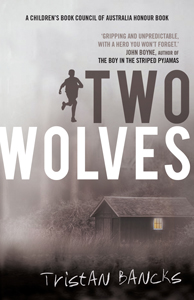
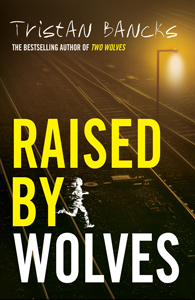
Epigraphs are always a valuable way in to a story. Introduce epigraphs to the class as any short quotation or phrase that the author deliberately places at the start of their work to set a mood or a theme or to suggest the concepts underlying the work.
In Two Wolves the epigraph Bancks has chosen has also supplied the title. He selects the story of an elder and two wolves, a meme of legendary status often attributed to First Nations American culture but having a wide use in literature when people want to consider the inner conflict in humans, their battle between good and evil, or for example, between bad human attributes and experiences: pride, envy, jealousy, greed, guilt and self-pity, and good attributes: kindness, hope, love, service, truth and humility.
In Raised By Wolves Bancks chooses the work of a noted American philosopher and writer, Ralph Waldo Emerson, and draws the reader’s attention to the battle within us again, and stresses the importance of what lies within us, what we are capable of (our values and morality and capacity for empathy ) in comparison to what we have experienced before and what lies for us in the future.
Group task: Ask students to predict what might occur in the novels based on the covers and the epigraphs.
Epigraph for Two Wolves
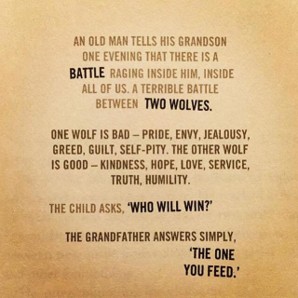
Epigraph for Raised by Wolves
|
‘What lies behind us and what lies before us are tiny matters compared to what lies within us.’ Ralph Waldo Emerson |
Task: In groups ask students to fill in the table below (some entries have been started) and to add other categories that could be compared.
| Focus | Two Wolves | Raised by Wolves | Comments |
| Chapters | Thirty eight quick fire chapters | Thirty eight quick fire chapters | |
| Point of view | Third person from Ben’s point of view | Third person with Olive’s point of view | |
| Length | 288 pages | 215 pages | |
| Opening line | ‘You keep runnin’, you’ll only go to jail tired,’ Ben Silver muttered. | Olive knows the man is watching her even before she wipes the foggy classroom window. | |
| Final line | For the moment the terrible battle was done. | Olive takes one big, bright breath, races down the stairs to join them and they head off into the city, together. | |
| Major plot twists / cliff hangers in the books |
|
|
|
| Setting | In the bush | In the suburbs and the bush | |
| Language techniques employed by the author |
|
|
|
| Characterisation | Ben as main protagonist, fierce protector of his sister | Olive as main protagonist, Ben as a protector | |
| Clues and mysteries | Ben’s notebook with his record of clues | ||
| Themes |
|
|
|
| Examples of the epitaph ideas | |||
| Add other categories |
In Two Wolves Olive is seven and Ben is thirteen. Care and antagonism are balanced in their sibling relationship and they share a delinquent parent and a mother conflicted over keeping the family together and acknowledging the criminality of her husband. In an interview with Good Reading Magazine Bancks writes of Ben’s thoughtfulness and Olive’s fire and the way he tries to protect his younger sister.
In Raised by Wolves Olive is 12 and Ben is eighteen. He still tries to keep her safe and talk sense into her and Ben has her back, even though he can’t control her. Bancks says Raised by Wolves was written in response to school students’ inquires about what happened to Olive, questions about whether the dad gets punished for what he did and whether Ben gets to become a cop. He delivers on all those questions that students raised with him.
Group Task: In groups create a profile for each character in each book. Also consider how much agency that is their development of an identity and sense of belonging and the power they have to fulfil their potential, and how that increases in Raised By Wolves.
| Characterisation | |||
| Olive Silver | Evidence from Two Wolves aged 7 | Evidence from Raised by Wolves aged 12 | Comments |
| Looks like / clothes | |||
| Personality | |||
| Greatest strength | |||
| Biggest fear | |||
| Agency | |||
| Relationship with brother | |||
| Relationship with mother | |||
| Relationship with father | |||
| Characterisation | |||
| Ben Silver | Evidence from Two Wolves aged 13 | Evidence from Raised by Wolves aged 18 | Comments |
| Looks like / clothes | |||
| Personality | |||
| Greatest strength | |||
| Biggest fear | |||
| Agency | |||
| Relationship with sister | |||
| Relationship with mother | |||
| Relationship with father | |||
In an interview for Good Reading Magazine, Bancks explains what he hopes readers experience when the read the novel:
I hope they lean in. I hope they can’t help but want to know what happens next. I hope they care about the characters and relate to some of the thoughts the characters have and the actions they take. Because even though Olive and Ben are in a terrible situation with some diabolical people, I hope the characters feel authentic and flawed and honest and that they make readers wonder, ‘What would I do if that happened to me?’
Ask students to discuss in groups the choices both Ben and Olive make in both books and how they would answer the question ‘What would I do if that happened to me?’
One of the best things about Tristan Bancks books are the excellent teaching resources provided. He really is a great friend to teachers and students. There are no Raised by Wolves resources as yet published, but look out for them. Two Wolves has excellent and extensive resources available at https://www.tristanbancks.com/2016/02/750.html
There is a terrific book trailer at https://www.youtube.com/watch?v=36e5BeuTIgY
A newsreader reads out an incident of missing children and the parents needing to be questioned by police. It would make a wonderful introduction to the novel for students to hook them into wanting to read the novel. There is also a Reading Australia unit by Claire Gluskie available at https://readingaustralia.com.au/books/two-wolves/
In 2018 BANG! Academy of Performing Arts, adapted Two Wolves for the stage by combining physical theatre, visual effects and an engineered soundscape. The five minute trailer would give students some ideas of the how the novel might transfer to the stage. The back projections of the car ride capture the escape for ‘the holiday’ which turns out to be no such thing. https://www.bangacademyofperformingarts.com/twowolves
Text requirements: novel, Australian author
Concepts: narrative • characterisation
A student analyses representations of ideas in literature through narrative, character, imagery, symbol and connotation, and adapts these representations when creating texts EN3-UARL-01
A student analyses representations of ideas in literature through genre and theme that reflect perspective and context, argument and authority, and adapts these representations when creating texts EN3-UARL-02
Narrative
Characterisation
Theme
Perspective and context
A student fluently reads and comprehends texts for wide purposes, analysing text structures and language, and by monitoring comprehension EN3-RECOM-01
Reading for interest and wide purposes
Text requirements: Raised By Wolves is a novel (extended prose) written by an Australian author and includes a range of cultural, social and gender perspectives.
Concepts could include narrative • characterisation • genre
A student uses a range of personal, creative and critical strategies to read texts that are complex in their ideas and construction EN4-RVL-01
Reading, viewing and listening for meaning
Reading for challenge, interest and enjoyment
A student analyses how meaning is created through the use of and response to language forms, features and structures EN4-URA-01
Characterisation
Narrative
Genre
(English K-10 Syllabus 2022 © NSW Education Standards Authority for and on behalf of the Crown in right of the State of New South Wales, 2023)


Jane Sherlock and Deb McPherson are experienced and passionate English teachers. They have also been involved in the education sector as authors and presenters at teaching conferences.
$9.95 flat rate shipping or free over $110
Australian family-owned & sourced
Supplier to over 1,000 schools Australia wide