




Flat Rate Shipping
$9.95 flat rate shipping or free over $110

Aussie Owned
Australian family-owned & sourced

School Supplier
Supplier to over 1,000 schools Australia wide

For Stage 3
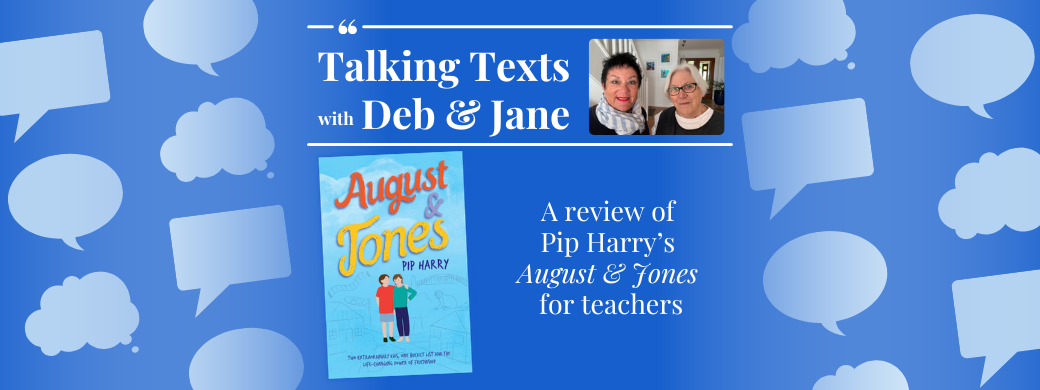
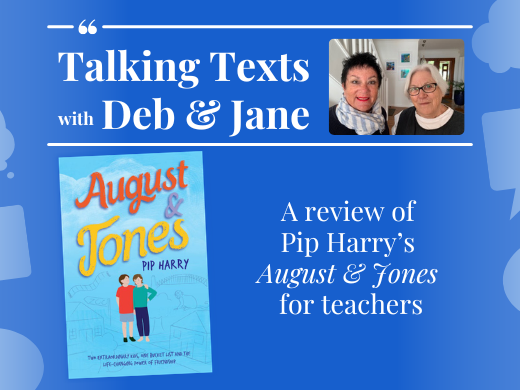
August & Jones has an unconventional title which introduces two wonderful eleven year old characters: Jones Kirby (she has her mother’s surname as her given name) and August Genting, known as Gus. This captivating book focuses on friendship: it’s about moving to the city from the country, leaving friends behind, being friendless, and then finding friends and keeping them. It is also about courage and resilience and dealing with some very serious stuff such as cancer and divorce and depression but the author does so in a warm and wonderful narrative.
August & Jones would be an excellent text for students to read and explore in the classroom in Stages 3 and 4, but would be perfect in the Year Five classroom, as students will identify with August and Jones’ real and authentic experiences in Year Five at their school Oakwood Primary. This is a tough and tender tale with true grit.
Pip Harry had an extraordinary inspiration for her story August & Jones as she explains on her webpage:
In 2019, I read a newspaper story about Victorian children Mathilde Cross and Jarrah Podesta in the Sydney Morning Herald ‘Two of Us’ column. Jarrah explained how he had lost his sight to retinoblastoma, a rare eye cancer, and how Mathilde had become his best friend and guide at school. They were funny and sweet and like many other readers, I was struck by their beautiful, supportive friendship, resilience, kindness and courage.I thought at the time that a middle grade novel that could portray a bond like these two remarkable kids shared would be very special. I didn’t think I’d write it!In telling the story, I embarked on extensive medical research into children’s eye cancer, vision loss and blindness, talking to paediatric oncologists and a children’s cancer researcher. I also worked with sensitivity reader and writer, Olivia Muscat, who loved the story, but offered invaluable advice on what she describes as the “ins and outs” of being blind and living with disability. If anyone needs a brilliant consulting reader Olivia can be found on her website oliviamuscat.comIt wasn’t until I had a finished rough draft that I approached the Cross and Podesta families to tell them Mathilde and Jarrah had loosely inspired the characters of August and Jones. I wanted to be certain it would be published and ensure my research was spot on. I heard back very quickly and both families were thrilled and very supportive of the book. Mathilde and Jarrah (now in high school) have both read the book and made a few editorial suggestions that I was able to incorporate! We all launched the book together at Castlemaine Library in 2022.
Pip Harry is an Australian author, journalist and copyrighter. She won the 2020 Children’s Book Council of the Year award for Younger Readers with her novel The Little Wave which was inspired by the real life Stewart House which supports country children and the Beach to Bush surf education program. August & Jones was shortlisted for the Children’s Book Council of the Year award for Younger Readers and won the 2023 CBCA Shadow Judging Book of the Year (Younger Readers). In 2023 Pip Harry has four new books coming out in 2026. Camp Spooky, (March, 2026), The Fast Lane (May, 2026) and The Goodbye Tree (July 2026). Pip says she is “passionate about ocean and pool swimming, reading fabulous Australian children's and YA books, travelling, children's literacy, gelato and chocolate”.
The novel is narrated by two eleven year olds in alternate chapters. It opens in the country as Jones’ family prepare to leave their beloved farm which has been drought stricken and move to the city to live in an apartment. It’s quite a wrench, especially for Jones who has lost one eye to retinoblastoma (a cancer of the eye) and is now worried that her vision is diminishing in her remaining eye and that perhaps the cancer has returned. The new place in Sydney is small and there is a new school to go to while leaving friends has been difficult for Jones. Gus takes up the story as he struggles to deal with his father’s pressure to play football and the increasing problems between his parents. He is keen to make a friend. The teacher asks him to show Jones around and the pair do become friends, despite their differences (Jones is keen on rock climbing while Gus loves the library and knitting and is full of fun facts). Gus is a loyal friend when Jones’ fears are confirmed and she faces the removal of her remaining eye to prevent the cancer spreading further. Gus comes up with the idea of a Must See Bucket list which includes seeing a rare monkey at Taronga Zoo, running across the Sydney Harbour Bridge and climbing Mount Kosciusko . The two friends support each other as Jones becomes blind and Gus’ parents separate. While there is grief and tears are shed, there is also humour and resilience. This genuine story will inspire many students with its positive nature and keen understanding of friendship and courage.
The story of Mathilde and Jarrah has been told extensively in the visual and print media.
The Two of Us article in the SMH Good Weekend magazine
A very special part of the story of this novel is that the children who were the real-life inspiration for it were thrilled to see their story told in a work of fiction. After being consulted about the novel by Pip Harry they made a few suggestions that the author happily incorporated. Both Mathilde and Jarrah helped launch the book at Castlemaine Library in 2022.
The former principal of Mathilde and Jarrah’s regional school in Victoria, Riss Leung, now a literacy consultant has also told their story in her blog at: https://www.ozlitteacher.com.au/blog/class-novel-recommendation-august-and-jones
Before they start reading introduce students to the fact that a real story of two kids, Mathilde and Jarrah, inspired the novel (but do this without giving away too much of the story!) After they have read some of the book explain that at the end of reading, the class will consider similarities and differences between the novel and the real story. They could start with the gender of the two characters and the setting in the novel as they are distinctly different to the real story. After class discussion divide the class into groups and give each group a copy of the Good Weekend story and a copy of Riss Leung’s blog. Groups could work together to fill in the table below and prepare a report for the class on what they have discovered about writing and representing by comparing the fictional story with the real one.
| Novel narrative | Real life story | Any comments | |
|
Characters
|
|||
|
Setting
|
|||
|
Issues such as:
|
|||
| Other areas of similarity or difference |
The author has created a friendship between two very different characters with opposite personality and interests. August (Gus) is bookish, rather isolated at school and really dislikes playing football with his dad as the coach and his brother Archer as the star footballer. He is closer to his sister Lexi and learns how to knit with her support. Jones is athletic and raised on a farm, she enjoys the outdoors and is independent, fearless and loves rock climbing. She faces the loss of her sight with amazing courage.
Task: In pairs students are to create a character profile for both protagonists - Jones and Gus and include interaction with parents and in Gus’s case with siblings.
Students could use the following table to get started and then produce a poster with images and annotations for class display.
| Attributes | Jones | Gus |
| Background | ||
| Personality | ||
| Appearance | ||
| Interests | ||
| Dislikes | ||
| Attitude to parents | ||
| Other ideas |
A distinctive feature of the novel is the dual narrative where the two main characters tell their story in alternate chapters. The reader gets two perspectives to consider and sees the story unfold through two different eyes. Of course a story can be told in many ways.
Task: In a class discussion ask students to consider the advantages and disadvantages of this narrative strategy and produce a board summary to reflect their views. Ask them to then consider what other ways a story can be told, for example third person omniscient narrator, or using an unreliable narrator and what advantages and disadvantages might occur when using these perspectives.
If August and Jones were real people they would both be in high school now. The real Mathilde and Jarrah were in high school when they joined the book launch of the novel based loosely on their lives.
Pair Task: Ask students to write an additional short chapter containing a conversation between the two narrators which represents what going to high school would be like for them both and how they would cope with the differences. Ask students with older siblings to talk with them about life in high school. Students could be prepared to read their conversation out to the class.
Task: Ask students to list what was in August and Jones’ bucket list. Make a board summary.
Then in groups ask students to consider what a Class Must See Bucket List might look like. What they would really like to see and experience in this year in Australia? After discussion their suggestions could be added to the board summary. Students could be asked to explain why they selected the experiences they did. An additional task, in the spirit of the Must See Bucket List, would be to ask students to consider planning some random acts of kindness which would bring joy to others.
Text requirements: novel, Australian author
A student analyses representations of ideas in literature through narrative, character, imagery, symbol and connotation, and adapts these representations when creating texts EN3-UARL-01
A student analyses representations of ideas in literature through genre and theme that reflect perspective and context, argument and authority, and adapts these representations when creating texts EN3-UARL-02
Narrative
Characterisation
Genre
Theme
Perspective and context
A student fluently reads and comprehends texts for wide purposes, analysing text structures and language, and by monitoring comprehension EN3-RECOM-01
Reading for interest and wide purposes
(English K-10 Syllabus 2022 © NSW Education Standards Authority for and on behalf of the Crown in right of the State of New South Wales, 2023)
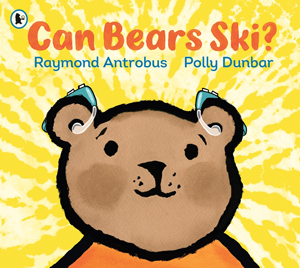
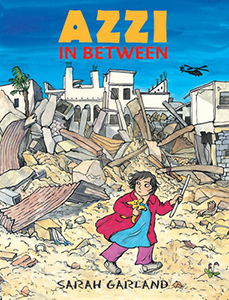
Wide reading is vital in schools today as research shows how the reading habit can slip away from students as they turned to social media for their stories. The new social media ban provides a great opportunity to increase book reading. The following novels and picture books explore different themes including living with disability, moving home, the power of friendship and the company of animals, family relationships and much more. Some are humorous, others are more serious and some combine elements of both. When students are given a range of books to choose from and the opportunity to select the books they read more reading happens. Ask your librarian to add some other popular books on these themes to the collection.



Jane Sherlock and Deb McPherson are experienced and passionate English teachers. They have also been involved in the education sector as authors and presenters at teaching conferences.
$9.95 flat rate shipping or free over $110
Australian family-owned & sourced
Supplier to over 1,000 schools Australia wide