Graham Akhurst's "Borderland" review for teachers - Talking Texts with Deb & Jane #32Graham Akhurst's "Borderland" review for teachers - Talking Texts with Deb & Jane #32

Brief description and distinctive features

  1. Borderland
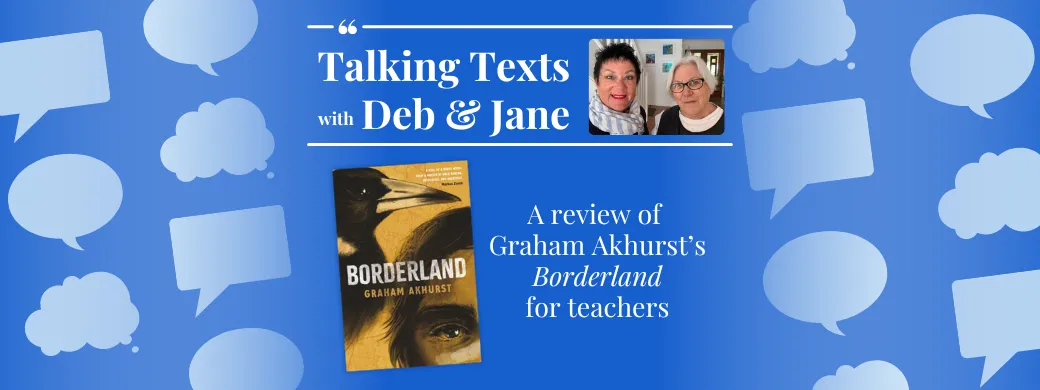
    Borderland
    Now: $20.69 Was: $22.99

For Stage 5 or Stage 6 Year 11

This novel has everything.

It is an exciting and gripping narrative that includes elements of the epic, the quest, the psychological thriller, as well as being a powerful First Nations story, incorporates wild and frightening fantastical figures … and it works! Journeys to the interior of Australia or other wild regions are always popular and this one is pacey, tense, authentic and will appeal to a wide range of students.

This novel is suitable for Stage 5 but may be even more successful in Year 11.


Brief description of Borderland

Jono Lane, a city-born First Nations teenager is about to leave school. Like all graduates Jono hopes to find out who he really is. Life in Brisbane at a private school has distanced him from Country and community. His best friend, Jenny, is much more confident in her identity and is always there for Jono.

Jono and Jenny join the Aboriginal Performing Arts Centre and very soon both are chosen as interns on a documentary film that is to promote a huge mining project in the interior of the Western Queensland desert. Jono is not sure what he should feel about the project but the thrill of earning big money and being involved is tantalising.

Once in Gambari there is tension, conflict, uncertainty and some colourful new characters. But it is the horrifying nightmare of a malicious spirit from the Dreaming which dominates Jono’s mind. The pressure escalates as he seeks to find out what this means. Is it connected to the mining project? Who is Jono really, and is Jenny what she seems?

Distinctive features of Borderland

  • Strong first-person narrative focalising the point of view and perspective of Jono Lane
  • Engaging relationships
  • Conflict over mining among the community is relevant and poignant
  • A convincing contemporary exploration of the gothic tradition which explores identity and the power of the landscape to echo pain, fear and personal tension
  • Authentic and accessible school context and work experience/internship
  • An effective recurring motif of the magpie as a narrative and cultural unifier
  • Exploration of a range of ideas and themes relevant to youth culture: belonging, identity, acceptance and cultural connection
  • Engaging and effective use of figurative language especially in capturing setting and the “Beast”.
  • Borderland is Graham Akhurst’s debut novel. Graham Akhurst is a Fulbright scholar from the Kokomini of Northern Queensland.
  • Detailed Teacher’s Notes from University of Western Australia Publishing are available. Click here to download.

Ways to use Borderland in the classroom

Pre reading 

Read Cara Shipp’s Listening from the Heart: Rewriting the Teaching of English with First Nations Voices (2023 AATE 150pp) to explore better ways to engage with First Nations People and their stories, their history and culture and to understand the protocols and appropriate terminology to use when reading and studying texts by First Nation authors. This warm, wise and generous book will be a huge help in the classroom


Consider these programming ideas:

For Stage 5 

  • A close study for Stage 5.
  • A core text for a unit on Representation of Identity and Youth Cultures 
  • A broader unit on “Growing up in Australia” with explores a range of different texts and different voices and includes this novel as a contemporary First Nations voice. 
  • Selection of texts to explore the narrative tradition/trope of the wild interior of Australia: film, television series, novels and Borderland.
  • Selection of texts to explore the power of the untamed world—real and imagined—to make sense of ourselves. Texts could include Journey to the Interior (Atwood), Heart of Darkness, The Rime of Ancient Mariner, Frankenstein. Students could also tap into Greek mythology (consider a game version of Ulysses, Jason and Argonauts)  

For Stage 6 Year 11 

  • Standard Reading to Write with the anchor of identity and a range of other texts which explore coming-of-age and identity.
  • Standard Close Study.  
  • Advanced Reading to Write: Representation of Different Voices including Borderland, Box the Pony (play), Interviews/documentary, The Sapphires (film), Tim Winton short stories. 


Features of Gothic horror

Borderland is described as a modern gothic horror story and this certainly contributes to its appeal, pace and intensity.

In their reading students could consider how Graham Akhurst has borrowed from traditional Gothic horror. 


Gothic literature is a genre that emerged the late 1700s, a literary genre that emerged as a part of the larger Romantic literary movement. The Gothic is characterised by terror, gruesome narratives, supernatural elements, and dark and often overwhelming scenery.

Elements in the genre include:

  • Mystery and fear; many Gothic works contain scenes, events and objects such as burials, flickering candles, evil potions, and other frightful concepts.
  • Visions, omens, and curses are often used throughout many narratives in Gothic literature to foreshadow the terror to come.  
  • Setting and atmosphere: Authors often used settings like castles, dark forests, steep mountain regions, and threatening weather conditions or natural disasters. 
  • Supernatural elements: suggestion of supernatural or baffling events, e.g. spirits, ghosts, vampires, objects coming to life 
  • Other features can include panic and terror, nightmares, romance, villains and anti-heroes.  

Consider Akhurst’s creation of setting to evoke tension and mood.

Choose five favourite examples of how setting captures and evokes the story’s mood and tension. Consider these as a starting point: 

  • The cackle of kookaburras drifted in on a breeze that shifted stale air p59
  • The night air was humid and thick, and the loud droning of cicadas travelled over the pitch-black oval in front of me pp 62- 63
  • The sun reflected off the parched ground. I felt marooned by the haze of heat surrounding me. Beyond was the desert – the true bringer of isolation. I looked out toward the nothingness.  p104
  • The horizon was still dark, but there were small beams of light poking through the angry clouds p167 
  • Clouds wrought a patchwork of darkness on the desert floor. P.207

Discuss the role of the “beast” and how Akhurst evokes the terror for Jono and then uses this to chart Jono’s growth and change.

  • Its skin was bloodless and pale. It had elongated arms with claws that rasped on the ground. A pinched mouth opened, baring canines, and empty pitch-black eyes stared through me p21
  • Re-read these sections: p 4, 47, 79, 128, 136. 145, 150-151, 180-181, 184, 190, 208-211, 212.


Responding to the text

1. The magpie as a recurring motif:
Trace the references to the magpie. How is it used to represent both Jono’s personal fears and journey and as an authentic inclusion of First Nations lore and spirituality.


2. Create a visual representation e.g. iMovie, PowerPoint or short film to capture the magpie as a visual representation of the protagonist’s conflicts and First Nations spiritual connection e.g. p.51, 161, 201-202, 219, 232, 234


3. Fiction has the power not only to build empathy for different peoples’ experiences but to broaden our own understanding of the world around us. Graham Akhurst authentically incorporates references to First Nations cultures and beliefs. These include Dreaming, the Bora Ring and Connection to Country. Students could choose one of these or another area of First Nations exploration in Borderland and discuss how Akhurst represents these First Nations experiences in his novel. In their responses students could reflect on the value of reading in broadening our understanding of a wider world. 


4. The ending: 

(Norman re-appears)
“How are you here…What’s going on?”
“You didn’t think I’d let you off that easy? We’ve got work to do.”

In small groups discuss what could happen next.

Pitch your new ending to the class.

The class to decide the two most engaging sequels. 


5. Reader’s Theatre

In small groups of 3-4 choose 2-3 pages from the narrative to re-create as Reader’s Theatre.

In preparation and rehearsal consider:

  • Which voice for which segment to enhance the narrative and emotional impact?
  • How you can enhance the impact e.g. clapping sticks, drums, background music. 
  • Present to the class
  • Reflection: which two readings most impacted on you and what was it about their presentation which shaped this response? How did your own collaborative experience contribute to an extended understanding of the key ideas of Borderland? 


6. Look at a series of advertisements from various mining companies and compare the perspectives being offered in the script of the documentary and how those perspectives are shaped by the different composers. 

Relevant details in relation to the new NSW English 7-10 syllabus

Text requirements: Borderland is a novel (extended prose) by Graham Akhurst, an Aboriginal author from the Kokomini of Northern Queensland, which contains intercultural and diverse experiences and cultural, social and gender perspectives, including from popular and youth cultures.
Pair this text with resources from our Year 11 texts and study guides and Year 9 texts and study guides for a deeper study program.

Concepts could include Narrative, Style, Connotation, Imagery and Symbol.


Relevant NSW English 7-10 Syllabus content for Stage 5

Reading, viewing and listening to texts

A student uses a range of personal, creative and critical strategies to interpret complex texts EN5-RVL-01

Reading, viewing and listening skills

  • Develop a deeper understanding of themes, ideas or attitudes by revisiting and reinterpreting texts to find new meaning

Reading, viewing and listening for meaning

  • Analyse the main ideas and thematic concerns represented in texts
  • Investigate how layers of meaning are constructed in texts and how this shapes a reader’s understanding and engagement
  • Clarify and justify personal responses to texts, explaining how aspects of the text, such as character, genre, tone, salience or voice, position a reader and influence these personal responses
  • Analyse how the use of language forms and features in texts have the capacity to create multiple meanings

Reading for challenge, interest and enjoyment

  • Read increasingly complex texts that challenge thinking, pique interest, enhance enjoyment and provoke a personal response
  • Engage in sustained and varied reading that presents increasingly diverse and complex perspectives and experiences, including those of Aboriginal and Torres Strait Islander Peoples, and respond in a range of ways, including through extended written responses
  • Consider how the social, cultural and ethical positions represented in texts represent, affirm or challenge views of the world
  • Evaluate experiences of reading by sharing responses to texts
  • Evaluate the ways reading texts help us understand ourselves and make connections to others and the world

Reflecting

  • Reflect on how reading, viewing and listening to texts has informed and inspired learning
  • Reflect on how an appreciation of texts can be enhanced through re-reading, and close or critical study
  • Understand and reflect on the value of reading for personal growth and cultural richness
  • Use reading strategies, and evaluate their effectiveness, when reflecting on the successes and challenges of extended reading
  • Reflect on how reading promotes a broad and balanced understanding of the world and enables students to explore wider universal issues
  • Reflect on own experiences of reading by interacting with peers in meaningful ways about the value of reading

Understanding and responding to texts A

A student analyses how meaning is created through the use and interpretation of increasingly complex language forms, features and structures EN5-URA-01

Representation

  • Analyse how contextual, creative and unconscious influences shape the composition, understanding and interpretation of all representations

Code and convention

  • Use metalanguage effectively to analyse how meaning is constructed by linguistic and stylistic elements in texts
  • Analyse how language forms, features and structures, specific or conventional to a text’s medium, context, purpose and audience, shape meaning, and experiment with this understanding through written, spoken, visual and multimodal responses
  • Explain how texts use, adapt or subvert textual conventions across a range of modes and media to shape new meanings, and explore this in own texts

Connotation, imagery and symbol

  • Analyse how figurative language and devices can be used to represent complex ideas, thoughts and feelings to contribute to larger patterns of meaning in texts, and experiment with this in own texts
  • Analyse how Aboriginal and Torres Strait Islander authors use figurative language and devices to represent culture, identity and experience

Point of view

  • Examine elements of focalisation, such as omniscience, limitations, indirect speech, tone, reliability and multiple narrators, and how these interact to shape perceptions of meaning in texts, and apply this in own texts
  • Recognise the difference between the actual author and authorial voice in texts and use this understanding to create texts with other kinds of imagined authors

Characterisation

  • Analyse how engaging, dynamic and complex characters are constructed in texts using language features and structures, and use these features and structures in own texts
  • Explore how characters in texts can be lifelike constructions with whom audiences establish intellectual and emotional connections, and can be perceived to reflect, challenge or subvert particular values and attitudes
  • Analyse how characters can serve structural roles in narrative, such as foils and drivers of action and conflict, and manipulate these ideas when composing own texts

Narrative

  • Analyse how narrative conventions vary across genres, modes, media and contexts and how they can be used to represent ideas and values and shape responses, and apply this understanding in own texts
  • Explore how narratives can represent and shape personal and shared identities, values and experiences
    • Example(s): Analysing how Aboriginal and Torres Strait Islander authors, and authors from a range of cultural backgrounds, choose to represent their identities and experiences through texts.

Understanding and responding to texts B

A student: evaluates how texts represent ideas and experiences, and how they can affirm or challenge values and attitudes EN5-URB-01

Theme

  • Analyse how themes can be understood to underpin cohesive meaning in texts, and apply this understanding in own texts
  • Appreciate the role of the audience in perceiving themes and how these themes can offer insights into an author’s perspective

Perspective and context

  • Understand how the personal perspectives of audiences are a product of historical and cultural contexts
  • Analyse how texts can be understood or interpreted from different perspectives, and experiment with this idea in own texts
  • Evaluate how texts can position audiences to accept, challenge or reject particular perspectives of the world, and reflect on this in own texts
  • Analyse how elements of an author’s personal, cultural and political contexts can shape their perspectives and representation of ideas, including form and purpose
  • Appreciate how all communication is a product of cultural context
    • Example(s): Engaging with a selection of narratives, poetry and artworks by Aboriginal and Torres Strait Islander authors, and discussing how words and images are used to reflect connections to Country/Place.
  • Explain how texts affirm or challenge established cultural attitudes and values in different contexts
  • Appreciate the significance and value of expressions of cultural context in texts constructed using elements of languages and dialects, including Standard Australian English, Aboriginal and/or Torres Strait Islander Languages, and Aboriginal English

Argument and authority

  • Evaluate how effective arguments are constructed through combinations of specific language forms, features and structures, and apply an understanding of this in own texts
  • Analyse how subjectivity and objectivity are constructed in texts to form arguments, and how these can represent particular perspectives
  • Analyse how an engaging personal voice in texts can represent a perspective or argument and communicate a sense of authority, and experiment with these ideas in own texts
  • Research, select and sequence appropriate evidence from texts and reliable sources to construct cohesive and authoritative arguments
  • Evaluate how the authority of a text is continually negotiated and reassessed by readers
    • Example(s): Examining 2 texts that present conflicting perspectives on an issue and considering how the second text challenges the authority of the first.
  • Appreciate how authority over meaning in texts, such as multimodal and interactive texts, can be distributed, and is a negotiation between acts of authorship, publication and interpretation

Style

  • Analyse how the distinctive aesthetic qualities and stylistic features of a text can shape and be shaped by its purpose, and experiment with this in own texts
  • Evaluate how particular styles in text can be privileged according to context
  • Examine the way an author’s distinct personal style shapes meaning in their work

Understanding and responding to texts C

A student investigates and explains ways of valuing texts and the relationships between them EN5-URC-01

Genre

  • Analyse how elements of genre in texts can shape the way ideas and values are represented and perceived, and experiment with elements of genre in own texts to shape meaning and response
  • Reflect on the evolution, adaptation, subversion and hybridity of genre in different time periods and cultural contexts, and how they demonstrate changing values

Intertextuality

  • Examine how meaningful connections made between texts can enrich the experience and understanding of literature and culture

Literary value

  • Analyse and evaluate how thematic and aesthetic qualities of a text contribute to the different ways an audience questions and negotiates the value of the text in particular contexts


(English K-10 Syllabus 2022 © NSW Education Standards Authority for and on behalf of the Crown in right of the State of New South Wales, 2023)

Connecting texts