




Flat Rate Shipping
$9.95 flat rate shipping or free over $110

Aussie Owned
Australian family-owned & sourced

School Supplier
Supplier to over 1,000 schools Australia wide
For Stage 5
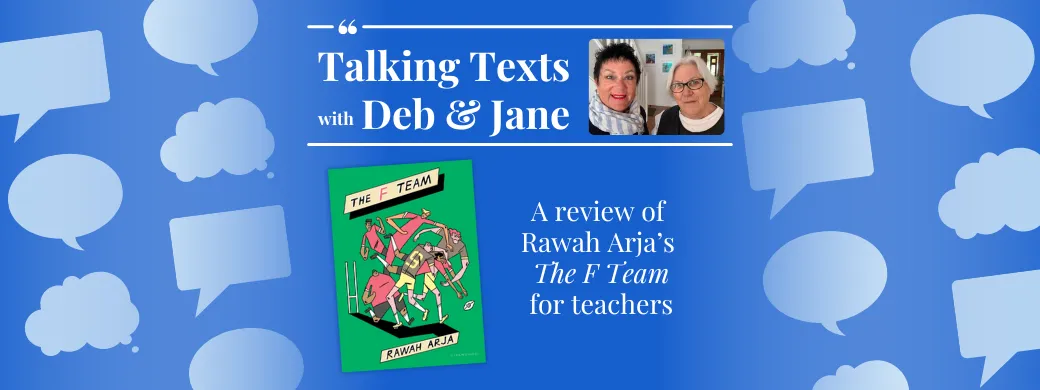
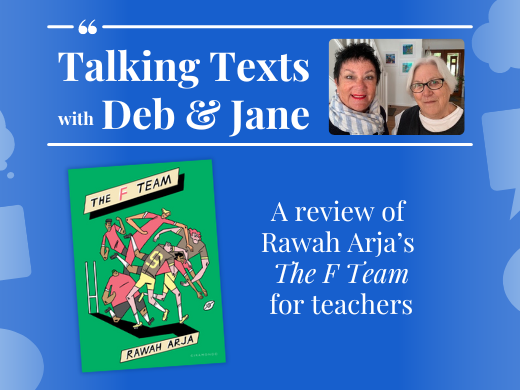
The author, Rawah Arja, explained why she wrote The F Team.
“I want to create a story that any child of a minority would feel proud of, and know they matter. They matter to me; they matter to their community and school; and most importantly, they would see themselves as worthy of being in print. They would be inspired to take ownership of their narrative, rather than sit idly by while the world tells their stories.”
From The F Team Teaching Notes (available from Giramondo Press)
Rawah Arja is a member of the Western Sydney women writers’ collective Finishing School. Her writing has featured in Arab, Australian, Other (Picador, 2019), SBS Voices and at the Sydney Writer’s Festival. The F Team was a 2021 CBCA Notable Book: Older Readers, shortlisted for PM literary YA Literature Award in 2021, shortlisted for the 2021 Readings Young Adult Prize. The F Team will be appreciated by students in Stage 5.
Tariq Nader is in Year 10 and is sure of his place in his large, lively family within Punchbowl's tight-knit Lebanese community, and in his school as leader of ‘The Wolf Pack’. The new Principal, Mr Archie, at Punchbowl High pushes Tariq outside his comfort zone and into Cronulla's Anglo-Australian society to compete, on and off the football field. Tariq’s actions and the actions of his friends could save his school or condemn it to closure. Tariq must battle his own anger and understand the consequences of it as he tries to be a good leader and friend while also falling for new girl, Jamila, who is smart and outspoken and counters his sometimes thoughtless, sexist attitudes.
The F Team is set in Punchbowl, a South West suburb in Sydney, home to the famous Canterbury Bulldogs NRL team. Much of the action occurs at the fictional Punchbowl High School. The real Punchbowl Boys High School is a school that figured in the media in the past, with a high degree of negativity and stereotyping. The widely condemned 2005 Cronulla Riots in Sydney’s south ignited public debate about multiculturism in Australia and were fuelled by inflammatory and racist broadcasts and social media. In the Teaching Notes, prepared for Giramondo Press by the author, Rawah Arja, she records:
“One boy said to me ‘We’re either the terrorists or we’re the bad guy with a big beard’. He was talking about the news, but still, this idea was prevalent amongst most of the boys I talked to.”
The F Team explores the school in a work of fiction which examines that sort of negativity and provides positive and authentic contrasts to it through understanding and respect. Punchbowl Boys High School, founded in 1955, has a fascinating history and an article on Jihad Dib, who was Principal from 2007-2014, looks at how he improved the school for the better. The article is available here on the Sydney Morning Herald (August 15 2014).
In groups, read the article and compare the qualities Mr Dibb brought to the school, and the actions he took, with the fictional Mr Archie. Present your conclusions to the class
The F Team has a range of interesting and engaging characters from family members to the Wolf Pack for you to examine and discuss. In groups select one of the following characters and prepare a character profile to share with the class.
Consider these points for your character profile:
The F Team is a humorous novel but with some serious issues and problems for Tariq and other characters to solve. Students can choose to
OR
OR
Text requirements: The F Team is a novel (extended prose) by an Australian author. It includes a range of cultural, social and gender perspectives.
For more recommended texts suitable for Stage 5, explore our Year 9 texts and study guides and Year 10 texts and study guides.
Concepts could include Characterisation and Perspective and Context.
Characterisation
Perspective and Context
Writing
(English K-10 Syllabus 2022 © NSW Education Standards Authority for and on behalf of the Crown in right of the State of New South Wales, 2023)



Jane Sherlock and Deb McPherson are experienced and passionate English teachers. They have also been involved in the education sector as authors and presenters at teaching conferences.
$9.95 flat rate shipping or free over $110
Australian family-owned & sourced
Supplier to over 1,000 schools Australia wide