




Flat Rate Shipping
$9.95 flat rate shipping or free over $110

Aussie Owned
Australian family-owned & sourced

School Supplier
Supplier to over 1,000 schools Australia wide
For Stages 4 and 5
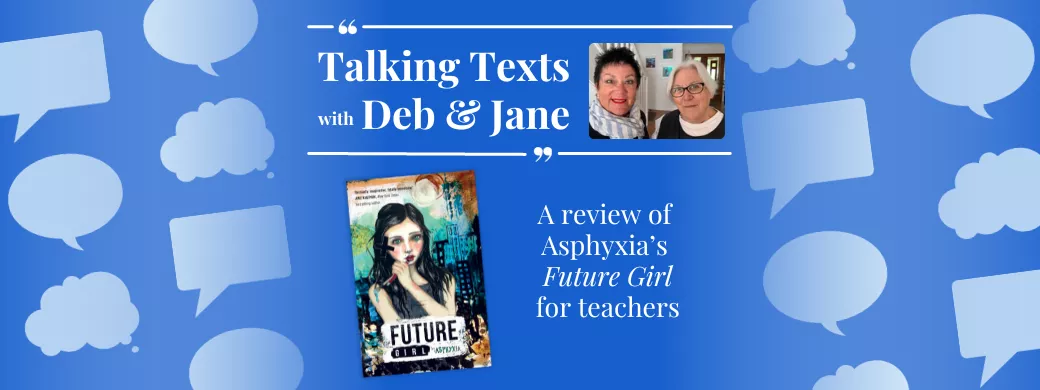
Future Girl is an illustrated novel by Australian writer, artist and Deaf activist, Asphyxia. It is set in the near future in Melbourne. In an environmental crisis, Piper, who is a Deaf daughter to a hearing adult, meets Marley who is a CODA (Child of a Deaf adult). Piper’s mum, who has just lost her job as leading scientist on the Recon project, has focused on getting Piper to speak and lipread rather than sign while Marley is a fluent Auslan signer. He introduces Piper to his mother, Robbie, and her garden. Piper is full of wonder at what Robbie has created and how delicious wild food can be, despite the government labelling it as poison. The crisis increases as the Recon food problems grow, businesses close and people try to turn to wild food. Piper starts her own garden on council land, learns to sign and her journal records all her experiences, including her up and down relationship with Marley, who has his own problems and concerns. As political pressure increases Piper’s art and her protest become central to the cause.
Future Girl was the winner of Readings Young Adult Book Prize in 2021 in Australia and the judges said:
‘Future Girl offers something completely unique, occupying a space between graphic novel and novel,’ … ‘Its detailed illustrations explore Piper’s experiences as she learns to navigate a hearing world that continually fails to accommodate her. Her coming-of-age story, as she embraces Deaf culture and learns to raise her voice to define her own space in the world, is nothing short of enlightening and powerful.’
Asphyxia has a free online AUSLAN course on her website https://helloasphyxia.wordpress.com
Terminology
Introduce students to the new online and downloadable glossary definitions in the 7-10 English Syllabus around d/Deaf so they understand that capitalisation can be used in reference to the individual or the Deaf community in order to show respect and deference. It also indicates a cultural identity.
Wide reading
Barack Obama praised the power of fiction “to put ourselves in someone else’s shoes, understand their struggles, and imagine new ways to tackle complex problems and effect change.” Wide reading in diverse perspectives is a way to enable students to walk a moment in someone’s else’s shoes. Create a wide reading book box so students can have some choice from a range of texts. See the connected texts below for some suggestions. Consider using non-fiction texts as well.
Authentic and diverse perspectives
We Need Diverse Books is an American website which strives to create a world in which all children can see themselves in the pages of a book. Future Girl is a book representing a different perspective because the protagonist is deaf. Such books used to be called ‘Own Voice’, and are books which centre on characters from groups who can be marginalised, written by authors from that group. Usually, the worlds created or described in these books are represented as authentically as possible by the lived experiences of the authors.
Focus question
Use a focus question to drive the study of different or diverse perspectives e.g. How do narratives and stories help us to understand and appreciate the lives of others?
With this question in mind ask groups of students to consider how the author represents different voices and lives through the texts they have read. They can present their conclusions to the class in a group report.
Text requirements: Future Girl is a work of extended prose (a graphic novel) as well as a quality multimodal text by an Australian author and artist who is Deaf. It contains intercultural and diverse experiences and cultural, social and gender perspectives, including from popular and youth cultures.
Explore our Year 9 texts and study guides and Year 7 texts and study guides for more Stage 4 and 5 reading material.
Concepts could include Perspective and context • Representation.


Jane Sherlock and Deb McPherson are experienced and passionate English teachers. They have also been involved in the education sector as authors and presenters at teaching conferences.
$9.95 flat rate shipping or free over $110
Australian family-owned & sourced
Supplier to over 1,000 schools Australia wide