Talking Texts with Deb & Jane: a review of Andrea James' "Sunshine Super Girl" for teachersTalking Texts with Deb & Jane: a review of Andrea James' "Sunshine Super Girl" for teachers

Brief description and distinctive features

For Stage 4

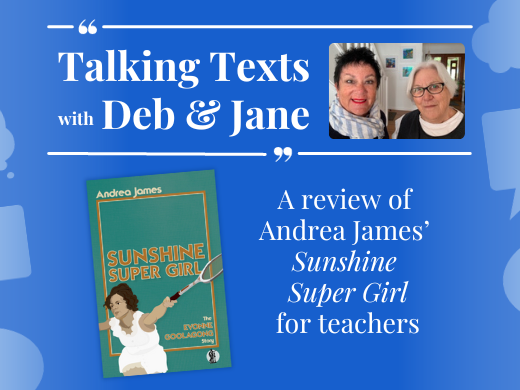
It is always a challenge to find plays for Stage 4 and Sunshine Super Girl is one to engage, interest and inform your students about the role theatre can have in telling important stories. They will be inspired by this story of tenacity, hard work, humility and huge success.

Brief description of Sunshine Super Girl:

Australians love a successful sporting hero. It is part of our culture and identity to idolise our sporting heroes. Evonne Goolagong-Cawley is certainly one of Australia’s greatest sporting heroes. She won 16 grand slam titles and when she won the prestigious Wimbledon Women’s Championship she was 19 years old. Yvonne was known for her speed and power and overcame the tennis greats of her time; Margaret Court, Billie-Jean King and Martina Navratilova. She was the first Indigenous Australian to win Wimbledon.

Evonne’s own story is a compelling one and this is brought to life in this play. She lived in Barellan, a tiny town on the way to Griffith. Today, if you visit the town you can see the  giant tennis racquet sculpture displayed as a tribute to her.

Evonne was one of eight children, living with her parents in a small and modest home. There was little money in the Goolagong family but lots of pride. Evonne’s early tennis days saw her playing with a paddle-style racquet made from a fruit box pallet. She joined the Barellan War Memorial Tennis Club when she was seven for a competition and had to borrow a racquet while her mother made her a tennis dress from a bedsheet. Locals believed in Evonne and her family and could see her potential. Her path to tennis stardom had begun but there would be racism, hardship, intense training and tragedy along the way, but Evonne always had her determination and her family’s support.

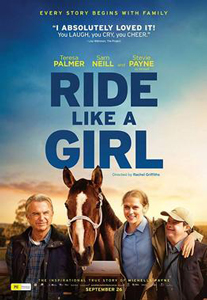
This play would suit Stage 4 as a close study which focus on drama as text or as a wider unit which explores how different textual forms and media represent true stories e.g. a documentary, a feature film e.g. Ride Like a Girl, newspaper articles and media photographs and speeches. Students could explore a range of texts and choose three favourites  to explore in an extended feature article or digital essay on how texts explore true stories: Real People. Real Stories. 

Distinctive features of Sunshine Super Girl:

  • A text written by Yorta Yorta woman and successful playwright, Andrea James about a First Nations sports hero. 
  • Sunshine Super Girl is not a documentary but a dramatisation for stage of significant moments and experiences which shaped the life of Australia’s iconic tennis star, Evonne Goolagong-Cawley. 
  • The title was a name the Press called Evonne after her Wimbledon win in 1971. 
  • A heartfelt and valuable Introduction by Federal Minister for Indigenous Affairs—Linda Burney, who is also a cousin of Evonne. 
  • The play is short, just 57 pages. It is in four Acts and there are 29 short scenes which act as a snapshot of different events and experiences in Evonne’s life and tennis career.
  • In production actors played numerous characters but in the classroom there would be sufficient roles for almost everyone to have a short part or groups could choose an Act and enjoy their own performances.
  • There are many examples of delightful humour which adds warmth and joy to the story and which authentically re-create the Goolagong family’s world.
  • Woven into Evonne’s story are references to specific events in Australia which sees the developing Indigenous movement e.g. Tent Embassy. There are also some delicate passages spoken by Evonne which beautifully capture First Nations Connection to Country.

Ways to use Sunshine Super Girl in the classroom

  • Contextualise the story of Evonne Goolagong-Cawley: start with some images from the 2022 Australian Open won by Ash Barty where Evonne can be seen as part of the celebrations. Yvonne was a powerful mentor and is a close friend of Ash Barty. 
  • Or start with a presentation of First Nations sports stars including Ash Barty, Greg Inglis, Adam Goodes, Cathy Freeman, Lionel Rose, Latrell Mitchell, Sam Riley and Buddy Franklin. This task could have resonance given the recent naming of a stand at Olympic Park to recognise Cathy Freeman’s extraordinary Olympic Games race.  
  • Link this to the importance of sporting success for national pride, identity and to see First Nations heroes as heroes for all Australians. 
  • Consider an interview with Evonne Goolagong-Cawley including: The ABC Of… with David Wenham and The Impossible Dream | Evonne Goolagong Cawley’s journey to Wimbledon glory. Students could create a timeline of Evonne’s life using one of the interviews. 
  • Create a classroom culture to explore drama texts where plays are seen as a unique form and intended for performance. Scripts are prompts for performance and students move and are active with scripts. It is not about creating actors but vocalizing. Use the metalanguage of script: stage directions, set design, scenes, acts.
  • Groups could present their chosen scenes to the class and write a short reflection on how being active with the script gave them deeper understanding to the play’s key ideas. There are images online of different productions which will assist students visualising how the tennis court was used to represent the narrative. 
  • Choose a scene and discuss how it contributes to the ideas and insights about Evonne Goolagong-Cawley and reveals the challenges for First Nations Australians.
  • Read the Introduction by Linda Burney. Ask students what are the three most illuminating points made by Burney which help you to understand and appreciate the ideas of Andrea James?
  • Research what Evonne is doing today especially with her Indigenous Tennis program in Darwin and in small groups write an epilogue, either in the voice of Evonne or one of her siblings or by Ash Barty.

Relevant details in relation to the new English 7-10 syllabus

Text requirements: Sunshine Super Girl is a drama text written by an Aboriginal Australian.  It contains intercultural experiences and cultural, social and gender perspectives.
Looking for more classroom texts for Stage 4 students? Browse our Year 7 texts and study guides and Year 8 texts and study guides at Five Senses Education.

Concepts could include Perspective and context • Representation.

Connecting texts

Connecting texts: Aboriginal and Torres Strait islander perspective 

Connecting texts: gender perspective

Ride Like a Girl, 2019 film by Rachel Griffiths