




Flat Rate Shipping
$9.95 flat rate shipping or free over $110

Aussie Owned
Australian family-owned & sourced

School Supplier
Supplier to over 1,000 schools Australia wide
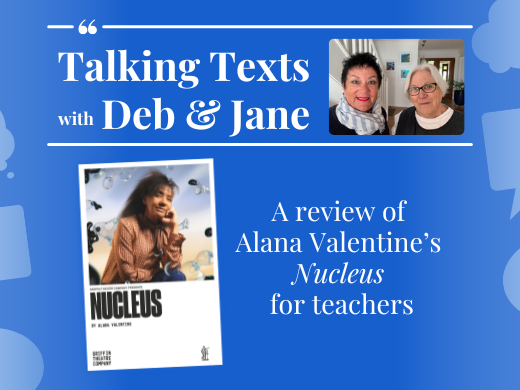
For Stage 6 Year 11
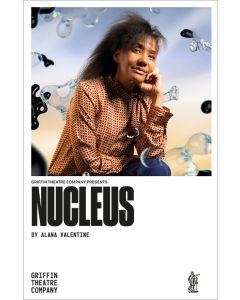
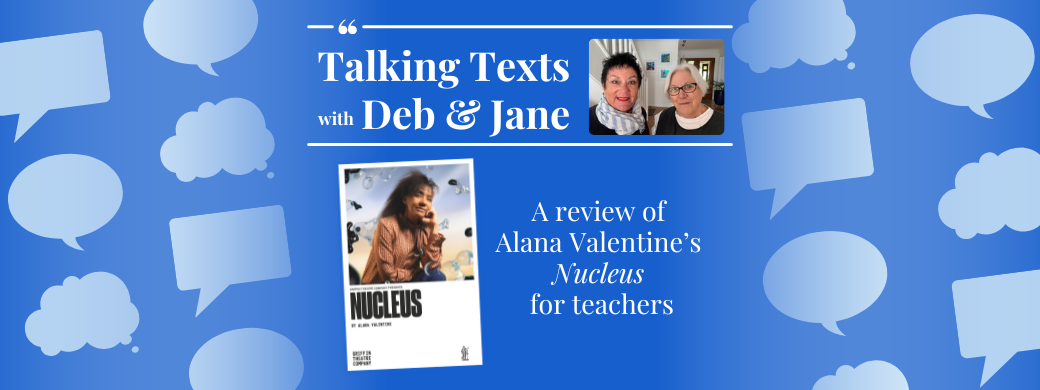
Alana Valentine has the extraordinary capacity to tap into contemporary Australia and that ensures her plays are engaging and thought-provoking. This play raises questions about the challenges of being close to someone with whom you hold totally opposite views. In this case, it is the nuclear debate and certainly in Australia this is a divisive topics. There are other such topics like Australia purchasing submarines, building windfarms in the ocean, creating high density apartment blocks near railway stations, providing social housing across all suburbs, balancing tourism and sustainability, vaccinations, and of course, which political party to support.
Sometimes it is easier not to have these discussions if we know our friends or families do not share our point of view.
As English teachers we cannot shape personal preference but we can help our young people to go beyond social media platforms and the diminution of informed debate so they can make balanced decisions.
There are two characters in this play: Dr Gabriel Hulst and Dr Cassie Logart. Gabriel is a nuclear engineer who emigrated to Australia in the 1960s “when Australia was interested in building (uranium) enrichment plants” and when John Gorton became Prime Minister in January 1968 he was “in favour of having a nuclear power station in Jervis Bay.” Gabriel opens the play with a long monologue where he establishes his antipathy towards Cassie and acknowledges they have known each other since the 1970s. Cassie is an anti-nuclear campaigner who is passionately against most of what Gabriel works for and believes in. But there is more to their relationship than ideological polarity and this provides an interesting twist to the narrative and provides dramatic tension. Valentine powerfully explores the human cost in what director, Andrea James calls “two love-struck enemies.”
Alana Valentine is an extraordinarily prolific creator who has written more than 20 plays and worked in creating films, television, dance and opera. Alana has won many awards nationally and in the international world of theatre and writing. It is worth students accessing her website to see the versatility and breadth of Alana’s work.
In 2024 Mission Australia surveyed 17,480 young people to learn about the issues which affected them most. The second most significant issue was climate change and the environment where 27% identified it as one of the most important issues in Australia. Access the website for more details.
Alana Valentine has certainly tapped into this anxiety about climate change and the environment. Nucleus also challenges her audience to consider what happens when someone you love or is close to has startlingly different views on such issues as the impact of government policy, science and the development of alternative power supplies like nuclear energy.
This play has several possibilities for Year 11 students.
It could feature as a core text in Reading to Write or in a suite of plays by Alana Valentine where students explore contemporary attitudes and values through drama.
In a Reading to Write unit a range of different texts in different forms could be used to explore different representations of challenging environmental issues.
Texts could include:
A range of editorial cartoons by talented creatives like Kathy Wilcox and David Pope. Identify the key issue and analyse the specific visual features.
A range of speeches to explore purpose, audience and specific language features; for example Tim Winton, Severn Suzuki, Greta Thunberg, Tim Minchin
Nucleus as a focus text
Picture books which explore environmental concerns as in The Dream of the Thyalcine, Fox, Cicada
Download the full report from Mission Australia to provide a research base for the exploration.
Susan Hoddinott, a friend and colleague, has written extensively on the importance of treating drama texts differently from prose:
“Teaching Drama can be one of the most daunting, yet one of the most rewarding experiences, for an English teacher. Drama is one of the oldest literary forms. It has a discreet body of knowledge that spans 2,500 years. It has its own terminology. It is closely linked to poetry as, like poetry, it springs from the very origins of story-telling and the oral tradition.
The understanding of the form and features strengthen a student’s understanding of how theatre is a distinctively visual, and auditory world.”
The exposition of any text is important but in a play the audience needs to be quickly oriented to the main characters, the narrative arc and the play’s style.
In Nucleus the exposition takes the form of an extended monologue by Gabriel Act 1, Scene i:
Act 1, Scene ii is very short and comprises exchanges of quick dialogue characterised by black humour and graphic details in their macabre bingo card game.
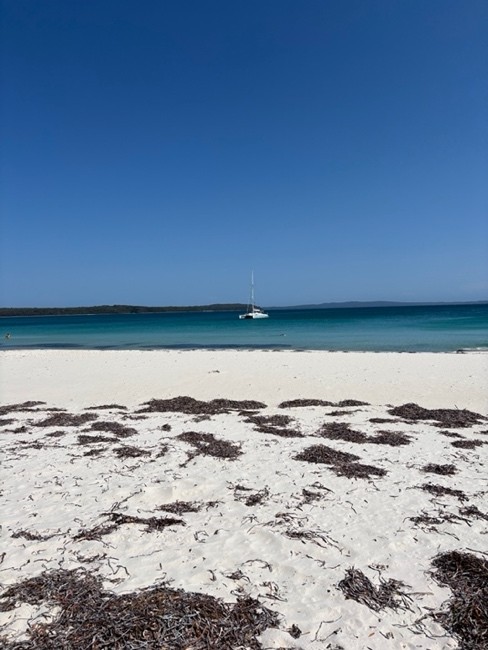
Act 1, Scene iii resumes Gabriel’s monologue where he continues his historical summary of Australia and nuclear development including details about Sir Phillip Baxter’s role. At this time the new Prime Minister John Gorton was in favour of a nuclear power station at Jervis Bay and Gabriel was employed to “investigate and clear the site.” Gabriel explains the reasons for initially choosing Jervis Bay and why the power station was never actually built there. He is derisive of the politics of the decision and points out that the protest movement in Australia at that time was small compared to the 1980s. (Today Jervis Bay remains a pristine and very beautiful part of the south coast and intermittently it becomes a focus for controversial government decisions.)
Gabriel continues his reflective monologue and expands his insights on the effects of radiation which drives the narrative to the romantic angle of the play: a flirtatious encounter at a conference which Gabriel believes was deliberately orchestrated by Cassie.
Task: In what ways does the opening Act establish key ideas of the play and its style?
Act 2 sees Cassie taking the longer monologue role where she explains her role in the relationship with Gabriel and her intention of writing an article post-seduction to taint his reputation. Cassie’s arguments against nuclear energy “being clean” are convincing. This conviction reinforces the premise of needing to hear both sides of controversial situations which is not always easy to obtain through social media or even traditional media sources.
Task: which of Cassie’s arguments do you find the most compelling?
This scene also raises questions about the ethics of deception and creating a situation where someone’s reputation could be compromised. Cassie also reveals their sexual encounter led to her pregnancy and her comments are confronting.
In Act 3 Gabriel resumes his monologue and his arguments are also convincing for example the storage of nuclear waste. This monologue reflects on encountering Cassie at an anti-nuclear rally in Canberra. Here the play’s title, Nucleus, becomes relevant. Gabriel explains the technicalities of the science of nuclear energy where the process “splits the nucleus of the uranium atom” which releases a huge amount of energy.
Gabriel celebrates the role of engineers who design for “efficiency, practicality, durability… the authors of modernity.” This monologue also reveals the dilemma of Cassie and Gabriel’s relationship and the reasons he told his wife about his infidelity. Gabriel makes a powerful point that when you love someone you want to share all aspects of your life and here Alana Valentine raises more questions about the challenges to relationships when you cannot share your point of view with those who are important to you.
Act 4 has a stage direction: “A bar. Painted with white orchids” and the narrative returns to a dialogue between the two characters evenly sharing lines. This scene captures their encounter at the conference and adds more detail.
Cassie resumes her monologue in Act 5 and her comment is poignant: “I just wondered if it was possible to love someone with whom you disagreed utterly.” This section also reveals a much more vulnerable Cassie which adds a different layer to the play that will be amplified in the ending.
Act 6 is also given stage directions for the setting: “The indoor pool of a large hotel. Gabriel and Cassie are in swimming costumes.” Their dialogue resumes as even lines between them and the tension grows; Gabriel’s comments about relationships is powerful: “People have to share values to be able to share a life.”
Act 7 states that “Cassie is alone on stage, playing cards. She uses a water jug to pour a glass of water and take two tablets from a small bottle in her pocket.”
This scene takes place in the present and it is now “several decades” since their initial encounter. In their conversation they both update each other and the audience of their involvement in both sides of the nuclear debate and interestingly, Gabriel comments that “I think anti-nuclear is seen as a bit of a thing of the past.” He also says that part of his current advocacy is “that nuclear power does not lead to nuclear war” and this is certainly an area of conjecture in the contemporary debate.
Gabriel makes a compelling point that:
“They used fossil fuels and warmed the planet to the point where we can’t live on it anymore … the threat of nuclear disaster is miniscule compared to the certain apocalypse of continuing to use carbon, coal, oil and all the other things that our generation thrived on.”
Gabriel reveals he has been asked to do another risk assessment on Jervis Bay and this certainly brings the play to the present. The play’s intensity increases when Cassie’s death is foreshadowed, and the poignancy of human frailty is evoked in these simple lines: “I’m so scared” and “I don’t want to die bitter.”
Even in the intensity of Cassie’s situation their dialogue about the positives and negatives of nuclear power continues and each line of dialogue is like a debate where each side has a totally different point of view.
Act 8 has the most detailed stage directions of the play. The scene has moved to Murrays Beach at Jervis Bay and as well as the large, concrete platform there is the “sound of nature, the blue of the sky and the ocean. Her scream becomes the scream of a yellow-tailed black cockatoo.”
Cassie opens this final Act with a gentle and lyrical description of the beauty of the area but the scene grows in its emotional intensity as both Cassie and Gabriel describe the plan to build the nuclear reactor according to their perspective:
Cassie: “you want to muffle fairyland.”
Gabriel: “I see a space to build. An emptiness to fill.”
The intensity and adversarial contest decreases and there is even delicacy in Cassie’s reverie:
“I called a wind Sweetness because it carried the smells of the forest, of pine and dirt and eucalypts crushed into muddy oil.”
The human tragedy of decades of deception and wanting each other to be different and to change is now the play’s focus. The final stage directions are full of the pathos that we call humanity. Valentine’s detail is intentional as she evokes the pity and pain of Michelangelo’s magnificent sculpture of Mary and Jesus in The Pieta of the Sistine Chapel:
“He holds her like a pieta, dead in his arms.
He cries.
Lights fade.”
Task: In what ways do the closing moments of Nucleus draw together the key ideas of the play?
There have been many variations on Michelangelo’s magnificent sculpture. Ask students to find a more contemporary example which captures the human frailty of this final tableaux of Nucleus. For example, the Harvard Art Museum.
There is another Pieta sculptured by American Gib Singleton at Via Dolorosa Sculpture Garden of the Museum of Biblical Art in Dallas, Texas. Visit his website for some powerful sculptures.
The playwright alternates scenes of long monologues to short, sharp pages of dialogue. With close focus on four scenes discuss the role of these dramatic conventions. In your view is one more effective than the other- explain your perspective.
Why has the playwright added the romantic layer to the narrative?
Create a table of main points for and against nuclear energy as made by Cassie and Gabriel. Is there another perspective? Research this topic to add a third perspective.
Sustained response: The importance of theatre is to provoke us to challenge our own assumptions. To what extent is this true of Alana Valentine’s Nucleus?
Write a feature article in the discursive style that explores this topic outlined below.
One of the important features of a healthy society is for the Arts to act as barometers for public knowledge, opinion and action. Explore how Alana Valentine’s play Nucleus fulfills this role. In your article include analysis of two editorial cartoons, one speech and one other text. Keep in mind that in English we need to focus on how the text shapes our understanding and knowledge - that is, the language choices of each composer in representing specific issues.
Compose a 3-4 minute persuasive speech (about 520 words) suitable for a Year 11/12 audience on the importance of debate on one of the following topics:
Include:
Text requirements: Nucleus meets Stage 6 text requirements for drama, Australian author, social, cultural and gender perspectives.
Find supporting resources in our Year 11 texts and study guides at Five Senses Education.


Jane Sherlock and Deb McPherson are experienced and passionate English teachers. They have also been involved in the education sector as authors and presenters at teaching conferences.
$9.95 flat rate shipping or free over $110
Australian family-owned & sourced
Supplier to over 1,000 schools Australia wide