





Flat Rate Shipping
$9.95 flat rate shipping or free over $110

Aussie Owned
Australian family-owned & sourced

School Supplier
Supplier to over 1,000 schools Australia wide

For Stage 5
Visceral.
Searing.
Striking.
These are the words that readers are using to describe this extraordinary graphic novel.
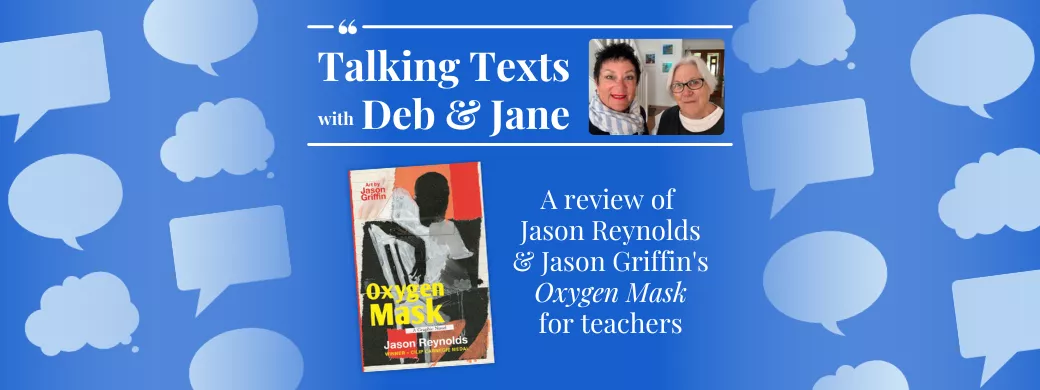
It is indeed all of these and more. . . I call it a text for our times - a text which both reflects and challenges so much of what has happened over the past few years.
Jason Reynolds and Jason Griffin have collaborated on this extraordinary graphic novel.
This could be the text that your gets your students talking, writing and reading!
Jason Reynolds’s own comments are sufficient to engage year 9 and 10 students:
“What Jason knows is that there are a lot — A LOT — of people, young, old, and in-between, who hate reading. He knows that many of these book haters are boys. He knows that many of these book-hating boys, don't actually hate books, they hate boredom. If you are reading this, and you happen to be one of these boys, first of all, you're reading this -Jason's master plan is already working and second of all, know that Jason totally feels you. He REALLY does. Because even though he's a writer, he hates reading boring books too.
So here's what he plans to do: NOT WRITE BORING BOOKS.
That's it, and that's all.” Jasonwritesbooks.com
The dedication at the front of the book says:
For everyone we lost
And everything we learned
In the strangest year of our lives- 2020
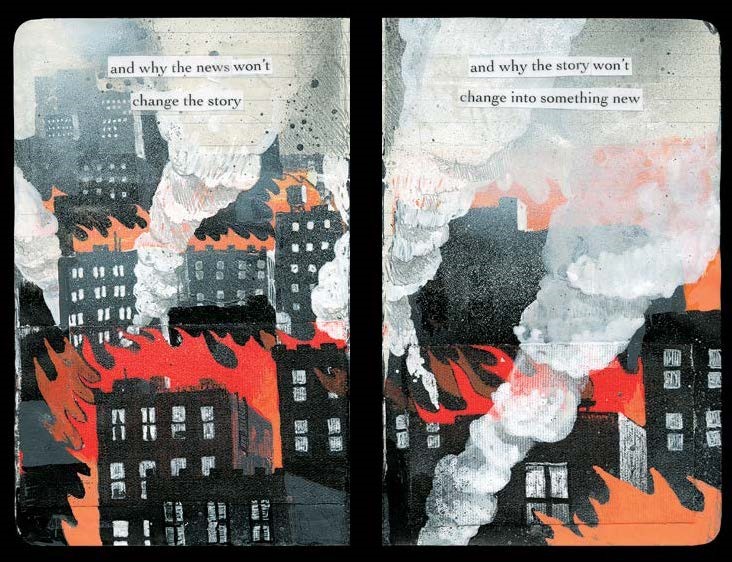
The story is set in the USA during the world-wide Covid pandemic and takes place within the walls of one family’s apartment. Told from the point of view of one of the family members the narrator poignantly shares with the reader the isolation within the family’s walls. His mother is watching an endless loop of news broadcasts covering the pandemic and the Black Lives Matter movement following the death of George Floyd: “I’m wondering why the news won’t change the story and why the story won’t change into something else.” His brother seeks refuge in his video game, his sister spends her time on her phone texting to her friends and his sick father is isolated in his bedroom where he coughs incessantly “like something in him is breaking up and breaking down at the same time.” The description of his father “lying in the bed his body an out-of-tune instrument that somehow only plays thunder” is tragedy at its simplest and finest.
The narrative is fast-paced as it alerts the reader to the challenges many faced during the pandemic and the freedom to breathe, the freedom to laugh, the omnipresence of masks and questions about how we treat each other and whether the world will ever be the same again.
Jason Reynolds is a Carnegie winner and critically acclaimed, multi award-winning writer and poet. He has just completed his role as National Ambassador for Young People's Literature in the US, and has written several books including All American Boys, Boy in the Black Suit, Long Way Down and the Run series.
Jason Griffin's first publishing endeavour was My Name Is Jason, Mine too, with Jason Reynolds. He's a gallery artist, street artist and book artist.
Facilitate a class discussion either in small groups or a full class about 2020.
If students are now fifteen, they would have been eleven or twelve, possibly in their final year of primary school.
What do you remember most clearly about COVID?
Create a class summary to get students thinking about this unique time of our lives.
In his dedication Jason Reynolds calls 2020 “the strangest year of our lives”.
“I represent all of the young people, but I definitely want to be a springboard for the ones that just haven’t felt safe in literature or in the world,” he adds, in what feels like an apt closing statement for his time as national ambassador. “So that they can then see that the world is broad and big and beautiful. And theirs.”
Suggested texts could include other graphic novels, verse novels, slam poetry, performance poetry, songs.
Text requirements: Oxygen Mask is a quality multimodal text from around the world. It includes a range of cultural, social and gender perspectives.
For more recommended texts suitable for Stage 5, explore our Year 9 texts and study guides and Year 10 texts and study guides.
Concepts could include Context • Representation • Connotation, imagery and symbol
As the focus of learning in each Stage, students are required to engage meaningfully with:
Across each stage, the selection of texts must give students experiences of:
A student: uses a range of personal, creative and critical strategies to interpret complex texts EN5-RVL-01
A student analyses how meaning is created through the use and interpretation of increasingly complex language forms, features and structures EN5-URA-01
A student evaluates how texts represent ideas and experiences, and how they can affirm or challenge values and attitudes EN5-URB-01
A student crafts personal, creative and critical texts for a range of audiences by experimenting with and controlling language forms and features to shape meaning EN5-ECA-01
(English K-10 Syllabus 2022 © NSW Education Standards Authority for and on behalf of the Crown in right of the State of New South Wales, 2023)



Jane Sherlock and Deb McPherson are experienced and passionate English teachers. They have also been involved in the education sector as authors and presenters at teaching conferences.
$9.95 flat rate shipping or free over $110
Australian family-owned & sourced
Supplier to over 1,000 schools Australia wide