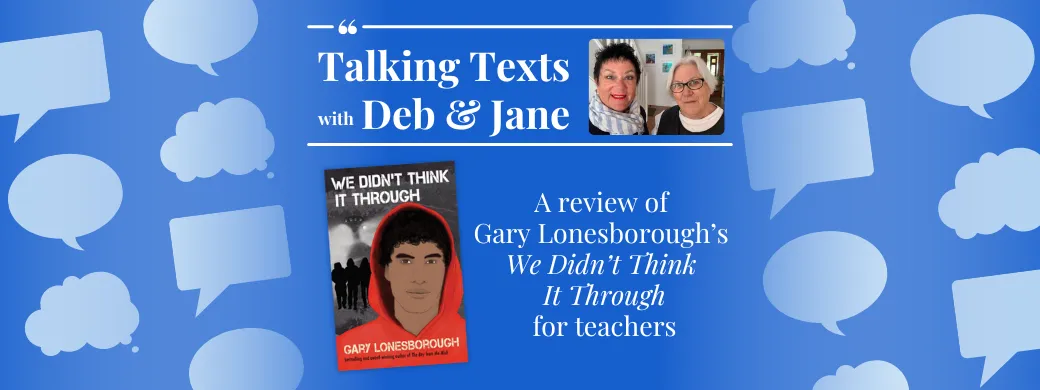
Gary Lonesborough's "We Didn't Think It Through" review for teachers - Talking Texts with Deb & Jane #34Gary Lonesborough's "We Didn't Think It Through" review for teachers - Talking Texts with Deb & Jane #34

Brief description and distinctive features

For Stage 5 Year 10

As I write this in April 2024 the media is full of events, situations and young men who could easily be the subject matter of this latest Gary Lonesborough novel.  On a daily basis young men must utter the words: “we didn’t think it through”.

This is a novel for its time. What’s more, this compelling text was written by First Nations writer, Gary Lonesborough. It will speak to Stage 5 students but is more appropriate for Year 10 or Year 11. 

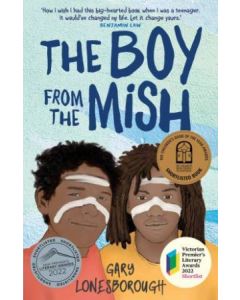
This novel is a tough read and will need guidance and discussion with your students about some of the content but it will certainly engage your young people especially your young adolescent males.  YA writer Will Kostakis praises Lonesborough as a “bold, necessary new talent.” Lonesborough’s debut novel The Boy From the Mish tackled confronting topics like male sexuality and acceptance. 

We Didn’t Think It Through extends this bold foray into adolescence with more darkness, grit but ultimately, hope. 

The NSW 7-10 English Syllabus states that across each stage, the selection of texts must give students experiences of a range of cultural, social and gender perspectives, including from popular and youth cultures. We know that student interest and engagement will be heightened if the texts mean something to our students’ lives. Texts which explore youth cultures will be effective choices,  especially for disengaged or reluctant readers. You might consider youth cultures as a broad umbrella or entry point for a series of units. In the case of We Didn’t Think it Through you are not only providing a genuine voice exploring youth culture but it is also authored by a First Nations writer.

While there is no specific definition currently in the new 7-10 English Syllabus glossary, this definition from the English 7-12 Syllabus 2012 is still very relevant:

“The shared beliefs, knowledge, creative activities, customs and lifestyle of young people, particularly teenagers, within a culture.

Youth cultures develop in those societies which differentiate teenagers as a group separate from children and adults. In Australia, the dominant youth culture identifies closely with popular culture and finds expression in the music and multimedia texts of popular culture.”

Brief description of We Didn't Think It Through

Jamie Langton is sixteen and lives in a small community called Dalton’s Bay. He is confused and angry about his parents’ rejection and lives with his aunt and uncle who are understanding and supportive. But they cannot save him when Jamie and his mates encounter more racism and bullying from the local white gang. Jamie and his mates retaliate by vandalising and stealing Mark Cassidy’s car. Neither Jamie nor his mates Dally and Lenny thought this through and the consequences are disastrous with Jamie now detained in the youth justice system. Jaimie knows he must find a way forward and Aunty Dawn’s words cannot console him: “Don’t let that place break you. You’re stronger than the system. Stay out of trouble. Do your time. “ p.73. But detention is not a place for redemption and healing. 

In the novel there are experiences of drug and alcohol abuse, violence and reckless adolescent behaviour but this is part of its appeal and engagement. In the Allen & Unwin teaching resource there is a very valuable interview with Gary Lonesborough who explains what influenced him to write We Didn’t Think it Through. 

Gary Lonesborough is a proud Yuin man who grew up on the South Coast of NSW and moved to Sydney to study film. Gary was a keen writer from childhood and enjoys talking about writing. His YouTube Writing tips Gary is engaging and offers valuable and accessible writing tips: https://www.youtube.com/watch?v=oGbyYUbOe_A

Another YouTube is his discussion about reading on Hook into Books: https://www.youtube.com/watch?v=8KiKstWU34Y 

Gary has wide experience in working with adolescents including working in the youth justice system. His debut YA novel, The Boy From The Mish, was published by Allen & Unwin in 2021.


Pre reading 

Read Cara Shipp’s Listening from the Heart Rewriting the Teaching of English with First Nations Voices (2023 AATE 150pp) to explore better ways to engage with First Nations People and their stories, their histories and cultures and to understand the protocols and appropriate terminology to use when reading and studying texts by First Nation authors. This warm, wise and generous book will be a huge help in the classroom. 
 

Distinctive features of We Didn't Think It Through

  • Written by First Nations author
  • First person narrative through the perspective of the main character Jamie adds to the power and impact of the narrative
  • Realistic and compelling young adult experiences 
  • Powerful and raw exploration of ideas including racism, youth justice system, challenges of growing up, making choices, belonging and identity
  • Endearing portrayal of his family support through his Aunty Dawn and Uncle
  • Incorporates prose and verse and the verse is often used to explore more challenging moments and themes
  • Lonesborough explains in interviews and reviews that the main character Jaime is very much shaped by the experiences he had with young offenders he had encountered in juvenile detention; their experiences of being in the wrong place at the wrong time and their poor decisions can have long term implications.
  • The Acknowledgments at the back of the book are valuable where Lonesborough discusses his experiences of trying to help a ten-year-old boy “Locked up behind tall walls and barbed wire.”
  • Detailed and extremely valuable teachers notes written by First Nations writer and teacher Cara Shipp and available on Allen and Unwin website.

Ways to use We Didn't Think It Through in the classroom

  • The title is a clever summary of the experiences of a range of characters in the novel but it also could be the mantra of many adolescent males in contemporary Australian society. Discuss what the words We Didn’t Think it Through evokes for your students e.g. reckless behaviour, in a hurry to act, rash decision, making poor choices, suffering significant consequences, hindsight is useful but may be too late.
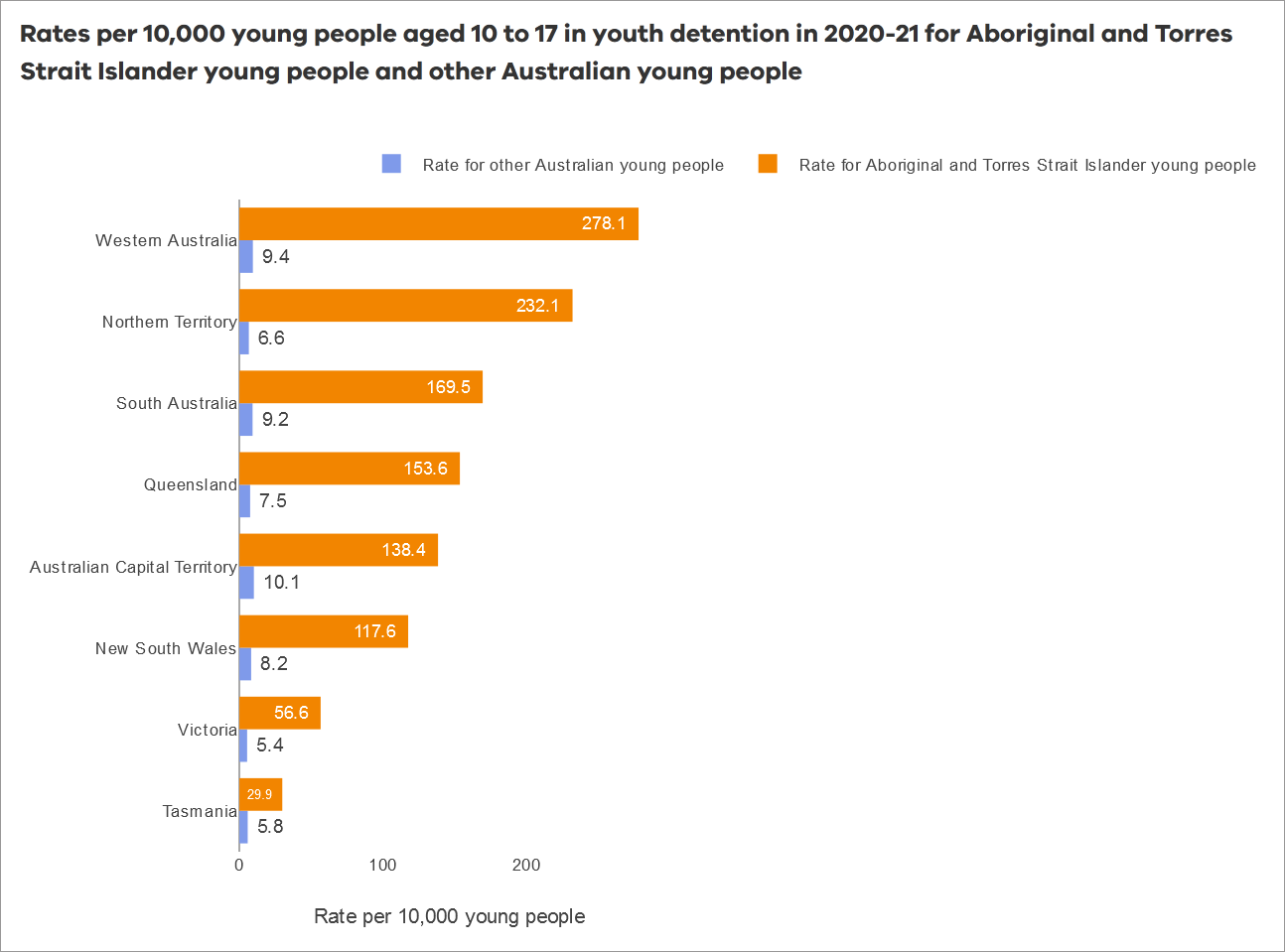
  • Depending on your school context it may be necessary to have discussions about culturally-sensitive topics including intergenerational trauma, drug and alcohol abuse and the over-representation of First Nations adolescents in detention facilities.
  • Consider research on First Nations over-representation of adolescents in detention like this table below from https://www.sentencingcouncil.vic.gov.au/sentencing-statistics/indigenous-young-people-in-detention 
  • As a class enable the students to enjoy being a community of readers and allocate class time to reading the novel rather than requesting it be read only at home.
  • Read Part 1 The Boy together. This could be achieved through an audio version or teacher reading or if the students are capable readers, to read in class.
    • Why has Lonesborough called Part 1 - The Boy? 
    • List the dangerous decisions the boys make in Part 1
    • In small groups reorder them in most dangerous to least dangerous: groups to share the reasons for their choices.
    • When could the boys have changed their direction?
    • How does the first-person narrative contribute to the power and intensity of the boys’ actions and experiences.
    • Choose the five most compelling examples in Part 1 of this first-person narrative 
    • Find the comments by Sergeant Hudson and Aunty Dawn - what impact do they have on you as a reader? 


Part 2 The Dark Place

  • In this section Lonesborough combines prose and verse.
  • Re-read Chapter 8 which is mostly in verse. How does this style of narration evoke the emotions and challenges of detention? Choose 3-5 lines which most evocatively capture this experience. Create a class wall display.
  • Watch Luka Lesson’s powerful video Seventeen which explores how Queensland was the only state left which incarcerated 17 years olds: https://vimeo.com/36798558 (note that  this law has now changed in Queensland)
  • Which text- We Didn’t Think it Through or Seventeen is most effective in capturing this tragedy? Small groups could discuss this and pool their responses. 
  • Use Chapter 14 as a Reader’s Theatre style where different groups read aloud different pages and explore how Lonesborough’s short lines of verse capture the tension and conflict. 
  • We Didn’t Think It Through is in many ways a coming-of-age story about growing up. Re-read the final page where Jamie compares happiness to a river and he has “cannonballed into happiness.” Trace the changes Jamie makes throughout his story and the contribution of the final chapters to his own bildungsroman. 


Tasks

  • Popular ABC radio presenter, journalist and author, Richard Glover often espouses that fiction functions as a "gymnasium of empathy" that enhances our understanding of human emotions, making us more empathetic and connected to others. Explore this idea with close reference to We Didn’t Think It Through. In what ways does Gary Lonesborough draw us into the world of Jamie Langton and develop our understanding of youth culture?
  • This task could be expanded into a feature article or digital essay which explores this novel and 2-3 other texts:

Relevant details in relation to the new NSW English 7-10 syllabus

Text requirements: We Didn’t Think It Through is extended prose, a novel by an Aboriginal and/or Torres Strait author.  It has cultural, social and gender perspectives, including from popular and youth cultures.
For more recommended texts suitable for Stage 5, explore our Year 9 texts and study guides and Year 10 texts and study guides.

Concepts could include Context, Representation, Point of View, Characterisation, Connotation, imagery and symbol.


Relevant NSW English 7-10 Syllabus content

Reading, viewing and listening to texts EN5-RVL-01

A student: uses a range of personal, creative and critical strategies to interpret complex texts

  • Develop a deeper understanding of themes, ideas or attitudes by revisiting and reinterpreting texts to find new meaning
  • Analyse the main ideas and thematic concerns represented in texts
  • Investigate how layers of meaning are constructed in texts and how this shapes a reader’s understanding and engagement
  • Analyse how the use of language forms and features in texts have the capacity to create multiple meanings
  • Read increasingly complex texts that challenge thinking, pique interest, enhance enjoyment and provoke a personal response
  • Engage in sustained and varied reading that presents increasingly diverse and complex perspectives and experiences, including those of Aboriginal and Torres Strait Islander Peoples, and respond in a range of ways, including through extended written responses
  • Consider how the social, cultural and ethical positions represented in texts represent, affirm or challenge views of the world
  • Evaluate experiences of reading by sharing responses to texts
  • Evaluate the ways reading texts help us understand ourselves and make connections to others and the world
  • Understand and reflect on the value of reading for personal growth and cultural richness
  • Reflect on how reading promotes a broad and balanced understanding of the world and enables students to explore wider universal issues

Understanding and responding to texts A EN5-URA-01

A student: analyses how meaning is created through the use and interpretation of increasingly complex language forms, features and structures 

Representation

  • Analyse how contextual, creative and unconscious influences shape the composition, understanding and interpretation of all representations

Code and convention

  • Use metalanguage effectively to analyse how meaning is constructed by linguistic and stylistic elements in texts
  • Analyse how language forms, features and structures, specific or conventional to a text’s medium, context, purpose and audience, shape meaning, and experiment with this understanding through written, spoken, visual and multimodal responses

Connotation, imagery and symbol

  • Analyse how figurative language and devices can be used to represent complex ideas, thoughts and feelings to contribute to larger patterns of meaning in texts, and experiment with this in own texts
  • Analyse how Aboriginal and Torres Strait Islander authors use figurative language and devices to represent culture, identity and experience

Point of view

  • Examine elements of focalisation, such as omniscience, limitations, indirect speech, tone, reliability and multiple narrators, and how these interact to shape perceptions of meaning in texts, and apply this in own texts

Characterisation

  • Analyse how engaging, dynamic and complex characters are constructed in texts using language features and structures, and use these features and structures in own texts

Narrative

  • Analyse how narrative conventions vary across genres, modes, media and contexts and how they can be used to represent ideas and values and shape responses, and apply this understanding in own texts
  • Explore how narratives can represent and shape personal and shared identities, values and experiences

Understanding and responding to texts B EN5-URB-01

A student: evaluates how texts represent ideas and experiences, and how they can affirm or challenge values and attitudes 

Perspective and context

  • Understand how the personal perspectives of audiences are a product of historical and cultural contexts
  • Analyse how texts can be understood or interpreted from different perspectives, and experiment with this idea in own texts
  • Evaluate how texts can position audiences to accept, challenge or reject particular perspectives of the world, and reflect on this in own texts
  • Analyse how elements of an author’s personal, cultural and political contexts can shape their perspectives and representation of ideas, including form and purpose
  • Explain how texts affirm or challenge established cultural attitudes and values in different contexts

Style

  • Analyse how the distinctive aesthetic qualities and stylistic features of a text can shape and be shaped by its purpose, and experiment with this in own texts
  • Examine the way an author’s distinct personal style shapes meaning in their work


(English K-10 Syllabus 2022 © NSW Education Standards Authority for and on behalf of the Crown in right of the State of New South Wales, 2023)
Connecting texts