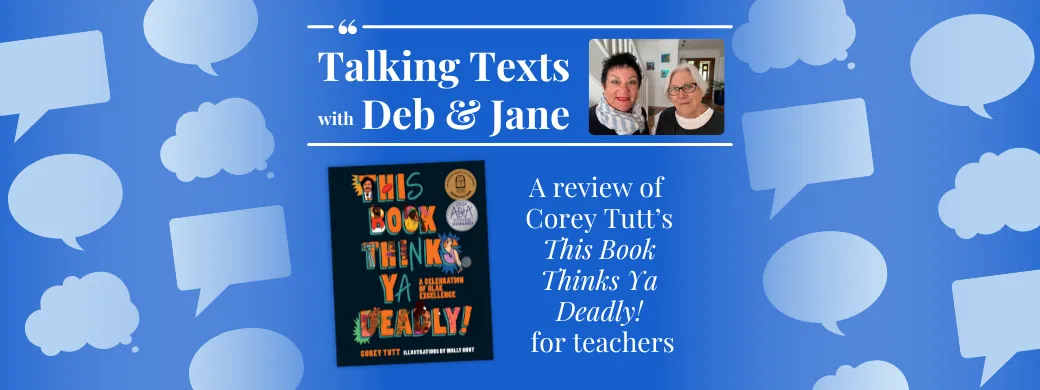
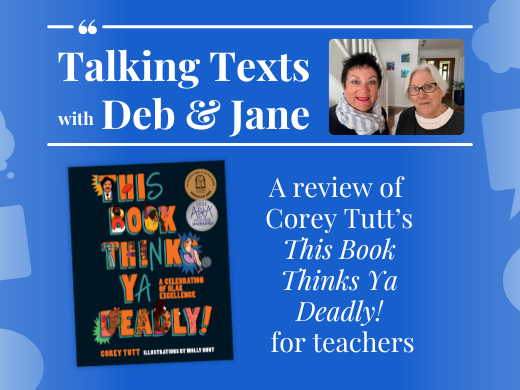
There are so many First Nations texts to inform, engage, inspire and enjoy. I am delighted to be sharing This Book Thinks Ya Deadly! with you.
The word “deadly” has been absorbed into contemporary usage, especially Aboriginal modern language, as an adjective suggesting positive, impressive and excellent qualities. In Australia, there are also the well-known Deadly Awards, which are annual awards made in Australia recognising excellence in music, sport, entertainment, and community achievement among Indigenous Australians; established in 1995. Interestingly, the word was coined in the 1900s and is also a popular adjective in Ireland.
This Book Thinks Ya Deadly! is a wonderful celebration of a cross-section of First Nations excellence. Written and compiled by Corey Tutt and illustrated by Molly Hunt, it is a bright, colourful, accessible and highly interesting coverage.
Corey Tutt is a Gamilaroi man from the Shoalhaven region of southern NSW. In 2018 Corey founded DeadlyScience which provides science resources to remote schools around Australia as part of his intention to increase the promotion of STEM to first Nations People. In 2019 he was named the NSW Young Australian of the Year and has received a range of impressive awards including the Human Rights Hero.
Molly Hunt is Balanggarra and Yolngu from the Far North of Australia. Molly is an artist, animator, journalist and radio presenter and has developed her bold and graphic style of art which has been widely commissioned for murals and public spaces
Brief description of This Book Thinks Ya Deadly!
The table of contents lists the nine categories of “deadliness”: Music, Film, Television and Stage, Visual Arts, Literature, Journalism, Education, Science, Health and Sport. I imagine most people would have assumed Sport to be the opening category so it is refreshing to see a focus on other areas of excellence. Each category covers First Nations people you would expect like Tony Birch and Anita Heiss in the Literature section but there are others you may not have thought of like Thomas Mayo and Kylie Captain. Each entrant is written in the first person: it becomes Corey Tutt’s story of why he has chosen this specific person and what has impressed Corey about each of these deadly Australians.
Each entry covers a double page and an accompanying illustration is included. The bold colours are very engaging and the information on each person is an excellent starting-point for further research and reading.
Distinctive features of This Book Thinks Ya Deadly!
Written and illustrated by First Nations authors
Table of Contents categorises the nine areas of excellence and lists the specific entries for each category
An Introduction by Corey Tutt provides a valuable and interesting background to the personal connection he has with each entry
Double page map of Indigenous Australia
Two pages are devoted to each person including a full-page illustration of the person while the single page on each entrant allows for quick reading
Colourful, bold graphic representations of the entrants
There are powerful personal references to Tutt’s own journey and the challenges navigating his world.
Ways to use This Book Thinks Ya Deadly! in the classroom
This book has appeal from Stages 4 -6 and could used as a reference text in many classrooms. It would be very relevant for a unit which focuses on biography and autobiography. I would certainly have multiple copies for students to explore and enjoy and it would work well in a selection of texts which explore different Australians and their own stories. The book lends itself for students to explore and learn about these impressive Australian to use it as a springboard for their own research and writing.
Give students time and access to the book so they can choose people who they know from such fields as music and sport.
Consider a class focus on about 6 entrants.
My choice would be Danzal Baker, Archie Roach, Ash Barty, Cathy Freeman, Adam Goodes and Miranda Tapsell.
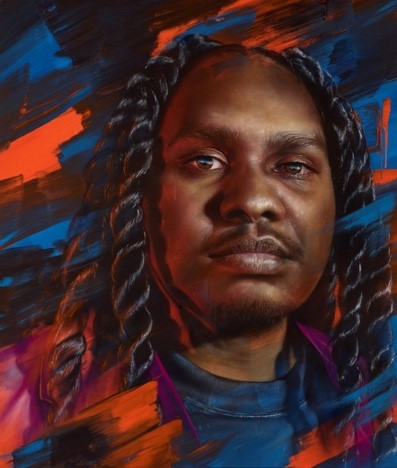
'Rhythms of heritage' by Matt Adnate, a portrait of Baker Boy
I would start with Danzal Baker.
Danzal Baker also known as Baker Boy is a Yolngu rapper, dancer, artist, and actor. Baker Boy is known for performing original hip-hop songs incorporating both English and Yolngu. He was Young Australian of the Year in 2019 and he has won numerous awards for his music. His portrait (see left) was the Packing-Room favourite in the 2024 Archibald Prize.
Consider introducing students to Baker through one of his musical videos for example, Marryuna.
Task: Create a file called Deadly Australians
Read the entrant on Baker and list three “deadly” features that Tutt celebrates
Research more on Baker and add three more points to add to his “deadliness.” Suggest to students that they research his family background as his father was a member of the original Baker Boys
Suggest to students that they search Google Images to find a favourite image of Baker and add it to their notes/file on Baker. There are many engaging images online of Baker and students could discuss which ones best capture his personality and culture.
Search for lyrics of Baker’s songs and consider an analysis of one e.g. Survive which Baker regards as his most political song yet.
Move onto Archie Roach whose portrait featured in the 2023 Archibald Prize. Be sure to acknowledge that Archie Roach is deceased and be sensitive to any First Nations students in your class.
Distribute copies of the lyrics of Roach’s most well-known and powerful song which explores the forcible removal of Indigenous children from their families, Took The Children Away, and play the song in class.
Explore the lyrics in terms of their content and analyse the way the didgeridoo is used in the song..
Read the entrant on Roach and list three features that Tutt recognises as “deadly”.
Research more on Roach and add three more points to add to his “deadliness.”
This same pattern could continue for Ash Barty, Cathy Freeman, Adam Goodes and Miranda Tapsell. There is considerable material on these personalities so it might be valuable to offer choice in who to explore. There is an accessible memoir for Young Readers on Ash Barty, called Champion, which students would enjoy.
There is also a delightful entry by Tapsell in Growing up in Australia: Nobody Puts Baby Spice in a Corner.
Group Work
Form small groups and choose one of the “deadlies” from This Book Thinks Ya Deadly! and another Australian who your group should be also considered “deadly”.
Here are some suggestions of other First Nations stars:
Evonne Goolagong Cawley
Latrell Mitchell
Lydia Williams
Linda Burney
Kirli Saunders
Sally Morgan
Amberlin Kwaymullina
Students would not need to only focus on First Nations.
Research the person and create a five minute multi-modal presentation for the class.
Discuss what multi-modal form your group would like to use: PowerPoint, Prezi, Petchakucha, I-movie
The presentation must include:
Why this person is “deadly”
Images of the person
Detail on their life and achievements
An excerpt from an interview or a YouTube excerpt (consider using an extract from Anh Do’s Brush with Fame where he interviews and paints a range of “deadlies”.
Create a listening/viewing evaluation document for students to use as they watch the group presentations. The evaluation should include such criteria as:
Effectiveness and control of the specific multi-modal form
Engagement through graphics
Effectiveness of integrating existing technology eg YouTube clip
Engagement through the oral skills of the speakers: volume, pace, pause, modulation
Persuasive impact of their new choice of a “deadly”
Level of interest sustained in the presentation.
Wide Reading:
Establish a reading challenge for students to read over the term a biography or autobiography of two different people.
Liaise with your school librarian to curate a display of biographies and autobiographies in the school library and hold a lesson in the library to showcase these books.
Consider also contacting the local municipal library to establish a similar display and encourage students to visit their local library as a source of books to choose.
If there are still insufficient books for your class to have plenty of choice, send out a call to parents as many households have biographies and autobiographies that they may like to loan or gift.
Allocate class time to student reading. Create a Class Reading Wall in a corridor of the school. Photocopy the cover of each book read and add to the wall with a comment from the student reader eg Max thinks this is awesome. Or If you love your footy Billy suggests you read this.
Relevant details in relation to the new NSW English 7-10 syllabus
Text requirements:This Book Thinks Ya Deadly! is a non-fiction multimodal text by an Aboriginal and Torres Strait Islander author with social, cultural, gender and youth culture perspectives.
Concepts could include Representation • Narrative
Relevant NSW English 7-10 Syllabus content
Reading, viewing and listening to texts | EN5-RVL-01
A student uses a range of personal, creative and critical strategies to interpret complex texts
Analyse the main ideas and thematic concerns represented in texts
Read increasingly complex texts that challenge thinking, pique interest, enhance enjoyment and provoke a personal response
Engage in sustained and varied reading that presents increasingly diverse and complex perspectives and experiences, including those of Aboriginal and Torres Strait Islander Peoples, and respond in a range of ways, including through extended written responses
Consider how the social, cultural and ethical positions represented in texts represent, affirm or challenge views of the world
Evaluate experiences of reading by sharing responses to texts
Evaluate the ways reading texts help us understand ourselves and make connections to others and the world
Understand and reflect on the value of reading for personal growth and cultural richness
Reflect on how reading promotes a broad and balanced understanding of the world and enables students to explore wider universal issues
Understanding and responding to texts A | EN5-URA-01
A student analyses how meaning is created through the use and interpretation of increasingly complex language forms, features and structures
Representation
Analyse how contextual, creative and unconscious influences shape the composition, understanding and interpretation of all representations
Code and convention
Analyse how language forms, features and structures, specific or conventional to a text’s medium, context, purpose and audience, shape meaning, and experiment with this understanding through written, spoken, visual and multimodal responses
Point of view
Examine elements of focalisation, such as omniscience, limitations, indirect speech, tone, reliability and multiple narrators, and how these interact to shape perceptions of meaning in texts, and apply this in own texts
Narrative
Analyse how narrative conventions vary across genres, modes, media and contexts and how they can be used to represent ideas and values and shape responses, and apply this understanding in own texts
Explore how narratives can represent and shape personal and shared identities, values and experiences
Understanding and responding to texts B | EN5-URB-01
A student evaluates how texts represent ideas and experiences, and how they can affirm or challenge values and attitudes
Perspective and context
Evaluate how texts can position audiences to accept, challenge or reject particular perspectives of the world, and reflect on this in own texts
Analyse how elements of an author’s personal, cultural and political contexts can shape their perspectives and representation of ideas, including form and purpose
Appreciate how all communication is a product of cultural context
Explain how texts affirm or challenge established cultural attitudes and values in different contexts
Appreciate the significance and value of expressions of cultural context in texts constructed using elements of languages and dialects, including Standard Australian English, Aboriginal and/or Torres Strait Islander Languages, and Aboriginal English
Style
Analyse how the distinctive aesthetic qualities and stylistic features of a text can shape and be shaped by its purpose, and experiment with this in own texts
Examine the way an author’s distinct personal style shapes meaning in their work
Expressing ideas and composing texts A | EN5-ECA-01
A student crafts personal, creative and critical texts for a range of audiences by experimenting with and controlling language forms and features to shape meaning
Writing
Select and adapt appropriate codes, conventions and structures to shape meaning when composing written texts that are analytical, informative, persuasive, discursive and/or imaginative
Develop a personal and informed voice that generates ideas and positions an audience through selection of appropriate word-level language and text-level features
Experiment with language to create tone, atmosphere and mood
Speaking
Communicate complex information, ideas and viewpoints using purposeful verbal and/or nonverbal language, including gestures, to emphasise key points, enhance engagement and clarify meaning
Deliver spoken, signed or communicated texts with engaging use of intonation, emphasis, volume, pace and timing
Jane Sherlock and Deb McPherson are experienced and passionate English teachers. They have also been involved in the education sector as authors and presenters at teaching conferences.