




Flat Rate Shipping
$9.95 flat rate shipping or free over $110

Aussie Owned
Australian family-owned & sourced

School Supplier
Supplier to over 1,000 schools Australia wide
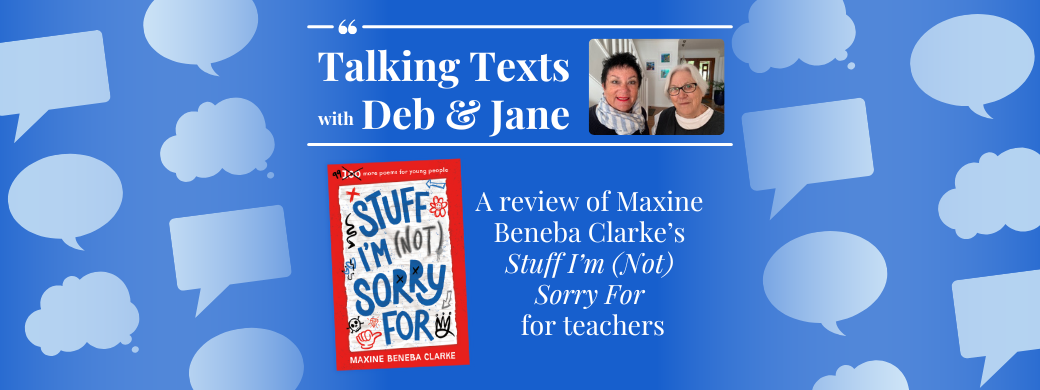
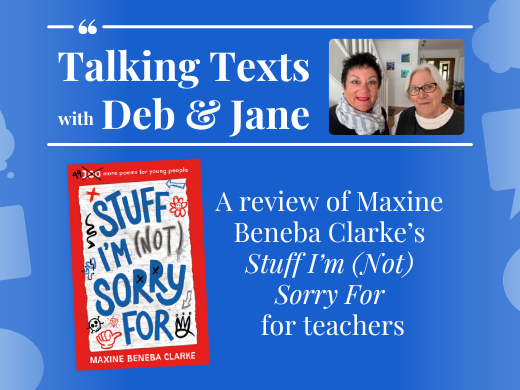
Maxine Beneba Clarke is back with another collection of marvellous poems to excite you and your Stage 3 or 4 students.
Stuff I’m (Not) Sorry For: 99 more poems for young people is a winner.
I am saddened when I listen to the anguish of my great nephews and nieces as they despair over having to analyse poetry as if the poems are written in some ancient and obscure language.
Let’s have some fun in the classroom and be inspired by Maxine to write like her. If you haven’t read my blog from 17th December 2023 on Maxine’s first poetry collection- It’s the Sound of the Thing- please do as I am sure you will want both collections for your Stage 4 poetry resources.
You can find it here.
It’s the Sound of the Thing won the 2024 Australian Book industry Award (ABIA) for Book of the Year for Younger Readers.
In a Note from Maxine on p.1 of Stuff I’m (Not) Sorry For she makes some insightful and engaging comments including this observation:
“I loved watching young people have fun with words and notice all the ordinary magic around them just waiting to be written.”
There are a few points here worth emphasising: the importance of giving students opportunities to have fun and to see language as something they can control, play with, and enjoy. Maxine alerts us to the message of harnessing the “ordinary” in our lives. If we take “ordinary” as the everyday experiences which unites us as people, we can see its wonderful value.
Brief description of Stuff I'm (Not) Sorry For
This collection of 99 poems covers a wide range of everyday experiences which reinforces the power of poetry to explore the extraordinary behind the ordinary. There are poems about the five-second rule when you drop food, enjoying being loud, street cricket, roller-skating, not enjoying the beach, empowering girls, internet trolls, a delightfully sad shape-poem called ‘Broken-Hearted’, dressing as an emo, eating all foods with tomato sauce, dad losing his job and the collection’s title poem ‘Stuff I’m (not)Sorry For’ is on p.78.
Maxine Beneba Clarke is an Australian award-winning writer of Afro-Caribbean heritage. She is the writer of 14 books including fiction, non-fiction and poetry and this is her second book of poetry for young people. Maxine Beneba Clarke is the author of the short fiction collection Foreign Soil, the memoir The Hate Race and the poetry collections Carrying the World and How Decent Folk Behave. Her children’s picture books include the CBCA Honour book The Patchwork Bike and the illustrated poem When we Say Black Lives Matter, which was longlisted for the Kate Greenaway Medal. She is currently Poet in Residence at the University of Melbourne.
For your own interest you want to view this Ted Talk as she explores her own journey to becoming a writer including the challenges of her childhood and finding refuge in the local library. Maxine comments that she had never read books about people like her.
The English 7-10 Syllabus recommends collections of poetry for Stage 4 and this is a perfect example of a collection by a single poet. It could be the focus for a poetry unit or part of a collection of other poetry anthologies for students to explore.
Be sure to give students the opportunity to hear the poems and to also say them aloud.
Build student confidence and agency through group readings of the poems that Maxine has specifically written for different voices. It is not about stage performance but about vocalising words and having fun.
‘The Grown-ups Need their Coffee’ (p. 38) is written for 10 separate voices with a final stanza for everyone. One possibility is to divide the class into 10 small groups where 3 students could speak each verse. Or divide the class into 3 groups and each group presents a reading with different students taking different voices.
Another poem for voices is ‘There’s a Blowfly in the Dunny’ on p. 182. The scatological humour is sure to appeal to students in Year 7.
‘Climate March Chant’ from Maxine’s first collection is another recommendation for class involvement. Consider either dividing the class into small groups and allocating 1-2 stanzas for them to prepare and present or perform the poem as a full class and allocate specific lines to different students.
Consider using simple instruments to add a soundscape for example, drums, castanets, clapping sticks.
Encourage students to write an additional stanza for the poem which maintains the same structure and rhyme scheme.
The following poems are my favourites from the collection as I can see them working well in the classroom as provoking ideas and providing models for students own writing:
On p 45-49 there are three short poems each titled and focusing on a specific human emotion: ‘Joy’, ‘Love’, ‘Pride’ and ‘Anxiety’.
‘Love’ is so simple in its poignancy:
Love
My nana’s soft hands,
Pinching my excited cheek:
And me, not minding.
This could be a model for students to write their own three-line poem on what love is for them; it could be their dog, or cat or best friend or a favourite food or activity.
The other poems ‘Joy’, ‘Pride’ and ‘Anxiety’ could also be a model or expand to include other emotions, for example: anger, weariness, fear, comfort, peace.
‘Back in Our Day’ (p.14) is also suitable for group reading as it suits many voices. It is a little more edgy than some of the other poems. The comments in the first two stanzas representing a different generation will resonate with students and then the mood changes in stanza 3. In what ways does Maxine Beneba Clarke now change the mood in the topics she raises?
The speaker changes perspective in the final stanza. How effective is this?
What is the poet’s intention in this poem?
‘Standing Ovation’ (p.52) is poignant in its revelations and celebrates the power of poetry to explore and understand experiences which are important for us. In the 2019 HSC Reading task there was a poem, ‘The Red Sweater’, written by Joseph O Legaspi which explored similar content and ideas. It is a more sophisticated poem but is moving and similarly poignant. Explore both poems in class and ask students to respond. Which poem do you prefer and in about 300 word explain the reasons for your choice.
‘Spotify List’ (p.65) provides possibilities for writing some extra examples to add to the second stanza after the third line. It would be fun to use contrasting music styles to add to the mother’s frustration.
‘Strange Fruit’ (p. 74) would be enhanced and enriched by students listening to this haunting and beautiful song especially a version sung by Billy Halliday who is referenced in the poem. Halliday encountered a great deal of opposition when she sang this song but her bravery and courage triumphed. The lyrics are very confronting as they capture the injustices and tragedy for many Afro-Americans at various times in the USA captured so powerfully in this line:
Black bodies swinging in the Southern breeze
An extension to this poem could be to write a similar poem on another singer from the past which was a favourite of a parent or grandparent or friend and captures memories of different times; for example, Bob Dylan, Pete Seger, The Beatles. Or students could write about a song which is important to them as perhaps it recalls a memory or a place or a special person.
‘18 Messages and 2 Missed Calls’ (p.96) is an accurate portrait of the role and impact of social media and mobile phones on the lives of many, and not just adolescents. Ask students to identify the stanza that most resonates with them and explain why. In small groups students could write two new stanzas to fit early in the poem.
What do you think the poet is intending with this poem?
‘Grunge Barbie ™’ (p.114) I love the trademark sign for the title. This is a fun piece of satire about commercialisation of toys to represent specific images. Students could choose another toy which idealises representation and write their own; for example, My Little Pony, Baby Dolls, The Lone Ranger toys.
‘Sunlight’ (p. 122) is a simple and beautiful poem which captures the joy and beauty of sunlight:
Dawn eases
Over the rooftops
Students could use this poem as a model to write about one of these experiences from nature: night-time, storm clouds, rainfall, lightning bursts, a thunderstorm.
‘The Smallest and Most Important of Gestures’ (p.140). This is a truly beautiful poem containing significant thoughts about the importance of such protocols and gestures when recognising First Nations lands. Ask students for their favourite line in the poem and use it as the opening to their own poem about respect for First Nations histories and cultures.
‘My Favourite Place’ (p.145) celebrates the library as a special place for the speaker and we know that growing up this was that place for the young Maxine.
Ask students to write their own poem which captures their ‘forever place’.
‘Change We Can Believe In’ (p 172) is a powerful reminder about the importance of having leaders with courage, vision and dedication to ensure change. Note the reference to Barack Obama who in 2008 was America’s first Black president and one of his campaign slogans was “Change We can Believe In.” Give students a copy of Obama’s inaugural speech or extracts.
Use the process of blacking out unwanted words to create their own poem about change. Other speeches could be used for example, Paul Keating’s Redfern Speech, Severn Suzuki’s speech to the UN.
Text requirements: Stuff I'm (Not) Sorry For is a poetry collection by an Australian author and poet and it has a range of cultural, social and gender perspectives, including from popular and youth cultures. Using such an anthology can encourage student choice for personal interest and enjoyment.
Find more texts suitable for primary students in our Year 7 texts and study guides at Five Senses Education.
A student uses a range of personal, creative and critical strategies to read texts that are complex in their ideas and construction EN4-RVL-01
A student analyses how meaning is created through the use of and response to language forms, features and structures EN4-URA-01
A student examines and explains how texts represent ideas, experiences and values EN4-URB-01
A student creates personal, creative and critical texts for a range of audiences by using linguistic and stylistic conventions of language to express ideas EN4-ECA-01
(English K-10 Syllabus 2022 © NSW Education Standards Authority for and on behalf of the Crown in right of the State of New South Wales, 2023)


Jane Sherlock and Deb McPherson are experienced and passionate English teachers. They have also been involved in the education sector as authors and presenters at teaching conferences.
$9.95 flat rate shipping or free over $110
Australian family-owned & sourced
Supplier to over 1,000 schools Australia wide