




Flat Rate Shipping
$9.95 flat rate shipping or free over $110

Aussie Owned
Australian family-owned & sourced

School Supplier
Supplier to over 1,000 schools Australia wide
For Stage 3
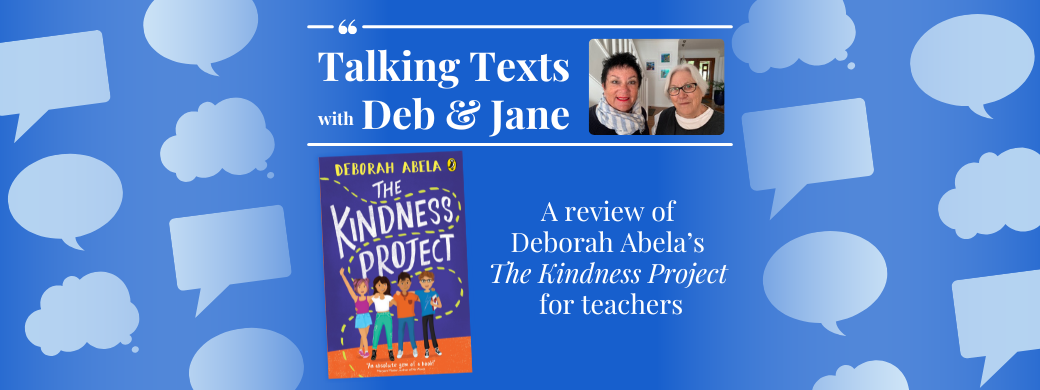
Reading this delightful book towards the end of January was a welcome relief and a soothing balm to what was happening around us at this time. We need books like The Kindness Project to remind us that we can be better than what we often see in the media and on the news. Kindness is a strength, and we need to give it “super-power” status as Deborah Abela has.
The Kindness Project is a verse novel, and this form has increased in popularity and publication. It appeals to a range of readers and is particularly engaging for reluctant readers. The amount of white space on any one page is appealing and there is a sense of achievement and positive reinforcement to read so many pages so quickly. Deborah Abela has added to this style her judicious use of a creative and interesting font which is very effective.
The Kindness Project is well suited to Years 5 and 6 and could be a close study of a novel looking at traditional elements of narrative, structure, characterisation and figurative language. Penguin have created a detailed set of teaching notes to assist with teaching and learning approaches and ideas:
It could also be valuable as a part of an author focus where students read The Kindness Project and a range of Abela’s novels to promote student choice, voice and agency. Alternatively, the novel could be used to explore a range of associated themes and ideas of friendship, belonging, attitudes, belief and agency.
The Kindness Project is told from the main character’s point of view. Her name is Nicolette and the narrative opens with this young girl visiting her aged grandmother in a nursing home. This element of the narrative becomes a key feature in the novels’ strength - Abela expertly reimagines the nursing home and it challenges how we may treat the elderly. Nanna is feisty and intelligent and she craves for some fun but this is not happening at her nursing home, nicknamed Alcatraz by Nicolette and her nanna. At school the teacher, Ms Skye, announces a group project on how kids can change the world through endeavours that create and encourage kindness. But Nicolette finds school and her class alienating and she rarely feels part of groups. Ms Skye places Nicolette in a group with three other students, all of whom have previously not been welcoming nor kind: the tough DJ, Layal who Nicolette is sure would prefer to totally ignore Nicolette, and the newcomer, Leaf who is an excellent illustrator and creates wonderful images of himself and Nicolette. The group struggles to interact or to think of a project but soon they each start to learn more about each other and their own challenges, especially those at home. Ideas evolve for their own kindness project and the group finds acceptance and identity with each other and indeed, the kindness of such friendships.
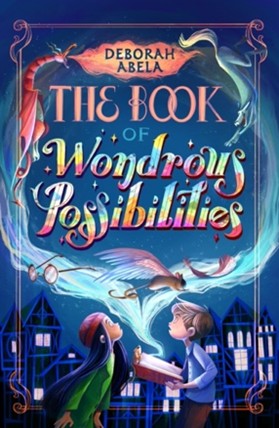
Deborah Abela is a popular and prolific Australian author who has written 30 internationally published and awarded books, including the Max Remy series, her climate change trilogy, New City and Final Storm and The Stupendously Spectacular Spelling Bee. Her CBCA Notable, The Book of Wondrous Possibilities, is about the power of books to save us when we feel lost.
After training as a teacher, Deb travelled to Africa, where she was trapped in a desert sandstorm, harassed by monkeys and thrown in jail twice. She trained as a teacher before becoming writer/producer of a national children’s TV show at Network TEN. Deb has a website: https://www.deborahabela.com/. She is a popular visitor to schools and can be contacted though her website.
The Kindness Project has already been included in significant book awards:
The title focuses on the key quality of “kindness.” We associate the word “kind” with people rather than the rest of the animal kingdom and it usually is linked to people who are friendly, generous, considerate, warm and good-natured. Interestingly the origin is Germanic (cynde) and was related to kin; the original meaning was “nature and the natural order” so it had a broader meaning and then evolved to be associated with one’s nature, and innate character. By Middle English the word became more specific and was equated with “well born or well bred”, and then “well-disposed by nature, courteous, gentle, benevolent” which is closer to what it means for us today.
The website Paperbark which explores ‘the joy in books’ added this explanation to their post on The Kindness Project:
Kindness is a superpower. It’s also infectious. We feel good when someone is kind to us, and when we’re kind to others. Studies show that kindness floods our bodies with hormones that make us calmer, healthier and happier, plus it’s simple and free! Kindness is a strength and helps build resilience. When we practice kindness, we also practice compassion. We understand everyone has bad days, including us, and that makes us more inclined to let things slide if someone is mean or doesn’t react as we want.
Discuss with the students their understanding of the word “kindness” Students could create a wall chart to display: “Kindness is …”
After reading the book discuss with students the effectiveness/success of the novel’s title in capturing the core ideas.
Discuss the narrative style known as the “verse novel.” As younger readers, students would have been familiar with picture books, nursery rhymes and stories being written in verse but this style has now expanded to older readers and indeed, there is a wide choice of Young Adult verse novels. It would be valuable to have a selection of other verse novels to show your students or ask the librarian to create a “Verse Novel” display.
A verse novel is a hybrid literary form that tells a full-length narrative story through poetry rather than prose, often using free verse, stanzaic forms, or varying poetic styles. Given the fewer words per page, authors need to be selective in what they choose to add to their story and this often results in greater emotional intensity and certainly ensures that writers make their point more quickly and efficiently.
Key characteristics and elements
What features of the verse novel are evident in The Kindness Project?
What other conventions characterise this novel; for example, note how Abela creatively uses different fonts. As students read the novel, suggest they take note of the different ways different fronts are used. At the end of the reading make a list of different fonts for different reasons. For example: in the chapter WHAT HAPPENS NEXT on p 176-178 the font changes amplify key emotions of this chapter.
Discuss why the author emphasises these words through font style and size: explodes, breaks, expect, lighter, weirdos, friendly shoves, DJ, Shoulder, crashing. Down, ever, supreme golden rule, when, even more, never, like he really means it, weirdos.
Sometimes the author chooses specific groups of words like adjectives or verbs to emphasise through the font. Verbs are the “muscles” of our writing and careful, purposeful selection of verbs will make the difference to our writing. For example, consider these verbs and why they are effective?
Abela creates characters we can relate to and believe in. This is a wonderful skill and is called characterisation. Choosing what to include in creating a character is very important in increasing the character’s’ realism, resonance and engagement with us, the reader.
Discuss with the students who are the main characters in The Kindness Project?
Who are secondary characters?
Where does nanna fit in to this scheme? Explain your response.
Allocate a character to small groups or groups choose a character:
Apart from the plot, narrative style and characters, a key to the success of a novel (or play or film) is what it leaves you thinking about once you have completed reading. We may call this the themes or messages of the novel which differs from the story. Themes are often more universal and consider the broader picture about humanity, life, people, society and if successful, they will speak to us across time and place.
Discuss the ideas and themes from the novel listed below and ask the class to add any more they think are important:
Return to the same groups as the “character” discussion and using the list of ideas from above and from the class discussion, create a hierarchy of their importance in the novel to your group. Be sure to emphasise that in many cases such decisions are not determined by being correct or not, but by what impact has been made on the reader.
Share the different hierarchies: how similar or different are they?
Task: choose 2-3 which are regarded as significant and write half a page on how these themes are represented in The Kindness Project.
When an author writes a novel, they want people to read it. This can be through purchasing a copy, borrowing a copy from the library or influencing teachers to incorporate the novel into their program in schools. Publishers use a variety of strategies to promote their books including collecting favourable comments from the wider reading audience including book reviewers, book sellers, book shops and enlisted readers representing the specific age groups and other writers.
Here are some comments by readers of The Kindness Project:
Task: Which comment best appeals to you and explain why.
Write your own 30-50 review of The Kindness Project which would suit the back cover or a promotional poster or a website.
Here are some ideas to take the story beyond what Deborah Abela has written.
In writing extra features, be sure to sustain the same narrative style and layout as Abela so that it fits naturally with her ideas and content.
Consider a separate chapter to focus on:
Access this interview with Deborah Abela: https://alphabetsoup.net.au/2024/07/24/deborah-abela-on-the-kindness-project/
Abela offers some suggestions for writing your own verse novel:
Think about a something that has happened to you that made you feel happy or nervous or excited. e.g. auditioning for a play, getting your first pet, the soccer grand final. Tell that story, including how you felt, but only writing a few words per line. Include only the really important parts of that story. When you think it is ready to review, look at the verse and see which words you can make look like their meaning. Here’s an example from pages 16 and 17 in The Kindness Project.
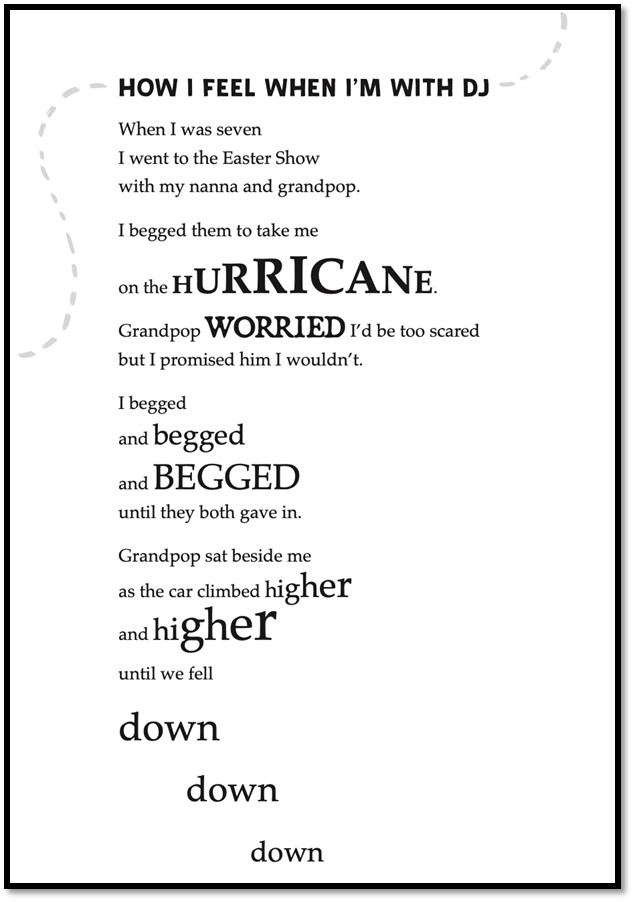
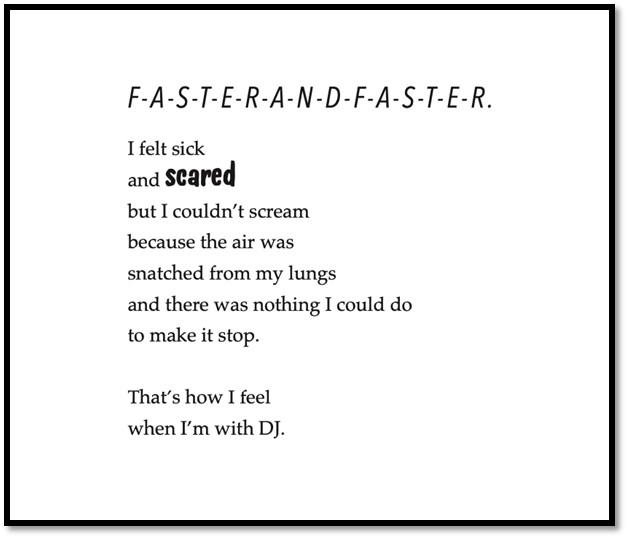
Tasks: Try writing another 2-3 verses where you incorporate different font styles and sizes to emphasise the verbs and then the adjectives.
or
Research Greta Thunberg and Malala Yousafzai and write 30-50 words in verse about their achievements. Be sure to incorporate some creative use of fonts.
On her website, Deborah Abela offers some excellent hints for writing and these will be valuable as you progress through to high school where effective and writing in. arrange of styles is very important:
Read lots
Whenever you can, while you're on the bus or waiting for your turn at the dentist or jogging on the spot getting ready for soccer practice, pick up a book and read. It not only expands your mind and imagination, there are studies that prove it sharpens your brain so that you actually become smarter!
Practice, practice, practice!
Like any skill you have, you can only improve with practice. No violinist or dancer or trapeze artist was ever brilliant at their first attempt.
Write about things you care about
If you're excited about what you're writing about, hopefully that excitement will be infectious and your reader will love what you're writing too.
Start now!
Go on, what are you waiting for?
Enjoy!
Text requirements: Australian author, novel
Concepts: representation • point of view • characterisation • connotation, imagery and symbol • genre
These statements from the K-6 English syllabus are an important and powerful reminder about our role in the classroom and the nature of literature
Students’ knowledge and understanding about language will grow and deepen as they engage with increasingly complex texts across a range of modes. Students continue to develop their understanding of how language use at word, sentence, paragraph and whole text-level, is determined by context, audience and purpose. Students’ knowledge of their first language will support this development.
The development of students’ vocabulary and background knowledge can be supported by their teachers engaging them in rich discussion and analysis of a range of texts, including those widely regarded as quality literature. This can support students’ comprehension and has the potential to expand their ideas and experience of both their own world and the world of others. As students deepen their knowledge of language, they can apply new understanding to purposefully communicate their ideas, with increasing confidence and efficacy. Through knowledge and understanding of language, students can appreciate, reflect on and enjoy texts that are widely regarded as quality literature.
Literature is defined as a body of work that has enduring personal, social, cultural or aesthetic value. It comprises a dynamic and evolving range of fiction and nonfiction texts from diverse contemporary, historical and cultural contexts. Literature is a way of sharing experiences about and beyond readers’ lives while also creating empathy and opportunities for enjoyment.
Literature should be readily available to students in the classroom and updated regularly.
Across each year of learning, teachers must give students daily opportunities:
A student analyses representations of ideas in literature through narrative, character, imagery, symbol and connotation, and adapts these representations when creating texts EN3-UARL-01
A student analyses representations of ideas in literature through genre and theme that reflect perspective and context, argument and authority, and adapts these representations when creating texts EN3-UARL-02
Narrative
Characterisation
Imagery, symbol and connotation
Genre
Theme
Perspective and context
A student fluently reads and comprehends texts for wide purposes, analysing text structures and language, and by monitoring comprehension EN3-RECOM-01
Reading for interest and wide purposes
(English K-10 Syllabus 2022 © NSW Education Standards Authority for and on behalf of the Crown in right of the State of New South Wales, 2023)
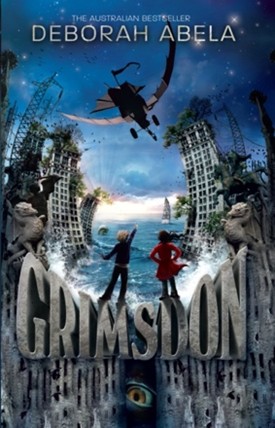
After The Kindness Project consider reading more books by Deborah Abela and write some short reflections on what it is about her books which makes her so popular:

Or explore more verse novels which have featured in this blog:
Sally Morgan’s Sister Heart (September 8 2023) and Bindi by Kirli Saunders (august 25 2023)
There are also the wonderful poetry anthologies by Maxine Beneba Clark- It’s the Sound of the Thing (December 17 2023) and Stuff I’m (Not) Sorry For (August 25 2025)

Jane Sherlock and Deb McPherson are experienced and passionate English teachers. They have also been involved in the education sector as authors and presenters at teaching conferences.
$9.95 flat rate shipping or free over $110
Australian family-owned & sourced
Supplier to over 1,000 schools Australia wide